Table of Contents
- 1. Product Overview
- 2. In-Depth Technical Parameter Analysis
- 2.1 Absolute Maximum Ratings
- 2.2 Electro-Optical Characteristics
- 3. Binning System Explanation
- 4. Performance Curve Analysis
- 5. Mechanical and Package Information
- 6. Soldering and Assembly Guidelines
- 7. Packaging and Ordering Information
- 8. Application Recommendations
- 8.1 Typical Application Scenarios
- 8.2 Design Considerations
- 9. Technical Comparison and Differentiation
- 10. Frequently Asked Questions (FAQs)
- 11. Practical Design and Usage Case
- 12. Principle Introduction
- 13. Technology Trends
1. Product Overview
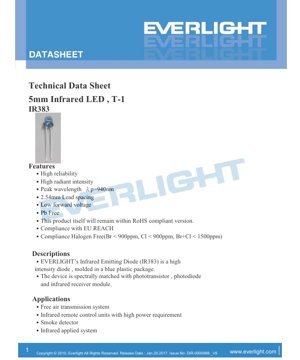
The IR383 is a high-intensity infrared emitting diode housed in a standard T-1 (5mm) blue plastic package. It is engineered to deliver reliable performance in infrared transmission systems. The device's primary function is to emit infrared light at a peak wavelength of 940nm, making it spectrally compatible with common phototransistors, photodiodes, and infrared receiver modules. Its core advantages include high radiant intensity, low forward voltage, and a design compliant with RoHS, REACH, and halogen-free standards, ensuring suitability for modern electronic manufacturing requirements.
2. In-Depth Technical Parameter Analysis
2.1 Absolute Maximum Ratings
The device is designed to operate within strict limits to ensure longevity and reliability. The continuous forward current (IF) is rated at 100mA, while a peak forward current (IFP) of 1.0A is permissible under pulsed conditions (pulse width ≤100μs, duty cycle ≤1%). The maximum reverse voltage (VR) is 5V. The operational temperature range is from -40°C to +85°C, with storage allowed up to +100°C. The device can withstand a soldering temperature of 260°C for up to 10 seconds. The maximum power dissipation (Pd) is 120mW when the ambient temperature is at or below 25°C.
2.2 Electro-Optical Characteristics
Key performance parameters are measured at a standard temperature of 25°C. The radiant intensity (Ie) is a minimum of 15.0 mW/sr at a forward current of 20mA, with a typical value of 20.0 mW/sr. Under pulsed operation (IF=50mA, pulse width ≤100μs, duty ≤1%), the typical radiant intensity reaches 80.0 mW/sr. The peak emission wavelength (λp) is centered at 940nm with a typical spectral bandwidth (Δλ) of 45nm. The forward voltage (VF) is typically 1.2V at 20mA, with a maximum of 1.5V. At 50mA under pulsed conditions, VF is typically 1.4V (max 1.8V). The reverse current (IR) is a maximum of 10μA at 5V reverse bias. The viewing angle (2θ1/2) is typically 20 degrees.
3. Binning System Explanation
The IR383 utilizes a radiant intensity binning system to categorize devices based on their output power. The bins are defined as follows: Bin P (15.0-24.0 mW/sr), Bin Q (21.0-34.0 mW/sr), Bin R (30.0-48.0 mW/sr), and Bin S (42.0-67.0 mW/sr). This binning allows designers to select components that meet specific intensity requirements for their application, ensuring consistent system performance. The measurement uncertainties are noted as ±0.1V for forward voltage, ±10% for luminous intensity, and ±1.0nm for dominant wavelength.
4. Performance Curve Analysis
The datasheet includes several characteristic curves that illustrate device behavior under varying conditions. Figure 1 shows the relationship between forward current and ambient temperature. Figure 2 depicts the spectral distribution, confirming the 940nm peak. Figure 3 graphs the peak emission wavelength shift against ambient temperature. Figure 4 illustrates the forward current versus forward voltage relationship. Figure 5 shows how relative intensity varies with forward current. Figure 6 presents the relative radiant intensity as a function of angular displacement from the central axis. Figure 7 plots relative intensity against ambient temperature, and Figure 8 shows how relative forward voltage changes with ambient temperature. These curves are essential for predicting performance in real-world operating environments.
5. Mechanical and Package Information
The IR383 uses a standard T-1 (5mm diameter) blue plastic package. The lead spacing is 2.54mm, compatible with standard breadboards and PCBs. A detailed package dimension drawing is provided in the datasheet, with all dimensions specified in millimeters. The tolerance for unspecified dimensions is ±0.25mm. The blue lens material helps in identifying the device as an infrared emitter.
6. Soldering and Assembly Guidelines
The device is rated for wave or reflow soldering at a maximum temperature of 260°C for a duration not exceeding 10 seconds. It is crucial to adhere to these limits to prevent damage to the plastic package or the semiconductor die. The device is Pb-free and compliant with halogen-free standards (Br < 900ppm, Cl < 900ppm, Br+Cl < 1500ppm). Standard ESD (Electrostatic Discharge) precautions should be observed during handling and assembly.
7. Packaging and Ordering Information
The standard packaging specification is 500 pieces per bag, 5 bags per box, and 10 boxes per carton, totaling 25,000 pieces per carton. The label form includes fields for the customer's part number (CPN), production part number (P/N), packing quantity (QTY), intensity rank (AT), peak wavelength (HUE), reference (REF), and lot number (LOT No).
8. Application Recommendations
8.1 Typical Application Scenarios
The IR383 is ideally suited for free-air infrared transmission systems, such as remote control units for consumer electronics (TVs, audio systems, set-top boxes) where high output power extends operational range. It is also applicable in smoke detectors, where it pairs with a receiver to detect particulate matter, and in various other infrared-based sensing and communication systems.
8.2 Design Considerations
When designing a drive circuit, the forward current must be limited to the maximum continuous or pulsed ratings using a series resistor or constant current source. The low forward voltage reduces power consumption. The narrow 20-degree viewing angle provides a more directed beam, which is beneficial for point-to-point communication but requires careful alignment. Heat sinking may be necessary if operating near maximum power dissipation, especially at high ambient temperatures.
9. Technical Comparison and Differentiation
Compared to generic 5mm IR LEDs, the IR383 offers a guaranteed minimum radiant intensity and is characterized with a comprehensive set of performance curves and a formal binning structure. Its compliance with modern environmental regulations (RoHS, REACH, Halogen-Free) is a key differentiator for markets with strict material restrictions. The specified 940nm wavelength is a common standard, ensuring wide compatibility with receiver ICs.
10. Frequently Asked Questions (FAQs)
Q: What is the difference between continuous and pulsed forward current ratings?
A: The continuous rating (100mA) is for steady-state operation. The pulsed rating (1.0A) allows for much higher instantaneous current to achieve brighter bursts of light, but only for very short pulses (≤100μs) with a low duty cycle (≤1%) to avoid overheating.
Q: How does ambient temperature affect performance?
A: As shown in the characteristic curves, increasing temperature typically causes a decrease in radiant output and a slight increase in forward voltage. Designers must derate performance parameters when operating above 25°C.
Q: Can this LED be used for data transmission?
A: Yes, its fast response time (inherent to LEDs) and high output make it suitable for modulated data transmission in remote controls and short-range communication links, though the datasheet does not specify a modulation bandwidth.
11. Practical Design and Usage Case
Case: Designing a Long-Range IR Remote Control
For a remote control requiring extended range, a designer would select an IR383 from Bin S for the highest radiant intensity. The drive circuit would use a microcontroller to generate a modulated signal (e.g., 38kHz carrier). A transistor switch would pulse the LED at 50mA or higher, staying within the 1% duty cycle limit for the pulse width used in the protocol. The narrow viewing angle helps concentrate the energy towards the receiver. A simple series resistor calculates as R = (Vcc - Vf) / If, where Vf is taken from the typical value at the pulsed current.
12. Principle Introduction
An Infrared Light Emitting Diode (IR LED) is a semiconductor p-n junction diode that emits non-visible infrared light when forward biased. Electrons recombine with holes within the device, releasing energy in the form of photons. The specific material (GaAlAs for the IR383) and structure of the semiconductor determine the wavelength of the emitted light, which is 940nm in this case. The plastic package encapsulates the chip, provides mechanical protection, and the lens shapes the radiation pattern.
13. Technology Trends
The trend in infrared LEDs continues towards higher efficiency (more radiant output per electrical watt), which reduces power consumption and heat generation. There is also a drive for increased reliability and longevity. Packaging is evolving to enable better thermal management and more precise optical control. Furthermore, integration with driver circuitry and sensors into compact modules is becoming more common for simplified end-user design. Compliance with evolving global environmental and material regulations remains a critical industry focus.
LED Specification Terminology
Complete explanation of LED technical terms
Photoelectric Performance
| Term | Unit/Representation | Simple Explanation | Why Important |
|---|---|---|---|
| Luminous Efficacy | lm/W (lumens per watt) | Light output per watt of electricity, higher means more energy efficient. | Directly determines energy efficiency grade and electricity cost. |
| Luminous Flux | lm (lumens) | Total light emitted by source, commonly called "brightness". | Determines if the light is bright enough. |
| Viewing Angle | ° (degrees), e.g., 120° | Angle where light intensity drops to half, determines beam width. | Affects illumination range and uniformity. |
| CCT (Color Temperature) | K (Kelvin), e.g., 2700K/6500K | Warmth/coolness of light, lower values yellowish/warm, higher whitish/cool. | Determines lighting atmosphere and suitable scenarios. |
| CRI / Ra | Unitless, 0–100 | Ability to render object colors accurately, Ra≥80 is good. | Affects color authenticity, used in high-demand places like malls, museums. |
| SDCM | MacAdam ellipse steps, e.g., "5-step" | Color consistency metric, smaller steps mean more consistent color. | Ensures uniform color across same batch of LEDs. |
| Dominant Wavelength | nm (nanometers), e.g., 620nm (red) | Wavelength corresponding to color of colored LEDs. | Determines hue of red, yellow, green monochrome LEDs. |
| Spectral Distribution | Wavelength vs intensity curve | Shows intensity distribution across wavelengths. | Affects color rendering and quality. |
Electrical Parameters
| Term | Symbol | Simple Explanation | Design Considerations |
|---|---|---|---|
| Forward Voltage | Vf | Minimum voltage to turn on LED, like "starting threshold". | Driver voltage must be ≥Vf, voltages add up for series LEDs. |
| Forward Current | If | Current value for normal LED operation. | Usually constant current drive, current determines brightness & lifespan. |
| Max Pulse Current | Ifp | Peak current tolerable for short periods, used for dimming or flashing. | Pulse width & duty cycle must be strictly controlled to avoid damage. |
| Reverse Voltage | Vr | Max reverse voltage LED can withstand, beyond may cause breakdown. | Circuit must prevent reverse connection or voltage spikes. |
| Thermal Resistance | Rth (°C/W) | Resistance to heat transfer from chip to solder, lower is better. | High thermal resistance requires stronger heat dissipation. |
| ESD Immunity | V (HBM), e.g., 1000V | Ability to withstand electrostatic discharge, higher means less vulnerable. | Anti-static measures needed in production, especially for sensitive LEDs. |
Thermal Management & Reliability
| Term | Key Metric | Simple Explanation | Impact |
|---|---|---|---|
| Junction Temperature | Tj (°C) | Actual operating temperature inside LED chip. | Every 10°C reduction may double lifespan; too high causes light decay, color shift. |
| Lumen Depreciation | L70 / L80 (hours) | Time for brightness to drop to 70% or 80% of initial. | Directly defines LED "service life". |
| Lumen Maintenance | % (e.g., 70%) | Percentage of brightness retained after time. | Indicates brightness retention over long-term use. |
| Color Shift | Δu′v′ or MacAdam ellipse | Degree of color change during use. | Affects color consistency in lighting scenes. |
| Thermal Aging | Material degradation | Deterioration due to long-term high temperature. | May cause brightness drop, color change, or open-circuit failure. |
Packaging & Materials
| Term | Common Types | Simple Explanation | Features & Applications |
|---|---|---|---|
| Package Type | EMC, PPA, Ceramic | Housing material protecting chip, providing optical/thermal interface. | EMC: good heat resistance, low cost; Ceramic: better heat dissipation, longer life. |
| Chip Structure | Front, Flip Chip | Chip electrode arrangement. | Flip chip: better heat dissipation, higher efficacy, for high-power. |
| Phosphor Coating | YAG, Silicate, Nitride | Covers blue chip, converts some to yellow/red, mixes to white. | Different phosphors affect efficacy, CCT, and CRI. |
| Lens/Optics | Flat, Microlens, TIR | Optical structure on surface controlling light distribution. | Determines viewing angle and light distribution curve. |
Quality Control & Binning
| Term | Binning Content | Simple Explanation | Purpose |
|---|---|---|---|
| Luminous Flux Bin | Code e.g., 2G, 2H | Grouped by brightness, each group has min/max lumen values. | Ensures uniform brightness in same batch. |
| Voltage Bin | Code e.g., 6W, 6X | Grouped by forward voltage range. | Facilitates driver matching, improves system efficiency. |
| Color Bin | 5-step MacAdam ellipse | Grouped by color coordinates, ensuring tight range. | Guarantees color consistency, avoids uneven color within fixture. |
| CCT Bin | 2700K, 3000K etc. | Grouped by CCT, each has corresponding coordinate range. | Meets different scene CCT requirements. |
Testing & Certification
| Term | Standard/Test | Simple Explanation | Significance |
|---|---|---|---|
| LM-80 | Lumen maintenance test | Long-term lighting at constant temperature, recording brightness decay. | Used to estimate LED life (with TM-21). |
| TM-21 | Life estimation standard | Estimates life under actual conditions based on LM-80 data. | Provides scientific life prediction. |
| IESNA | Illuminating Engineering Society | Covers optical, electrical, thermal test methods. | Industry-recognized test basis. |
| RoHS / REACH | Environmental certification | Ensures no harmful substances (lead, mercury). | Market access requirement internationally. |
| ENERGY STAR / DLC | Energy efficiency certification | Energy efficiency and performance certification for lighting. | Used in government procurement, subsidy programs, enhances competitiveness. |