1. Product Overview
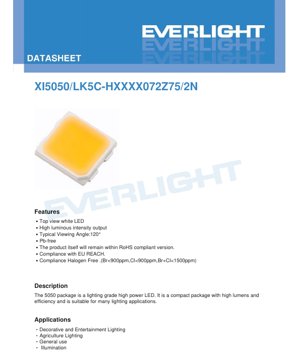
The XI5050 series is a lighting-grade, high-power LED housed in a compact 5050 surface-mount package. This device is engineered to deliver high luminous output and efficiency, making it a versatile component suitable for a broad spectrum of general and specialized illumination applications. Its top-view white emission and wide 120-degree viewing angle facilitate uniform light distribution.
1.1 Core Advantages
- High Luminous Efficacy: The package is optimized for high lumen output, with minimum flux values reaching up to 690 lumens depending on the specific bin and model.
- Robust Thermal Design: With a thermal resistance (junction to board) of 7°C/W, the LED effectively manages heat dissipation, supporting stable long-term operation.
- Environmental Compliance: The product is compliant with key environmental standards including RoHS, EU REACH, and is Halogen Free (Br<900ppm, Cl<900ppm, Br+Cl<1500ppm).
- Wide Color Temperature Range: Available in correlated color temperatures (CCT) spanning from warm white (3000K) to cool white (6500K), with precise binning for color consistency.
1.2 Target Applications
The primary application areas for the XI5050 LED include decorative and entertainment lighting, agricultural lighting systems, and general illumination purposes where reliable, high-brightness white light is required.
2. In-Depth Technical Parameter Analysis
2.1 Absolute Maximum Ratings
The device's operational limits are defined to ensure reliability and prevent damage. The key absolute maximum ratings are:
- Forward Current (IF): 750 mA (Continuous)
- Pulse Forward Current (IPF): 1125 mA
- Power Dissipation (Pd): 5.4 W
- Operating Temperature (Topr): -35°C to +85°C
- Junction Temperature (Tj): 115°C
- Thermal Resistance (Rθjc): 7 °C/W (Junction to Board)
Exceeding these ratings, especially the junction temperature, can lead to permanent degradation of luminous output and reduced operational lifespan.
2.2 Photometric and Electrical Characteristics
The performance of specific part numbers is detailed in the product table. Key parameters include:
- Minimum Luminous Flux: Ranges from 640 lm to 690 lm, measured at a thermal pad temperature of 25°C with a tolerance of ±10%.
- Forward Voltage (VF): Typically between 6.0V and 7.2V when driven at the nominal 750mA current. This range is further subdivided into precise voltage bins for design consistency.
- Correlated Color Temperature (CCT): Standard offerings include 3000K (Warm White), 4000K (Neutral White), 5000K (Neutral White), and 6500K (Cool White).
- Color Rendering Index (CRI): Models are available with minimum CRI values from 60 (M) up to 90 (H), with a typical tolerance of ±2.
3. Binning System Explanation
To ensure color and brightness consistency in production runs, the XI5050 LEDs are classified into precise bins for key parameters.
3.1 Luminous Flux Binning
Flux bins define the guaranteed minimum and maximum luminous output for a group of LEDs. Example bins include N (640-690 lm), 6974 (690-740 lm), and 7479 (740-790 lm). This allows designers to select components that meet specific brightness requirements for their application.
3.2 Forward Voltage Binning
Voltage bins categorize LEDs based on their forward voltage drop at 750mA. Bins such as 6062 (6.0-6.2V), 6264 (6.2-6.4V), up to 7072 (7.0-7.2V) help in designing efficient and consistent driver circuits, ensuring uniform current distribution in multi-LED arrays.
3.3 Chromaticity Coordinate Binning
This is the most critical binning for color quality. For each CCT (e.g., 3000K, 4000K, 5000K, 6500K), the chromaticity coordinates (CIE x, y) are tightly controlled within defined quadrangles on the CIE 1931 chromaticity diagram. Each quadrangle is assigned a bin code (e.g., 30K-A, 40K-B, 50K-F, 65K-G). This system ensures that all LEDs within a specific CCT and bin code will appear visually identical in color, which is essential for applications requiring uniform white light, such as panel lighting or architectural accents.
4. Performance Curve Analysis
While specific graphical curves are not provided in the extracted text, the datasheet provides tabular data that defines performance boundaries. The relationship between forward current and voltage is implied by the VF bins at 750mA. The thermal resistance value (7°C/W) is crucial for modeling the junction temperature rise above the board temperature, which directly impacts luminous flux maintenance and long-term reliability. Designers must use this value in thermal simulations to ensure the LED operates within its safe Tj limit.
5. Mechanical and Package Information
The LED utilizes the standard 5050 surface-mount device (SMD) footprint. The package dimensions are approximately 5.0mm in length and width. The component features a thermal pad which is essential for efficient heat transfer from the LED junction to the printed circuit board (PCB). Proper solder paste application and reflow profiling for this pad are critical to achieving the specified thermal performance (Rθjc = 7°C/W).
6. Soldering and Assembly Guidelines
6.1 Reflow Soldering Parameters
The LED is sensitive to high temperatures. The recommended soldering profile must not exceed:
Peak Temperature: 260°C
Time at Peak: 10 seconds maximum.
These parameters are typical for lead-free (Pb-free) solder processes and must be strictly adhered to prevent damage to the internal die and phosphor.
6.2 Handling and Storage
- ESD Sensitivity: The device is sensitive to electrostatic discharge (ESD). Proper ESD precautions (e.g., grounded workstations, wrist straps) must be observed during handling and assembly.
- Storage Conditions: The recommended storage temperature range is from -35°C to +85°C, in a dry environment to prevent moisture absorption.
7. Ordering Information and Model Number Decoding
The part number follows a specific structure: XI5050/LK5C-HXXXX072Z75/2N.
An example is decoded as follows: XI5050/LK5C-H6569072Z75/2N
- XI5050: Series and package size (5.0x5.0mm).
- H6569072: This segment contains key performance codes.
- 6: CRI Index code (e.g., 'L' for CRI 70 Min.). The digit corresponds to the CRI symbol table.
- 5: First digit of CCT (e.g., '5' for part of 6500K).
- 690: Minimum Luminous Flux in lumens (690 lm).
- 072: Maximum Forward Voltage code (7.2V).
- Z75: Forward Current Index (750 mA).
8. Application Design Considerations
8.1 Driver Circuit Design
Given the forward voltage range (6.0-7.2V) and nominal current of 750mA, a constant-current LED driver is mandatory. The driver must be capable of delivering a stable 750mA while accommodating the maximum VF of the selected voltage bin. For designs using multiple LEDs, series, parallel, or series-parallel configurations can be used, but careful consideration of forward voltage matching (using bins) is necessary to ensure uniform current and brightness.
8.2 Thermal Management
Effective heat sinking is paramount. With a power dissipation of up to 5.4W (750mA * 7.2V), the PCB must be designed to conduct heat away from the LED's thermal pad. This involves using a PCB with sufficient copper thickness and area, potentially with thermal vias connecting to internal ground planes or a dedicated metal-core PCB (MCPCB) for high-power applications. The goal is to minimize the temperature rise from the board (Tboard) to the LED junction (Tj).
8.3 Optical Integration
The 120° viewing angle provides a wide beam. For applications requiring focused light, secondary optics such as lenses or reflectors must be used. The material and design of these optics should account for potential efficiency losses and color shift.
9. Technical Comparison and Differentiation
The XI5050 differentiates itself within the 5050 LED market through its combination of high flux output (up to 690lm min) at a standard 750mA drive current, coupled with a comprehensive and precise chromaticity binning system. This makes it particularly suitable for applications where both high brightness and excellent color uniformity are critical, such as high-quality linear lighting or commercial panel lights. The specified thermal resistance of 7°C/W is competitive, indicating a package design optimized for heat extraction.
10. Frequently Asked Questions (FAQ)
10.1 What is the difference between the various CRI options?
CRI (Color Rendering Index) measures how accurately a light source reveals the colors of objects compared to a natural reference light. A higher CRI (e.g., 90 vs. 70) generally means colors will appear more vivid and true-to-life under the LED's illumination. The choice depends on the application; a CRI of 80+ is often desired for retail or residential lighting, while a CRI of 70 may be sufficient for utility or outdoor lighting.
10.2 Can I drive this LED at a current lower than 750mA?
Yes, the LED can be operated at currents below the maximum 750mA. This will reduce the light output and power consumption, and typically improve efficacy (lumens per watt) and longevity due to lower junction temperatures. The forward voltage will also decrease. The device must always be driven with a constant current source, not a constant voltage source.
10.3 How do I select the right bin for my project?
Selection depends on your design priorities:
- For brightness consistency: Specify a tight luminous flux bin (e.g., 6974).
- For driver efficiency and current matching in arrays: Specify a tight forward voltage bin (e.g., 6466).
- For perfect color matching: Specify the exact CCT and the tightest chromaticity bin code available (e.g., 40K-F). For large projects, it is advisable to procure all LEDs from the same manufacturing lot.
11. Practical Design and Usage Case
Case: Designing a High-Uniformity Linear Light Fixture
A designer is creating a 4-foot linear LED fixture for office lighting targeting a CCT of 4000K and high color uniformity. They would select the XI5050 model with 4000K CCT and a high CRI (e.g., 80 or 90). To ensure visual consistency across the entire fixture, they would specify a single, tight chromaticity bin code (e.g., 40K-F) for all LEDs. The LEDs would be mounted on a long, narrow MCPCB with a continuous thermal pad design. A constant-current driver capable of powering the series/parallel combination of LEDs at 750mA would be selected, with input voltage accommodating the total VF of the string. A diffuser would be placed over the LEDs to create a comfortable, glare-free light output.
12. Operating Principle
The XI5050 is a phosphor-converted white LED. The core of the device is a semiconductor chip (typically based on InGaN) that emits blue light when electrical current passes through it in the forward direction. This blue light is partially absorbed by a layer of yellow (and often red/green) phosphor coating deposited on or around the chip. The phosphor re-emits light at longer wavelengths. The combination of the remaining blue light and the broad-spectrum yellow/red light from the phosphor mixes to produce white light. The exact proportions of blue and phosphor-converted light determine the correlated color temperature (CCT) of the emitted white light.
13. Technology Trends
The general trend in high-power LED technology like the XI5050 is towards ever-increasing luminous efficacy (more lumens per watt), which directly reduces energy consumption for a given light output. There is also a strong focus on improving color quality and consistency, leading to more precise binning systems and higher typical CRI values. Furthermore, advancements in package materials and thermal interface technologies continue to lower thermal resistance, allowing for higher drive currents and greater light output from the same footprint, or improved reliability at standard drive conditions. The push for sustainability drives compliance with stricter environmental regulations and the development of more efficient manufacturing processes.
LED Specification Terminology
Complete explanation of LED technical terms
Photoelectric Performance
| Term | Unit/Representation | Simple Explanation | Why Important |
|---|---|---|---|
| Luminous Efficacy | lm/W (lumens per watt) | Light output per watt of electricity, higher means more energy efficient. | Directly determines energy efficiency grade and electricity cost. |
| Luminous Flux | lm (lumens) | Total light emitted by source, commonly called "brightness". | Determines if the light is bright enough. |
| Viewing Angle | ° (degrees), e.g., 120° | Angle where light intensity drops to half, determines beam width. | Affects illumination range and uniformity. |
| CCT (Color Temperature) | K (Kelvin), e.g., 2700K/6500K | Warmth/coolness of light, lower values yellowish/warm, higher whitish/cool. | Determines lighting atmosphere and suitable scenarios. |
| CRI / Ra | Unitless, 0–100 | Ability to render object colors accurately, Ra≥80 is good. | Affects color authenticity, used in high-demand places like malls, museums. |
| SDCM | MacAdam ellipse steps, e.g., "5-step" | Color consistency metric, smaller steps mean more consistent color. | Ensures uniform color across same batch of LEDs. |
| Dominant Wavelength | nm (nanometers), e.g., 620nm (red) | Wavelength corresponding to color of colored LEDs. | Determines hue of red, yellow, green monochrome LEDs. |
| Spectral Distribution | Wavelength vs intensity curve | Shows intensity distribution across wavelengths. | Affects color rendering and quality. |
Electrical Parameters
| Term | Symbol | Simple Explanation | Design Considerations |
|---|---|---|---|
| Forward Voltage | Vf | Minimum voltage to turn on LED, like "starting threshold". | Driver voltage must be ≥Vf, voltages add up for series LEDs. |
| Forward Current | If | Current value for normal LED operation. | Usually constant current drive, current determines brightness & lifespan. |
| Max Pulse Current | Ifp | Peak current tolerable for short periods, used for dimming or flashing. | Pulse width & duty cycle must be strictly controlled to avoid damage. |
| Reverse Voltage | Vr | Max reverse voltage LED can withstand, beyond may cause breakdown. | Circuit must prevent reverse connection or voltage spikes. |
| Thermal Resistance | Rth (°C/W) | Resistance to heat transfer from chip to solder, lower is better. | High thermal resistance requires stronger heat dissipation. |
| ESD Immunity | V (HBM), e.g., 1000V | Ability to withstand electrostatic discharge, higher means less vulnerable. | Anti-static measures needed in production, especially for sensitive LEDs. |
Thermal Management & Reliability
| Term | Key Metric | Simple Explanation | Impact |
|---|---|---|---|
| Junction Temperature | Tj (°C) | Actual operating temperature inside LED chip. | Every 10°C reduction may double lifespan; too high causes light decay, color shift. |
| Lumen Depreciation | L70 / L80 (hours) | Time for brightness to drop to 70% or 80% of initial. | Directly defines LED "service life". |
| Lumen Maintenance | % (e.g., 70%) | Percentage of brightness retained after time. | Indicates brightness retention over long-term use. |
| Color Shift | Δu′v′ or MacAdam ellipse | Degree of color change during use. | Affects color consistency in lighting scenes. |
| Thermal Aging | Material degradation | Deterioration due to long-term high temperature. | May cause brightness drop, color change, or open-circuit failure. |
Packaging & Materials
| Term | Common Types | Simple Explanation | Features & Applications |
|---|---|---|---|
| Package Type | EMC, PPA, Ceramic | Housing material protecting chip, providing optical/thermal interface. | EMC: good heat resistance, low cost; Ceramic: better heat dissipation, longer life. |
| Chip Structure | Front, Flip Chip | Chip electrode arrangement. | Flip chip: better heat dissipation, higher efficacy, for high-power. |
| Phosphor Coating | YAG, Silicate, Nitride | Covers blue chip, converts some to yellow/red, mixes to white. | Different phosphors affect efficacy, CCT, and CRI. |
| Lens/Optics | Flat, Microlens, TIR | Optical structure on surface controlling light distribution. | Determines viewing angle and light distribution curve. |
Quality Control & Binning
| Term | Binning Content | Simple Explanation | Purpose |
|---|---|---|---|
| Luminous Flux Bin | Code e.g., 2G, 2H | Grouped by brightness, each group has min/max lumen values. | Ensures uniform brightness in same batch. |
| Voltage Bin | Code e.g., 6W, 6X | Grouped by forward voltage range. | Facilitates driver matching, improves system efficiency. |
| Color Bin | 5-step MacAdam ellipse | Grouped by color coordinates, ensuring tight range. | Guarantees color consistency, avoids uneven color within fixture. |
| CCT Bin | 2700K, 3000K etc. | Grouped by CCT, each has corresponding coordinate range. | Meets different scene CCT requirements. |
Testing & Certification
| Term | Standard/Test | Simple Explanation | Significance |
|---|---|---|---|
| LM-80 | Lumen maintenance test | Long-term lighting at constant temperature, recording brightness decay. | Used to estimate LED life (with TM-21). |
| TM-21 | Life estimation standard | Estimates life under actual conditions based on LM-80 data. | Provides scientific life prediction. |
| IESNA | Illuminating Engineering Society | Covers optical, electrical, thermal test methods. | Industry-recognized test basis. |
| RoHS / REACH | Environmental certification | Ensures no harmful substances (lead, mercury). | Market access requirement internationally. |
| ENERGY STAR / DLC | Energy efficiency certification | Energy efficiency and performance certification for lighting. | Used in government procurement, subsidy programs, enhances competitiveness. |