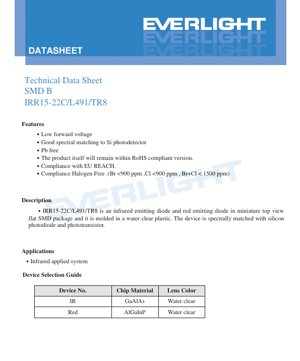
1. Product Overview
The IRR15-22C/L491/TR8 is a dual-emitter surface-mount device (SMD) integrating an infrared (IR) emitting diode and a red emitting diode within a single miniature, top-view flat package. The device is encapsulated in water-clear plastic, which allows for efficient light transmission for both wavelengths. A key design feature is the spectral matching of the IR emitter to silicon photodiodes and phototransistors, optimizing it for sensing and detection applications. The product adheres to modern environmental standards, being Pb-free, RoHS compliant, EU REACH compliant, and halogen-free.
1.1 Core Features and Advantages
- Low Forward Voltage: Ensures higher energy efficiency and reduced power consumption in the circuit.
- Spectral Matching: The IR diode's output is specifically matched to the responsivity curve of silicon-based photodetectors, enhancing signal-to-noise ratio in optical sensing systems.
- Dual Emission: Combines IR (for sensing, remote control) and Red (for status indication, simple displays) functionalities in one compact footprint, saving board space.
- Environmental Compliance: Meets Pb-free, RoHS, REACH, and halogen-free requirements, making it suitable for a wide range of global markets and environmentally conscious designs.
- Miniature SMD Package: The top-view flat package (3.0mm x 1.6mm x 1.1mm) is ideal for automated assembly and high-density PCB designs.
1.2 Target Market and Applications
This component is primarily targeted at applications requiring reliable, low-power optical sources for sensing and indication. Its primary application is in infrared-applied systems, which include but are not limited to:
- Proximity and presence sensors
- Object detection and counting systems
- Optical encoders
- Touchless switches and interfaces
- Simple data transmission links (e.g., remote control receivers)
- Devices where a red indicator light is needed alongside an IR function
2. In-Depth Technical Parameter Analysis
2.1 Absolute Maximum Ratings
These ratings define the limits beyond which permanent damage to the device may occur. Operation under or at these limits is not guaranteed.
- Continuous Forward Current (IF): 50 mA for both IR and Red chips. Exceeding this current will cause excessive heating and rapid degradation.
- Reverse Voltage (VR): 5 V. The LED has limited reverse voltage tolerance; proper circuit design should prevent reverse bias conditions.
- Power Dissipation (Pc): 100 mW for the IR chip and 130 mW for the Red chip at or below 25°C free air temperature. This parameter is crucial for thermal management.
- Operating & Storage Temperature: -25°C to +85°C (operating), -40°C to +100°C (storage).
- Soldering Temperature: 260°C for a maximum of 5 seconds, compliant with typical lead-free reflow profiles.
2.2 Electro-Optical Characteristics (Ta=25°C)
These are the typical performance parameters under specified test conditions.
- Radiant Intensity (IE): Measured in mW/sr (milliwatts per steradian). Typical values are 2.1 mW/sr (IR) and 2.3 mW/sr (Red) at IF=20mA. This indicates the optical power emitted into a specific solid angle.
- Peak Wavelength (λp): 940 nm for IR (typical) and 660 nm for Red (typical). The IR wavelength is ideal for silicon photodetectors, which have peak sensitivity around 900-1000 nm.
- Spectral Bandwidth (Δλ): Approximately 30 nm for IR and 20 nm for Red, defining the spectral purity of the emitted light.
- Forward Voltage (VF): Typical values are 1.30 V for IR and 1.90 V for Red at IF=20mA. The Red chip has a higher VF due to the different semiconductor material (AlGaInP vs. GaAlAs).
- View Angle (2θ1/2): 120 degrees. This wide viewing angle is characteristic of the top-view, non-lensed water-clear package, providing a broad emission pattern.
3. Performance Curve Analysis
3.1 Infrared (IR) Chip Characteristics
The provided curves for the IR chip offer critical design insights:
- Spectral Distribution: The curve shows a sharp peak at 940 nm with a full width at half maximum (FWHM) of about 30 nm, confirming good spectral matching to silicon detectors.
- Forward Current vs. Forward Voltage (I-V Curve): This exponential curve is essential for selecting the current-limiting resistor. A small change in voltage leads to a large change in current, underscoring the need for constant current drive or a well-calculated series resistor.
- Relative Intensity vs. Forward Current: Shows that radiant intensity increases linearly with current up to the maximum rating, allowing for brightness modulation via current control.
- Forward Current vs. Ambient Temperature: Demonstrates the derating requirement. The maximum allowable forward current decreases as ambient temperature increases to prevent exceeding the power dissipation limit.
3.2 Red Chip Characteristics
The curves for the Red chip follow similar principles but with material-specific differences:
- Spectral Distribution: Centered at 660 nm (deep red) with a narrower bandwidth (~20 nm), resulting in a saturated red color.
- I-V Curve, Intensity vs. Current, and Thermal Derating: These curves are analogous to the IR chip's but with different voltage and power dissipation values, as indicated in the Absolute Maximum Ratings and Electro-Optical Characteristics tables.
3.3 Angular Characteristics
The Relative Light Current vs. Angular Displacement curve (presumably from a paired detector) illustrates the spatial emission pattern. The 120-degree view angle results in a Lambertian-like distribution where intensity is highest at 0° (perpendicular to the emitting surface) and decreases to half at ±60°. This is important for designing optical paths and ensuring adequate signal strength at the receiver.
4. Mechanical and Package Information
4.1 Package Dimensions
The device comes in a miniature SMD package. Key dimensions (in mm) include a body size of approximately 3.0 x 1.6, with a height of 1.1. The cathode is typically identified by a marking or a notch on the package. The dimensional drawing shows the lead spacing and land pattern recommendations for PCB footprint design, which are critical for reliable soldering and mechanical stability.
4.2 Polarity Identification
Correct polarity connection is vital. The datasheet's package diagram indicates the anode and cathode terminals. Applying reverse polarity exceeding the 5V reverse voltage rating can instantly damage the diode junction.
5. Soldering, Assembly, and Handling Guidelines
5.1 Critical Precautions
- Over-current Protection: An external current-limiting resistor is mandatory. The steep I-V curve means even a small voltage increase can cause a destructive current surge.
- Storage and Moisture Sensitivity: The device is moisture-sensitive (MSL). It must be stored in its original moisture-proof bag with desiccant. After opening, it should be used within 168 hours (7 days) unless rebaked (60°C for 24 hours).
5.2 Soldering Conditions
- Reflow Soldering: A lead-free temperature profile is recommended, with a peak temperature of 260°C for a maximum of 5 seconds. Reflow should not be performed more than twice.
- Hand Soldering: If necessary, use a soldering iron with a tip temperature <350°C, apply heat to each terminal for <3 seconds, and use a low-power iron (<25W). Allow cooling between joints.
- Repair: Not recommended. If unavoidable, use a dual-head soldering iron to simultaneously heat both terminals and avoid mechanical stress on the solder joints.
6. Packaging and Ordering Information
6.1 Packaging Specification
The devices are supplied on embossed carrier tape wound onto reels. The standard packing quantity is 2000 pieces per reel. The carrier tape dimensions ensure compatibility with standard SMD pick-and-place equipment.
6.2 Label and Traceability
The packaging includes labels on the moisture-proof bag and the reel. These labels contain traceability information such as Part Number (P/N), Lot Number (LOT No.), quantity (QTY), and production place. This is essential for quality control and supply chain management.
7. Application Design Considerations
7.1 Circuit Design
When designing the drive circuit:
- Calculate the Series Resistor (Rs): Use the formula Rs = (Vsupply - VF) / IF. Use the maximum VF from the datasheet to ensure sufficient current under all conditions. For example, for the Red LED at 20mA with a 5V supply: Rs = (5V - 2.5V) / 0.02A = 125Ω. Use the next standard value (e.g., 130Ω or 150Ω).
- Consider PWM for Dimming: For intensity control, use Pulse Width Modulation (PWM) rather than analog current reduction, as it maintains consistent color (for Red) and wavelength.
- Thermal Management: Ensure the PCB layout provides adequate copper area for heat sinking, especially if operating near maximum current or in elevated ambient temperatures.
7.2 Optical Design
- For Sensing (IR): Align the IR emitter and the photodetector optically. Use apertures, lenses, or light guides to define the sensing field and block ambient light interference. The wide 120° angle may require shielding to create a more directed beam for longer-range sensing.
- For Indication (Red): The water-clear lens and wide angle provide good visibility. Consider using a diffuser if a softer, more uniform indication is desired.
8. Technical Comparison and Differentiation
The IRR15-22C/L491/TR8's primary differentiation lies in its dual-wavelength, single-package design. Compared to using two separate LEDs, it offers:
- Space Savings: Reduces PCB footprint by 50%.
- Simplified Assembly: One pick-and-place operation instead of two.
- Cost Efficiency: Potentially lower total component and assembly cost.
- Optimized IR Performance: The specific 940nm GaAlAs chip is chosen for optimal performance with silicon detectors, which may offer better sensitivity and range compared to generic IR LEDs.
9. Frequently Asked Questions (FAQs)
9.1 Can I drive the IR and Red LEDs simultaneously?
Yes, but they must be driven by separate current-limiting circuits (resistors or drivers). They share a common package but have independent semiconductor chips and electrical connections.
9.2 Why is a current-limiting resistor absolutely necessary?
LEDs are current-operated devices. Their forward voltage has a negative temperature coefficient and varies from unit to unit. A voltage source without a series resistor would cause uncontrolled current flow, leading to immediate thermal runaway and destruction.
9.3 What is the typical lifetime of this LED?
LED lifetime is typically defined as the point where light output degrades to 50% of its initial value (L70/L50). While not explicitly stated in this datasheet, properly operated SMD LEDs (within ratings, with good thermal management) often have lifetimes exceeding 50,000 hours.
9.4 How do I interpret the Radiant Intensity (mW/sr) value for my sensor design?
Radiant intensity describes optical power per solid angle. To estimate the power (in mW) received by a detector, you need to know the detector's active area and its distance/angle from the LED. The angular displacement curve helps in this calculation for off-axis alignment.
10. Practical Application Example
10.1 Simple Proximity Sensor
Scenario: Detect when an object comes within 5 cm of a device.
Implementation: Mount the IRR15-22C/L491/TR8 on a PCB. Drive the IR emitter with a 20mA constant current (using a calculated resistor from a 3.3V supply). Place a silicon phototransistor opposite it, with a small barrier between them to prevent direct optical coupling. When an object enters the gap, it reflects IR light from the emitter to the detector. The detector's output current increases, which can be converted to a voltage by a load resistor and read by a microcontroller's ADC or comparator. The Red LED can be connected to a GPIO pin to provide a visual "detection active" or "object present" indicator.
11. Operating Principle
Light Emitting Diodes (LEDs) are semiconductor p-n junction devices. When a forward voltage is applied, electrons from the n-region and holes from the p-region are injected into the junction region. When these charge carriers recombine, they release energy in the form of photons (light). The wavelength (color) of the emitted light is determined by the bandgap energy of the semiconductor material. The IRR15-22C/L491/TR8 uses GaAlAs (Gallium Aluminum Arsenide) for the IR emitter (940nm) and AlGaInP (Aluminum Gallium Indium Phosphide) for the Red emitter (660nm). The water-clear epoxy lens encapsulates the chip, provides mechanical protection, and shapes the light output pattern.
12. Technology Trends
The development of SMD LEDs like this one follows several key industry trends:
- Miniaturization: Continuous reduction in package size (e.g., from 0603 to 0402 to 0201) to enable smaller end products.
- Multi-Chip Packages (MCPs): Integrating multiple LED chips (different colors or same color) in one package for higher output, color mixing, or multi-functionality, as seen in this dual-wavelength device.
- Higher Efficiency: Ongoing improvements in internal quantum efficiency (IQE) and light extraction efficiency lead to higher radiant intensity for the same input current, improving system power budgets.
- Enhanced Reliability: Advances in packaging materials (epoxy, silicone) and die-attach techniques improve performance under high temperature and humidity, extending operational lifetime.
- Smart Integration: A growing trend is the integration of control ICs (drivers, sensors) within the LED package, creating "smart LED" modules that simplify system design.
LED Specification Terminology
Complete explanation of LED technical terms
Photoelectric Performance
| Term | Unit/Representation | Simple Explanation | Why Important |
|---|---|---|---|
| Luminous Efficacy | lm/W (lumens per watt) | Light output per watt of electricity, higher means more energy efficient. | Directly determines energy efficiency grade and electricity cost. |
| Luminous Flux | lm (lumens) | Total light emitted by source, commonly called "brightness". | Determines if the light is bright enough. |
| Viewing Angle | ° (degrees), e.g., 120° | Angle where light intensity drops to half, determines beam width. | Affects illumination range and uniformity. |
| CCT (Color Temperature) | K (Kelvin), e.g., 2700K/6500K | Warmth/coolness of light, lower values yellowish/warm, higher whitish/cool. | Determines lighting atmosphere and suitable scenarios. |
| CRI / Ra | Unitless, 0–100 | Ability to render object colors accurately, Ra≥80 is good. | Affects color authenticity, used in high-demand places like malls, museums. |
| SDCM | MacAdam ellipse steps, e.g., "5-step" | Color consistency metric, smaller steps mean more consistent color. | Ensures uniform color across same batch of LEDs. |
| Dominant Wavelength | nm (nanometers), e.g., 620nm (red) | Wavelength corresponding to color of colored LEDs. | Determines hue of red, yellow, green monochrome LEDs. |
| Spectral Distribution | Wavelength vs intensity curve | Shows intensity distribution across wavelengths. | Affects color rendering and quality. |
Electrical Parameters
| Term | Symbol | Simple Explanation | Design Considerations |
|---|---|---|---|
| Forward Voltage | Vf | Minimum voltage to turn on LED, like "starting threshold". | Driver voltage must be ≥Vf, voltages add up for series LEDs. |
| Forward Current | If | Current value for normal LED operation. | Usually constant current drive, current determines brightness & lifespan. |
| Max Pulse Current | Ifp | Peak current tolerable for short periods, used for dimming or flashing. | Pulse width & duty cycle must be strictly controlled to avoid damage. |
| Reverse Voltage | Vr | Max reverse voltage LED can withstand, beyond may cause breakdown. | Circuit must prevent reverse connection or voltage spikes. |
| Thermal Resistance | Rth (°C/W) | Resistance to heat transfer from chip to solder, lower is better. | High thermal resistance requires stronger heat dissipation. |
| ESD Immunity | V (HBM), e.g., 1000V | Ability to withstand electrostatic discharge, higher means less vulnerable. | Anti-static measures needed in production, especially for sensitive LEDs. |
Thermal Management & Reliability
| Term | Key Metric | Simple Explanation | Impact |
|---|---|---|---|
| Junction Temperature | Tj (°C) | Actual operating temperature inside LED chip. | Every 10°C reduction may double lifespan; too high causes light decay, color shift. |
| Lumen Depreciation | L70 / L80 (hours) | Time for brightness to drop to 70% or 80% of initial. | Directly defines LED "service life". |
| Lumen Maintenance | % (e.g., 70%) | Percentage of brightness retained after time. | Indicates brightness retention over long-term use. |
| Color Shift | Δu′v′ or MacAdam ellipse | Degree of color change during use. | Affects color consistency in lighting scenes. |
| Thermal Aging | Material degradation | Deterioration due to long-term high temperature. | May cause brightness drop, color change, or open-circuit failure. |
Packaging & Materials
| Term | Common Types | Simple Explanation | Features & Applications |
|---|---|---|---|
| Package Type | EMC, PPA, Ceramic | Housing material protecting chip, providing optical/thermal interface. | EMC: good heat resistance, low cost; Ceramic: better heat dissipation, longer life. |
| Chip Structure | Front, Flip Chip | Chip electrode arrangement. | Flip chip: better heat dissipation, higher efficacy, for high-power. |
| Phosphor Coating | YAG, Silicate, Nitride | Covers blue chip, converts some to yellow/red, mixes to white. | Different phosphors affect efficacy, CCT, and CRI. |
| Lens/Optics | Flat, Microlens, TIR | Optical structure on surface controlling light distribution. | Determines viewing angle and light distribution curve. |
Quality Control & Binning
| Term | Binning Content | Simple Explanation | Purpose |
|---|---|---|---|
| Luminous Flux Bin | Code e.g., 2G, 2H | Grouped by brightness, each group has min/max lumen values. | Ensures uniform brightness in same batch. |
| Voltage Bin | Code e.g., 6W, 6X | Grouped by forward voltage range. | Facilitates driver matching, improves system efficiency. |
| Color Bin | 5-step MacAdam ellipse | Grouped by color coordinates, ensuring tight range. | Guarantees color consistency, avoids uneven color within fixture. |
| CCT Bin | 2700K, 3000K etc. | Grouped by CCT, each has corresponding coordinate range. | Meets different scene CCT requirements. |
Testing & Certification
| Term | Standard/Test | Simple Explanation | Significance |
|---|---|---|---|
| LM-80 | Lumen maintenance test | Long-term lighting at constant temperature, recording brightness decay. | Used to estimate LED life (with TM-21). |
| TM-21 | Life estimation standard | Estimates life under actual conditions based on LM-80 data. | Provides scientific life prediction. |
| IESNA | Illuminating Engineering Society | Covers optical, electrical, thermal test methods. | Industry-recognized test basis. |
| RoHS / REACH | Environmental certification | Ensures no harmful substances (lead, mercury). | Market access requirement internationally. |
| ENERGY STAR / DLC | Energy efficiency certification | Energy efficiency and performance certification for lighting. | Used in government procurement, subsidy programs, enhances competitiveness. |