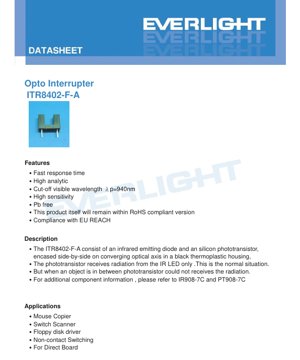
1. Product Overview
The ITR8402-F-A is a compact opto interrupter module designed for non-contact sensing applications. It integrates an infrared emitting diode (IRED) and a silicon phototransistor aligned on a converging optical axis within a black thermoplastic housing. The fundamental operating principle involves the phototransistor receiving infrared radiation emitted by the IRED under normal conditions. When an opaque object interrupts the optical path between the emitter and detector, the phototransistor ceases to receive the signal, enabling object detection or position sensing.
Key features of this device include a fast response time, high sensitivity, and a peak emission wavelength of 940nm, which is outside the visible spectrum to minimize interference from ambient light. The device is constructed using lead-free materials and complies with relevant environmental regulations such as RoHS and EU REACH.
2. Technical Parameter Deep-Dive
2.1 Absolute Maximum Ratings
These ratings define the limits beyond which permanent damage to the device may occur. Operation under these conditions is not guaranteed.
- Input (IRED): Power dissipation (Pd) is 75 mW at or below 25°C free air temperature. The maximum reverse voltage (VR) is 5V, and the maximum forward current (IF) is 50 mA.
- Output (Phototransistor): Collector power dissipation (Pd) is 75 mW. The maximum collector current (IC) is 20 mA. The collector-emitter voltage (BVCEO) is 30V, and the emitter-collector voltage (BVECO) is 5V.
- Environmental: Operating temperature (Topr) range is -25°C to +85°C. Storage temperature (Tstg) range is -40°C to +85°C. Lead soldering temperature (Tsol) must not exceed 260°C for a duration of 5 seconds or less, measured 3mm from the package body.
2.2 Electro-Optical Characteristics
These parameters are measured at an ambient temperature (Ta) of 25°C and define the typical performance of the device.
- Input (IRED): The typical forward voltage (VF) is 1.2V at a forward current (IF) of 20mA, with a maximum of 1.5V. Reverse current (IR) is a maximum of 10 µA at VR=5V. The peak wavelength (λP) is 940nm.
- Output (Phototransistor): The dark current (ICEO) is a maximum of 100 nA at VCE=20V with zero irradiance. The collector-emitter saturation voltage (VCE(sat)) is a maximum of 0.4V when the collector current (IC) is 2mA under an irradiance (Ee) of 1 mW/cm².
- Transfer Characteristics: The minimum collector current (IC(ON)) is 0.5 mA when VCE=5V and IF=20mA. The typical rise time (tr) and fall time (tf) are both 15 µs under test conditions of VCE=5V, IC=1mA, and a load resistor (RL) of 1 kΩ.
3. Performance Curve Analysis
The datasheet provides typical characteristic curves for both the IR emitter and the phototransistor. These curves are essential for understanding device behavior under varying conditions.
3.1 IR Emitter Characteristics
The curves illustrate the relationship between forward current and forward voltage, which is crucial for designing the driving circuit. They also show the derating of collector power dissipation as ambient temperature increases, which is vital for thermal management. The spectral sensitivity curve confirms the peak emission at 940nm.
3.2 Phototransistor Characteristics
The spectral sensitivity curve for the phototransistor shows its responsivity across different wavelengths, with peak sensitivity typically aligned with the IR emitter's 940nm output, ensuring optimal coupling efficiency.
4. Mechanical and Package Information
4.1 Package Dimensions
The ITR8402-F-A is housed in a compact, industry-standard package. Key dimensions include an overall body size, lead spacing, and positioning of the optical aperture. All dimensions are specified in millimeters with a standard tolerance of ±0.3 mm unless otherwise noted. The lead spacing is measured at the point where the leads emerge from the package body.
4.2 Polarity Identification
The component is designed for through-hole mounting. The pinout configuration must be carefully observed during PCB layout and assembly to ensure correct electrical connection of the IRED anode and cathode and the phototransistor collector and emitter.
5. Soldering and Assembly Guidelines
5.1 Lead Forming
If lead forming is required, it must be performed before soldering. Bending should occur at a minimum distance of 3mm from the bottom of the epoxy package to avoid stress-induced damage. The leads must be secured during bending, and the package itself should not be touched or stressed. Cutting of leads should be done at room temperature.
5.2 Soldering Process
Soldering must be performed with care to prevent thermal or mechanical damage.
- Hand Soldering: Maximum iron tip temperature of 300°C (for irons rated 30W max). Soldering time per lead should not exceed 3 seconds. Maintain a minimum distance of 3mm from the solder joint to the epoxy bulb.
- Wave/DIP Soldering: Maximum preheat temperature of 100°C for up to 60 seconds. Solder bath temperature should not exceed 260°C, with a dwell time of 5 seconds maximum. The 3mm distance rule from the epoxy bulb also applies.
A recommended soldering temperature profile is provided, emphasizing controlled ramp-up, a defined peak temperature plateau, and a controlled cool-down phase. Rapid cooling is not recommended. Soldering (dip or hand) should not be performed more than once. After soldering, the device should be protected from mechanical shock until it returns to room temperature.
5.3 Cleaning and Storage
Ultrasonic cleaning of the assembled device is prohibited as it can cause internal damage. For storage, devices should be kept at 10-30°C with relative humidity at 70% or less. The recommended storage life in the original shipping package is 3 months. For longer storage, a nitrogen atmosphere at 10-25°C and 20-60% RH is advised. Once opened, devices should be used within 24 hours, and any remaining components should be resealed promptly.
6. Packaging and Ordering Information
The standard packing specification is 90 pieces per tube, 48 tubes per box, and 4 boxes per carton. The label on the packaging includes fields for Customer Part Number (CPN), Part Number (P/N), Packing Quantity (QTY), Ranks (CAT), Reference (REF), and Lot Number (LOT No).
7. Application Suggestions
7.1 Typical Application Scenarios
The ITR8402-F-A is well-suited for various non-contact sensing and switching applications, including but not limited to: position sensing in computer mice and copiers, paper detection in scanners and floppy disk drives, edge detection in printers, and general-purpose object detection. Its through-hole package makes it suitable for direct board mounting in a wide range of consumer and industrial electronics.
7.2 Design Considerations
When designing with this opto interrupter, several factors are critical:
- Circuit Design: A current-limiting resistor is mandatory for the IRED to operate within its specified forward current (IF). The phototransistor output typically requires a pull-up resistor to define the logic high level when the beam is uninterrupted.
- Mechanical Integration: The PCB holes must align precisely with the component leads to avoid mounting stress. The slot between the emitter and detector must be kept clear of obstructions and contamination.
- Thermal Management: The power dissipation of both the IRED and phototransistor must be considered, especially in high ambient temperature environments. Refer to the derating curves for guidance.
- Ambient Light Immunity: While the 940nm wavelength and housing provide some immunity, designing the system to operate in a controlled light environment or using modulated IR signals can enhance reliability in challenging conditions.
8. Technical Comparison and Differentiation
The ITR8402-F-A offers a balance of speed, sensitivity, and size. Its fast 15µs response time makes it suitable for applications requiring quick detection, such as in encoders or high-speed counting. The high sensitivity allows for reliable operation even with lower drive currents or in dusty environments. The side-by-side, converging axis design in a standard package provides a cost-effective solution for many common sensing needs compared to more specialized or reflective sensors.
9. Frequently Asked Questions (FAQ)
9.1 What is the typical sensing distance or gap?
The datasheet does not specify a maximum sensing gap. This parameter depends heavily on the applied current to the IRED, the sensitivity of the specific phototransistor, the required output signal swing, and the characteristics of the interrupting object (opacity, size). It is determined empirically for each application.
9.2 Can I use this sensor in sunlight?
Direct sunlight contains significant infrared radiation and can saturate the phototransistor, causing unreliable operation. For outdoor or high-ambient-light applications, additional shielding, optical filtering, or the use of a modulated IR signal with synchronous detection is strongly recommended.
9.3 Why is the rise/fall time specified with a 1kΩ load?
The switching speed of a phototransistor is affected by the RC time constant formed by its junction capacitance and the load resistance. Specifying it with a standard load (1 kΩ) allows for consistent comparison between devices. Using a different load resistor will alter the effective rise and fall times.
10. Practical Design and Usage Cases
10.1 Case Study: Paper Jam Detection in a Printer
In this application, multiple ITR8402-F-A sensors are placed along the paper path. The IR beam is normally interrupted by the presence of paper. A paper jam is detected when the beam remains uninterrupted (phototransistor ON) for longer than the expected transit time between two sensors, or when it becomes interrupted (phototransistor OFF) at a sensor where paper should not be present. The fast response time ensures timely detection, preventing damage.
10.2 Case Study: Rotary Encoder for Motor Speed Control
A slotted disk attached to a motor shaft rotates between the emitter and detector of the ITR8402-F-A. As the slots pass through the beam, they generate a pulsed output from the phototransistor. The frequency of these pulses is directly proportional to the motor's rotational speed. The 15µs response time enables accurate speed measurement even at high RPMs.
11. Operating Principle
An opto interrupter, or photointerrupter, is a self-contained component combining an infrared light source and a photodetector in a single package, facing each other across a physical gap. The IRED is forward-biased to emit invisible infrared light. The phototransistor, positioned opposite, acts as a light-controlled switch. Its collector-emitter resistance is very high (it is \"OFF\") when no light falls on it (dark current is minimal). When the IR light strikes its base region, electron-hole pairs are generated, effectively biasing the transistor and allowing a significant collector current to flow, turning it \"ON.\" An object placed in the gap blocks the light, turning the phototransistor off. This digital ON/OFF signal is used for detection.
12. Technology Trends
The core technology of opto interrupters is mature, but trends focus on miniaturization (smaller SMD packages), higher speed for data transmission applications, and integration of additional circuitry (such as Schmitt triggers or amplifiers) within the package to provide a cleaner digital output signal and improve noise immunity. There is also a trend towards lower operating currents for battery-powered IoT devices. The fundamental principle of modulated light detection for ambient light rejection remains a key area of development for robust industrial and automotive applications.
LED Specification Terminology
Complete explanation of LED technical terms
Photoelectric Performance
| Term | Unit/Representation | Simple Explanation | Why Important |
|---|---|---|---|
| Luminous Efficacy | lm/W (lumens per watt) | Light output per watt of electricity, higher means more energy efficient. | Directly determines energy efficiency grade and electricity cost. |
| Luminous Flux | lm (lumens) | Total light emitted by source, commonly called "brightness". | Determines if the light is bright enough. |
| Viewing Angle | ° (degrees), e.g., 120° | Angle where light intensity drops to half, determines beam width. | Affects illumination range and uniformity. |
| CCT (Color Temperature) | K (Kelvin), e.g., 2700K/6500K | Warmth/coolness of light, lower values yellowish/warm, higher whitish/cool. | Determines lighting atmosphere and suitable scenarios. |
| CRI / Ra | Unitless, 0–100 | Ability to render object colors accurately, Ra≥80 is good. | Affects color authenticity, used in high-demand places like malls, museums. |
| SDCM | MacAdam ellipse steps, e.g., "5-step" | Color consistency metric, smaller steps mean more consistent color. | Ensures uniform color across same batch of LEDs. |
| Dominant Wavelength | nm (nanometers), e.g., 620nm (red) | Wavelength corresponding to color of colored LEDs. | Determines hue of red, yellow, green monochrome LEDs. |
| Spectral Distribution | Wavelength vs intensity curve | Shows intensity distribution across wavelengths. | Affects color rendering and quality. |
Electrical Parameters
| Term | Symbol | Simple Explanation | Design Considerations |
|---|---|---|---|
| Forward Voltage | Vf | Minimum voltage to turn on LED, like "starting threshold". | Driver voltage must be ≥Vf, voltages add up for series LEDs. |
| Forward Current | If | Current value for normal LED operation. | Usually constant current drive, current determines brightness & lifespan. |
| Max Pulse Current | Ifp | Peak current tolerable for short periods, used for dimming or flashing. | Pulse width & duty cycle must be strictly controlled to avoid damage. |
| Reverse Voltage | Vr | Max reverse voltage LED can withstand, beyond may cause breakdown. | Circuit must prevent reverse connection or voltage spikes. |
| Thermal Resistance | Rth (°C/W) | Resistance to heat transfer from chip to solder, lower is better. | High thermal resistance requires stronger heat dissipation. |
| ESD Immunity | V (HBM), e.g., 1000V | Ability to withstand electrostatic discharge, higher means less vulnerable. | Anti-static measures needed in production, especially for sensitive LEDs. |
Thermal Management & Reliability
| Term | Key Metric | Simple Explanation | Impact |
|---|---|---|---|
| Junction Temperature | Tj (°C) | Actual operating temperature inside LED chip. | Every 10°C reduction may double lifespan; too high causes light decay, color shift. |
| Lumen Depreciation | L70 / L80 (hours) | Time for brightness to drop to 70% or 80% of initial. | Directly defines LED "service life". |
| Lumen Maintenance | % (e.g., 70%) | Percentage of brightness retained after time. | Indicates brightness retention over long-term use. |
| Color Shift | Δu′v′ or MacAdam ellipse | Degree of color change during use. | Affects color consistency in lighting scenes. |
| Thermal Aging | Material degradation | Deterioration due to long-term high temperature. | May cause brightness drop, color change, or open-circuit failure. |
Packaging & Materials
| Term | Common Types | Simple Explanation | Features & Applications |
|---|---|---|---|
| Package Type | EMC, PPA, Ceramic | Housing material protecting chip, providing optical/thermal interface. | EMC: good heat resistance, low cost; Ceramic: better heat dissipation, longer life. |
| Chip Structure | Front, Flip Chip | Chip electrode arrangement. | Flip chip: better heat dissipation, higher efficacy, for high-power. |
| Phosphor Coating | YAG, Silicate, Nitride | Covers blue chip, converts some to yellow/red, mixes to white. | Different phosphors affect efficacy, CCT, and CRI. |
| Lens/Optics | Flat, Microlens, TIR | Optical structure on surface controlling light distribution. | Determines viewing angle and light distribution curve. |
Quality Control & Binning
| Term | Binning Content | Simple Explanation | Purpose |
|---|---|---|---|
| Luminous Flux Bin | Code e.g., 2G, 2H | Grouped by brightness, each group has min/max lumen values. | Ensures uniform brightness in same batch. |
| Voltage Bin | Code e.g., 6W, 6X | Grouped by forward voltage range. | Facilitates driver matching, improves system efficiency. |
| Color Bin | 5-step MacAdam ellipse | Grouped by color coordinates, ensuring tight range. | Guarantees color consistency, avoids uneven color within fixture. |
| CCT Bin | 2700K, 3000K etc. | Grouped by CCT, each has corresponding coordinate range. | Meets different scene CCT requirements. |
Testing & Certification
| Term | Standard/Test | Simple Explanation | Significance |
|---|---|---|---|
| LM-80 | Lumen maintenance test | Long-term lighting at constant temperature, recording brightness decay. | Used to estimate LED life (with TM-21). |
| TM-21 | Life estimation standard | Estimates life under actual conditions based on LM-80 data. | Provides scientific life prediction. |
| IESNA | Illuminating Engineering Society | Covers optical, electrical, thermal test methods. | Industry-recognized test basis. |
| RoHS / REACH | Environmental certification | Ensures no harmful substances (lead, mercury). | Market access requirement internationally. |
| ENERGY STAR / DLC | Energy efficiency certification | Energy efficiency and performance certification for lighting. | Used in government procurement, subsidy programs, enhances competitiveness. |