Table of Contents
- 1. Product Overview
- 1.1 Core Advantages and Target Market
- 2. In-Depth Technical Parameter Analysis
- 2.1 Absolute Maximum Ratings
- 2.2 Electro-Optical Characteristics
- 3. Binning System Explanation
- 3.1 Luminous Intensity Binning
- 3.2 Dominant Wavelength Binning
- 3.3 Forward Voltage Binning
- 4. Performance Curve Analysis
- 5. Mechanical and Package Information
- 6. Soldering and Assembly Guidelines
- 6.1 Lead Forming
- 6.2 Soldering Process
- 6.3 Storage Conditions
- 7. Packaging and Ordering Information
- 7.1 Packaging Specification
- 7.2 Label Information
- 8. Application Recommendations
- 8.1 Typical Application Scenarios
- 8.2 Design Considerations
- 9. Technical Comparison and Differentiation
- 10. Frequently Asked Questions (Based on Technical Parameters)
- 11. Practical Design and Usage Case
- 12. Technical Principle Introduction
- 13. Technology Trends
1. Product Overview
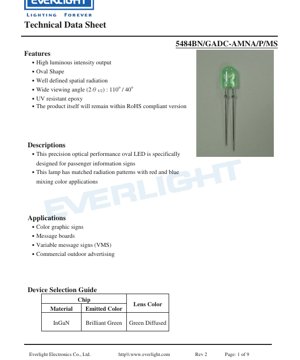
This document details the specifications for a precision optical performance oval LED. The device is engineered specifically for applications requiring high visibility and consistent color mixing, such as in passenger information systems and large-format signage.
1.1 Core Advantages and Target Market
The primary advantages of this LED include its high luminous intensity output and its unique oval shape, which creates a well-defined spatial radiation pattern. This pattern is characterized by a wide, asymmetrical viewing angle of 110 degrees in one axis and 40 degrees in the perpendicular axis. This feature is crucial for ensuring readability from various angles in signage applications. The device is constructed with UV-resistant epoxy, enhancing its durability for long-term outdoor use. It is designed for the commercial outdoor advertising and transportation signage markets, including color graphic signs, message boards, and variable message signs (VMS).
2. In-Depth Technical Parameter Analysis
The following sections provide a detailed breakdown of the device's electrical, optical, and thermal characteristics.
2.1 Absolute Maximum Ratings
These ratings define the limits beyond which permanent damage to the device may occur. Operation under these conditions is not guaranteed.
- Forward Current (IF): 30 mA (DC)
- Pulse Forward Current (IFP): 100 mA (Duty Cycle 1/10 @ 1 kHz)
- Reverse Voltage (VR): 5 V
- Power Dissipation (Pd): 100 mW
- Operating Temperature (Topr): -40°C to +85°C
- Storage Temperature (Tstg): -40°C to +100°C
- Soldering Temperature (Tsol): 260°C for a maximum of 5 seconds
- Electrostatic Discharge (ESD): Withstands 1000V (Human Body Model)
2.2 Electro-Optical Characteristics
These parameters are measured at a junction temperature (Ta) of 25°C and a standard test current of 20 mA, unless otherwise specified.
- Luminous Intensity (IV): Ranges from 2880 mcd to 4970 mcd, categorized into specific bins (M1, M2, N1).
- Viewing Angle (2θ1/2): 110° (X-axis) / 40° (Y-axis). This oval pattern is ideal for horizontal signage.
- Peak Wavelength (λp): Typically 522 nm.
- Dominant Wavelength (λd): Ranges from 525 nm to 535 nm, divided into fine bins (1a, 1b, 2a, 2b) for precise color matching.
- Spectral Half Width (Δλ): Typically 35 nm.
- Forward Voltage (VF): Ranges from 2.8 V to 3.6 V at 20 mA, categorized into bins (0, 1, 2, 3).
- Reverse Current (IR): Maximum 50 μA at a reverse voltage of 5V.
3. Binning System Explanation
To ensure consistency in mass production, LEDs are sorted into bins based on key parameters. This allows designers to select parts that meet specific application requirements for brightness and color.
3.1 Luminous Intensity Binning
Intensity is categorized into three primary ranks:
- M1: 2880 ~ 3450 mcd
- M2: 3450 ~ 4140 mcd
- N1: 4140 ~ 4970 mcd
3.2 Dominant Wavelength Binning
Color (wavelength) is finely binned into four categories to enable precise color mixing, especially with other colored LEDs:
- 1a: 525.0 ~ 527.5 nm
- 1b: 527.5 ~ 530.0 nm
- 2a: 530.0 ~ 532.5 nm
- 2b: 532.5 ~ 535.0 nm
3.3 Forward Voltage Binning
Forward voltage is binned to aid in circuit design for current regulation:
- 0: 2.8 ~ 3.0 V
- 1: 3.0 ~ 3.2 V
- 2: 3.2 ~ 3.4 V
- 3: 3.4 ~ 3.6 V
4. Performance Curve Analysis
While specific graphical data is not provided in the excerpt, typical performance curves for such a device would include:
- Relative Luminous Intensity vs. Forward Current (IV-IF): Shows how light output increases with current, up to the maximum rating.
- Relative Luminous Intensity vs. Ambient Temperature: Illustrates the decrease in light output as temperature rises, which is critical for thermal management in enclosed signs.
- Forward Voltage vs. Forward Current (VF-IF): Important for designing the driving circuitry.
- Spectral Distribution: A graph showing the intensity of light emitted across different wavelengths, centered around the dominant wavelength.
5. Mechanical and Package Information
The LED features a through-hole package with an oval lens. Key dimensional notes include:
- All dimensions are in millimeters with a standard tolerance of ±0.25 mm unless otherwise noted.
- The maximum protrusion of resin under the flange is 1.5 mm.
- The leadframe bowl geometry is defined to ensure proper light extraction and mechanical stability.
6. Soldering and Assembly Guidelines
Proper handling is crucial to prevent damage to the LED.
6.1 Lead Forming
- Bending must occur at least 3 mm from the base of the epoxy bulb.
- Form leads before soldering.
- Avoid applying stress to the package during forming or when inserting into PCB holes.
- Cut leads at room temperature.
6.2 Soldering Process
Maintain a minimum distance of 3 mm from the solder joint to the epoxy bulb.
- Hand Soldering: Iron tip temperature max 300°C (30W max), soldering time max 3 seconds.
- Wave/DIP Soldering: Preheat max 100°C for 60 sec max; solder bath max 260°C for 5 sec max.
6.3 Storage Conditions
- Store at ≤30°C and ≤70% Relative Humidity after receipt.
- Shelf life under these conditions is 3 months.
- For longer storage (up to 1 year), use a sealed container with a nitrogen atmosphere and desiccant.
- Avoid rapid temperature changes in humid environments to prevent condensation.
7. Packaging and Ordering Information
The device is packaged to prevent electrostatic discharge (ESD) and physical damage during shipping.
7.1 Packaging Specification
- LEDs are placed in anti-static bags.
- Packing Quantity: 500 pieces per bag. 5 bags (2500 pcs) per inner carton. 10 inner cartons (25,000 pcs) per master (outside) carton.
7.2 Label Information
Labels on the packaging contain critical information for traceability and correct application:
- CPN (Customer Part Number)
- P/N (Manufacturer Part Number)
- QTY (Quantity)
- CAT (Binning code for Luminous Intensity and Forward Voltage, e.g., M2-2)
- HUE (Binning code for Dominant Wavelength, e.g., 1a)
- REF (Reference code)
- LOT No. (Production Lot Number)
8. Application Recommendations
8.1 Typical Application Scenarios
- Passenger Information Signs: In buses, trains, and airports, where the oval beam pattern provides wide horizontal visibility.
- Variable Message Signs (VMS) and Message Boards: For traffic management and outdoor advertising.
- Color Graphic Signs: Where this green LED is mixed with red and blue LEDs to create full-color images or specific color tones.
8.2 Design Considerations
- Current Driving: Always use a constant current driver or a current-limiting resistor. Do not exceed the absolute maximum forward current of 30 mA DC.
- Thermal Management: Although power dissipation is low, ensure adequate ventilation in enclosed signs, especially in high ambient temperatures, to maintain light output and longevity.
- Optical Design: The asymmetric viewing angle should be aligned with the intended viewing direction of the sign (typically with the 110° axis horizontal).
- ESD Protection Implement standard ESD handling procedures during assembly.
9. Technical Comparison and Differentiation
This LED differentiates itself through its combination of features:
- Oval Radiation Pattern: Unlike standard round LEDs, this shape is purpose-built for signage, eliminating the need for secondary optics to spread light horizontally.
- High Intensity in a Through-Hole Package: Offers a simple, robust mounting solution compared to some surface-mount alternatives, while still delivering high brightness suitable for daylight-readable signs.
- Fine Color and Intensity Binning: Enables superior color consistency across a large display, which is critical for graphic quality.
- UV-Resistant Package: Specifically designed for long-term reliability in outdoor, sun-exposed environments.
10. Frequently Asked Questions (Based on Technical Parameters)
Q: What is the purpose of the oval beam pattern?
A: The 110°/40° viewing angle provides a very wide horizontal coverage and a narrower vertical coverage. This is ideal for signs intended to be read by people standing or sitting over a wide area, concentrating the light where viewers are likely to be.
Q: How do I select the right bin for my application?
A: For monochromatic signs, choose a luminous intensity bin (M1, M2, N1) based on required brightness. For color-mixing applications, you must also specify the dominant wavelength bin (1a, 1b, etc.) to ensure the green color matches perfectly between different LEDs and production batches.
Q: Can I drive this LED at higher than 20 mA for more brightness?
A: You may operate it up to the Absolute Maximum Rating of 30 mA DC. However, this will increase forward voltage, power dissipation, and junction temperature, which can reduce lifespan and luminous efficiency. Always refer to the derating curves (if available) and ensure proper thermal management.
Q: Why is the storage condition and shelf life important?
A: The epoxy material and internal components can absorb moisture from the air. If a "wet" device is subjected to high-temperature soldering, the rapid vaporization of this moisture can cause internal delamination or cracking ("popcorning"), leading to failure.
11. Practical Design and Usage Case
Scenario: Designing a Full-Color Outdoor Bus Stop Display
A designer is creating an LED matrix display for real-time bus information. The display must be readable in direct sunlight and have a consistent white balance.
- LED Selection: This oval green LED is chosen alongside equivalent red and blue LEDs. The oval beam ensures good horizontal viewing for passengers waiting on a platform.
- Binning Strategy: To achieve a consistent white point, the designer orders all green LEDs from a single, narrow dominant wavelength bin (e.g., 1b) and a specific intensity bin (e.g., M2). The red and blue LEDs are sourced with matching intensity bins relative to the green to maintain the desired white balance formula.
- Circuit Design: A constant current driver is designed for each color channel. The forward voltage bin information (e.g., bin 1 for 3.0-3.2V) is used to calculate the minimum required driver voltage, ensuring it can handle the worst-case (highest VF) LED in the batch.
- Assembly: During PCB assembly, the wave soldering profile is strictly controlled to the recommended 260°C for 5 seconds to prevent thermal damage. The 3mm lead bending rule is followed to avoid stress on the epoxy.
12. Technical Principle Introduction
This LED is based on an Indium Gallium Nitride (InGaN) semiconductor chip. When a forward voltage is applied across the p-n junction, electrons and holes recombine, releasing energy in the form of photons. The specific composition of the InGaN alloy determines the bandgap energy, which in turn defines the wavelength (color) of the emitted light—in this case, green (~530 nm). The oval-shaped epoxy lens is a primary optic that molds the raw light from the chip into the desired asymmetric radiation pattern, enhancing optical efficiency for the target application.
13. Technology Trends
The development of LEDs for signage follows several key trends:
- Increased Efficiency and Luminous Intensity: Ongoing improvements in epitaxial growth and chip design yield more light output per unit of electrical input, allowing for brighter displays or lower power consumption.
- Enhanced Color Gamut and Consistency: Advances in phosphor technology (for white LEDs) and epitaxial precision (for colored LEDs like this one) enable displays with richer, more accurate, and more consistent colors.
- Improved Reliability and Lifetime: Better packaging materials, such as high-performance, UV-stable epoxies or silicones, and robust die-attach methods extend operational life, especially critical for 24/7 outdoor installations.
- Integration with Smart Drivers: LEDs are increasingly paired with intelligent driver ICs that can individually adjust brightness and perform diagnostics, enabling more dynamic and reliable display systems.
LED Specification Terminology
Complete explanation of LED technical terms
Photoelectric Performance
| Term | Unit/Representation | Simple Explanation | Why Important |
|---|---|---|---|
| Luminous Efficacy | lm/W (lumens per watt) | Light output per watt of electricity, higher means more energy efficient. | Directly determines energy efficiency grade and electricity cost. |
| Luminous Flux | lm (lumens) | Total light emitted by source, commonly called "brightness". | Determines if the light is bright enough. |
| Viewing Angle | ° (degrees), e.g., 120° | Angle where light intensity drops to half, determines beam width. | Affects illumination range and uniformity. |
| CCT (Color Temperature) | K (Kelvin), e.g., 2700K/6500K | Warmth/coolness of light, lower values yellowish/warm, higher whitish/cool. | Determines lighting atmosphere and suitable scenarios. |
| CRI / Ra | Unitless, 0–100 | Ability to render object colors accurately, Ra≥80 is good. | Affects color authenticity, used in high-demand places like malls, museums. |
| SDCM | MacAdam ellipse steps, e.g., "5-step" | Color consistency metric, smaller steps mean more consistent color. | Ensures uniform color across same batch of LEDs. |
| Dominant Wavelength | nm (nanometers), e.g., 620nm (red) | Wavelength corresponding to color of colored LEDs. | Determines hue of red, yellow, green monochrome LEDs. |
| Spectral Distribution | Wavelength vs intensity curve | Shows intensity distribution across wavelengths. | Affects color rendering and quality. |
Electrical Parameters
| Term | Symbol | Simple Explanation | Design Considerations |
|---|---|---|---|
| Forward Voltage | Vf | Minimum voltage to turn on LED, like "starting threshold". | Driver voltage must be ≥Vf, voltages add up for series LEDs. |
| Forward Current | If | Current value for normal LED operation. | Usually constant current drive, current determines brightness & lifespan. |
| Max Pulse Current | Ifp | Peak current tolerable for short periods, used for dimming or flashing. | Pulse width & duty cycle must be strictly controlled to avoid damage. |
| Reverse Voltage | Vr | Max reverse voltage LED can withstand, beyond may cause breakdown. | Circuit must prevent reverse connection or voltage spikes. |
| Thermal Resistance | Rth (°C/W) | Resistance to heat transfer from chip to solder, lower is better. | High thermal resistance requires stronger heat dissipation. |
| ESD Immunity | V (HBM), e.g., 1000V | Ability to withstand electrostatic discharge, higher means less vulnerable. | Anti-static measures needed in production, especially for sensitive LEDs. |
Thermal Management & Reliability
| Term | Key Metric | Simple Explanation | Impact |
|---|---|---|---|
| Junction Temperature | Tj (°C) | Actual operating temperature inside LED chip. | Every 10°C reduction may double lifespan; too high causes light decay, color shift. |
| Lumen Depreciation | L70 / L80 (hours) | Time for brightness to drop to 70% or 80% of initial. | Directly defines LED "service life". |
| Lumen Maintenance | % (e.g., 70%) | Percentage of brightness retained after time. | Indicates brightness retention over long-term use. |
| Color Shift | Δu′v′ or MacAdam ellipse | Degree of color change during use. | Affects color consistency in lighting scenes. |
| Thermal Aging | Material degradation | Deterioration due to long-term high temperature. | May cause brightness drop, color change, or open-circuit failure. |
Packaging & Materials
| Term | Common Types | Simple Explanation | Features & Applications |
|---|---|---|---|
| Package Type | EMC, PPA, Ceramic | Housing material protecting chip, providing optical/thermal interface. | EMC: good heat resistance, low cost; Ceramic: better heat dissipation, longer life. |
| Chip Structure | Front, Flip Chip | Chip electrode arrangement. | Flip chip: better heat dissipation, higher efficacy, for high-power. |
| Phosphor Coating | YAG, Silicate, Nitride | Covers blue chip, converts some to yellow/red, mixes to white. | Different phosphors affect efficacy, CCT, and CRI. |
| Lens/Optics | Flat, Microlens, TIR | Optical structure on surface controlling light distribution. | Determines viewing angle and light distribution curve. |
Quality Control & Binning
| Term | Binning Content | Simple Explanation | Purpose |
|---|---|---|---|
| Luminous Flux Bin | Code e.g., 2G, 2H | Grouped by brightness, each group has min/max lumen values. | Ensures uniform brightness in same batch. |
| Voltage Bin | Code e.g., 6W, 6X | Grouped by forward voltage range. | Facilitates driver matching, improves system efficiency. |
| Color Bin | 5-step MacAdam ellipse | Grouped by color coordinates, ensuring tight range. | Guarantees color consistency, avoids uneven color within fixture. |
| CCT Bin | 2700K, 3000K etc. | Grouped by CCT, each has corresponding coordinate range. | Meets different scene CCT requirements. |
Testing & Certification
| Term | Standard/Test | Simple Explanation | Significance |
|---|---|---|---|
| LM-80 | Lumen maintenance test | Long-term lighting at constant temperature, recording brightness decay. | Used to estimate LED life (with TM-21). |
| TM-21 | Life estimation standard | Estimates life under actual conditions based on LM-80 data. | Provides scientific life prediction. |
| IESNA | Illuminating Engineering Society | Covers optical, electrical, thermal test methods. | Industry-recognized test basis. |
| RoHS / REACH | Environmental certification | Ensures no harmful substances (lead, mercury). | Market access requirement internationally. |
| ENERGY STAR / DLC | Energy efficiency certification | Energy efficiency and performance certification for lighting. | Used in government procurement, subsidy programs, enhances competitiveness. |