Table of Contents
- 1. Product Overview
- 1.1 Core Advantages and Product Positioning
- 1.2 Target Market and Applications
- 2. Technical Parameter Deep-Dive
- 2.1 Absolute Maximum Ratings
- 2.2 Electro-Optical Characteristics
- 2.3 Thermal Characteristics
- 3. Binning System Explanation
- 3.1 Luminous Intensity Binning
- 3.2 Dominant Wavelength Binning
- 4. Performance Curve Analysis
- 4.1 Relative Intensity vs. Wavelength
- 4.2 Directivity Pattern
- 4.3 Forward Current vs. Forward Voltage (I-V Curve)
- 4.4 Relative Intensity vs. Forward Current
- 4.5 Temperature Dependence Curves
- 5. Mechanical and Package Information
- 5.1 Package Dimensions
- 5.2 Polarity Identification
- 6. Soldering and Assembly Guidelines
- 6.1 Lead Forming
- 6.2 Storage Conditions
- 6.3 Soldering Process
- 7. Packaging and Ordering Information
- 7.1 Moisture Resistant Packing
- 7.2 Packing Quantities
- 7.3 Label Explanation
- 7.4 Carrier Tape and Reel Specifications
- 7.5 Product Designation / Part Numbering
- 8. Application Suggestions and Design Considerations
- 8.1 Typical Application Circuits
- 8.2 Thermal Management
- 8.3 Optical Integration
- 9. Technical Comparison and Differentiation
- 10. Frequently Asked Questions (FAQ)
- 11. Design and Usage Case Study
- 12. Operational Principle
1. Product Overview
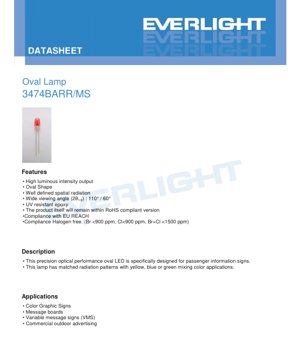
This document details the specifications for a high-performance, oval-shaped LED lamp. The device is engineered for applications requiring precise optical performance and reliable illumination in information display systems.
1.1 Core Advantages and Product Positioning
The primary advantage of this LED is its unique oval radiation pattern, which is specifically matched for mixing color applications in yellow, blue, or green systems. It is designed to deliver high luminous intensity output within a well-defined spatial radiation envelope. The product is positioned as a specialized component for commercial and public information displays where clarity, reliability, and specific beam shaping are critical.
1.2 Target Market and Applications
The target market encompasses manufacturers of professional signage and information systems. Key applications include:
- Color Graphic Signs
- Message Boards
- Variable Message Signs (VMS)
- Commercial Outdoor Advertising
These applications benefit from the LED's high brightness, defined beam pattern, and environmental robustness.
2. Technical Parameter Deep-Dive
This section provides an objective analysis of the device's key electrical, optical, and thermal characteristics.
2.1 Absolute Maximum Ratings
The Absolute Maximum Ratings define the stress limits beyond which permanent damage to the device may occur. Operating the device continuously at or near these limits is not recommended and will affect reliability.
- Reverse Voltage (VR): 5 V. Exceeding this voltage in reverse bias can cause junction breakdown.
- Forward Current (IF): 50 mA (Continuous).
- Peak Forward Current (IFP): 160 mA (pulsed, Duty Cycle 1/10 @ 1kHz). This rating allows for short-duration overdrive, useful in multiplexed display applications.
- Power Dissipation (Pd): 120 mW. This is the maximum power the package can dissipate at Ta=25°C. Derating is necessary at higher ambient temperatures.
- Operating Temperature (Topr): -40°C to +85°C. This wide range ensures functionality in harsh outdoor environments.
- Storage Temperature (Tstg): -40°C to +100°C.
- Soldering Temperature (Tsol): 260°C for 5 seconds. This defines the reflow soldering profile tolerance.
2.2 Electro-Optical Characteristics
These parameters are measured at a standard test condition of IF = 15mA and Ta = 25°C, providing a baseline for performance comparison.
- Luminous Intensity (Iv): 715 mcd (Min), 1573 mcd (Max). The typical value falls within this binning range (see Section 3). High intensity is crucial for daylight visibility in signage.
- Viewing Angle (2θ1/2): 110° (X-axis) / 60° (Y-axis). This asymmetric oval pattern is a key feature, providing wide horizontal coverage and more focused vertical emission, ideal for signage viewed from various horizontal angles.
- Peak Wavelength (λp): 632 nm (Typical). This is the wavelength at which the spectral power distribution is maximum.
- Dominant Wavelength (λd): 619 nm (Min), 621 nm (Typ), 629 nm (Max). This is the single-wavelength perception of the LED's color by the human eye and is subject to binning.
- Spectrum Radiation Bandwidth (Δλ): 20 nm (Typical). This indicates the spectral purity of the red light emitted by the AlGaInP chip.
- Forward Voltage (VF): 1.6 V (Min), 2.6 V (Max) at IF=15mA. This range must be considered for driver design and power supply requirements.
- Reverse Current (IR): 10 μA (Max) at VR=5V. A low reverse current indicates good junction quality.
2.3 Thermal Characteristics
While not explicitly listed in a separate table, thermal performance is implied through the Power Dissipation rating and Operating Temperature range. The device's performance will vary with ambient temperature, as shown in the characteristic curves. Proper PCB layout and, if necessary, heatsinking are required to maintain the junction temperature within safe limits, especially when operating at high forward currents or in elevated ambient temperatures.
3. Binning System Explanation
To ensure consistent color and brightness in an assembly, LEDs are sorted (binned) based on key parameters.
3.1 Luminous Intensity Binning
LEDs are categorized into three bins (RH, RJ, RK) based on their measured luminous intensity at IF = 15mA. The tolerance within a bin is ±10%.
- Bin RH: 715 mcd to 930 mcd
- Bin RJ: 930 mcd to 1210 mcd
- Bin RK: 1210 mcd to 1573 mcd
Specifying a bin code is essential for applications requiring uniform panel brightness.
3.2 Dominant Wavelength Binning
LEDs are also binned by their dominant wavelength to control color consistency. The tolerance is ±1nm.
- Bin R1: 619 nm to 624 nm
- Bin R2: 624 nm to 629 nm
For color-mixing applications or signs requiring a specific shade of red, specifying the wavelength bin is critical.
4. Performance Curve Analysis
The typical characteristic curves provide insight into the device's behavior under non-standard conditions.
4.1 Relative Intensity vs. Wavelength
This curve shows the spectral power distribution, peaking around 632 nm with a typical bandwidth (FWHM) of 20 nm. It confirms the emission is within the red spectrum of an AlGaInP chip.
4.2 Directivity Pattern
The polar plot visually represents the asymmetric viewing angle: approximately 110° in the horizontal (X) plane and 60° in the vertical (Y) plane, confirming the oval radiation pattern.
4.3 Forward Current vs. Forward Voltage (I-V Curve)
This curve is essential for driver design. It shows the exponential relationship between current and voltage. At the typical operating current, the forward voltage is expected to be between 1.6V and 2.6V. The curve helps in calculating series resistors or designing constant-current drivers.
4.4 Relative Intensity vs. Forward Current
This curve demonstrates the light output's dependence on drive current. While output increases with current, it is not perfectly linear, and efficiency may drop at very high currents due to thermal effects. Operating above the absolute maximum rating is prohibited.
4.5 Temperature Dependence Curves
Relative Intensity vs. Ambient Temperature: Shows the light output decreasing as ambient temperature increases. This derating must be accounted for in thermal design to maintain sufficient brightness in hot environments.
Forward Current vs. Ambient Temperature: Likely illustrates how the forward voltage characteristic shifts with temperature, which is important for constant-voltage drive scenarios.
5. Mechanical and Package Information
5.1 Package Dimensions
The dimensional drawing provides critical measurements for PCB footprint design, placement, and clearance. Key features include the oval lens shape, lead spacing (2.54mm pitch), and the maximum protrusion of the resin below the flange (1.5mm). All unspecified dimensions have a tolerance of ±0.25mm. Designers must adhere to these dimensions to ensure proper fit and soldering.
5.2 Polarity Identification
The datasheet diagram indicates the anode and cathode leads. Typically, the longer lead is the anode (+), but the PCB footprint design must clearly match the package drawing to prevent reverse installation. Correct polarity is essential for device operation and preventing damage from reverse bias.
6. Soldering and Assembly Guidelines
Proper handling is crucial for reliability.
6.1 Lead Forming
- Bending must occur at least 3mm from the base of the epoxy bulb.
- Form leads before soldering.
- Avoid applying stress to the package during bending.
- Cut leads at room temperature.
- Ensure PCB holes align perfectly with LED leads to avoid mounting stress.
6.2 Storage Conditions
- Recommended storage: ≤30°C and ≤70% Relative Humidity.
- Shelf life after shipment: 3 months under these conditions.
- For longer storage (up to 1 year): Use a sealed container with a nitrogen atmosphere and desiccant.
- Avoid rapid temperature changes in humid environments to prevent condensation.
6.3 Soldering Process
- Maintain a distance of more than 3mm from the solder joint to the epoxy bulb.
- Soldering should not extend beyond the base of the tie bar on the leadframe.
- Follow the peak soldering temperature limit of 260°C for 5 seconds during reflow.
7. Packaging and Ordering Information
7.1 Moisture Resistant Packing
The components are supplied in moisture-resistant packaging, which includes carrier tape and reel, placed within inner cartons and outer cartons.
7.2 Packing Quantities
- 2500 pieces per Inner Carton.
- 10 Inner Cartons per Outside Carton (25,000 pieces total).
7.3 Label Explanation
The reel label contains essential information for traceability and verification: Customer's Product Number (CPN), Product Number (P/N), Packing Quantity (QTY), and the Binning Codes for Luminous Intensity (CAT), Dominant Wavelength (HUE), and Forward Voltage (REF), along with the Lot Number (LOT No).
7.4 Carrier Tape and Reel Specifications
Detailed dimensions for the carrier tape (pocket pitch, depth, etc.) and reel are provided for compatibility with automated pick-and-place assembly equipment. Key parameters include a component pitch (F) of 2.54mm and a tape feed hole pitch (P) of 12.70mm.
7.5 Product Designation / Part Numbering
The part number follows a structured format: 3474 B A R R - □ □ □ □. The "3474" likely denotes the package family/size. The following letters (B, A, R, R) specify attributes such as color (Brilliant Red), lens type, and performance grade. The final four placeholders (□) are for specifying the binning codes for intensity (CAT) and wavelength (HUE), allowing users to order the exact performance grade required for their application.
8. Application Suggestions and Design Considerations
8.1 Typical Application Circuits
For simple constant-voltage supply (e.g., 5V), a series current-limiting resistor is mandatory. The resistor value (Rs) can be calculated using Ohm's Law: Rs = (Vsupply - VF) / IF. Use the maximum VF from the datasheet to ensure the current does not exceed limits. For multi-LED arrays or critical applications, a constant-current driver is strongly recommended to ensure stable brightness and longevity, as it compensates for VF variations and temperature effects.
8.2 Thermal Management
Although a low-power device, thermal management is important in densely packed signs or high-ambient-temperature environments (e.g., outdoor cabinets). Ensure adequate ventilation and consider the use of metal-core PCBs (MCPCBs) for large arrays to dissipate heat effectively and maintain light output.
8.3 Optical Integration
The oval beam pattern is designed to mix with other colors. When designing a multi-color pixel (e.g., for full-color signs), the physical placement and orientation of the red, green, and blue LEDs must account for their respective viewing angles to achieve proper color mixing at the intended viewing positions.
9. Technical Comparison and Differentiation
The primary differentiator of this LED is its oval radiation pattern (110°x60°). Compared to standard round LEDs with symmetric viewing angles (e.g., 120°), this shape provides optimized light distribution for horizontal signage, potentially reducing wasted light and improving efficiency for the target application. The use of UV-resistant epoxy is critical for outdoor applications to prevent lens yellowing and maintain light output over time. Compliance with Halogen-Free (Br/Cl limits) and RoHS/REACH standards makes it suitable for global markets with strict environmental regulations.
10. Frequently Asked Questions (FAQ)
Q1: What is the difference between Peak Wavelength and Dominant Wavelength?
A1: Peak Wavelength (λp) is the physical peak of the spectral output curve (632 nm here). Dominant Wavelength (λd) is the perceived color point (621 nm typical). Dominant wavelength is more relevant for color specification in displays.
Q2: Can I drive this LED at 20mA instead of 15mA?
A2: Yes, but you must consult the "Relative Intensity vs. Forward Current" curve. The luminous intensity will be higher, but you must ensure the product of IF and VF does not exceed the absolute maximum power dissipation (120mW), especially at high ambient temperatures. Derating may be necessary.
Q3: Why is the storage life only 3 months?
A3: This is a precaution for moisture-sensitive devices. The epoxy package can absorb moisture from the air. If a "wet" device is subjected to high-temperature soldering, the rapid vaporization of moisture can cause internal damage ("popcorning"). The 3-month limit assumes standard factory floor conditions. For longer storage, the nitrogen-bag method is prescribed.
Q4: How do I interpret the bin codes when ordering?
A4: You must specify the required combination of Luminous Intensity Bin (e.g., RK) and Dominant Wavelength Bin (e.g., R1) in the part number placeholder fields. This ensures you receive LEDs with consistent brightness and color.
11. Design and Usage Case Study
Scenario: Designing a Single-Line VMS for a Highway.
An engineer is designing a variable message sign. Each pixel requires a red sub-pixel. They select this oval LED for its high brightness (daylight visibility) and wide horizontal viewing angle, ensuring legibility for drivers across multiple lanes. They choose bin RK for maximum intensity and bin R1 for a consistent red hue. The LEDs are driven by a constant-current driver set to 15mA per LED to ensure longevity and stable output. The PCB layout follows the package dimensions exactly, and the design includes thermal vias under the LED pad to dissipate heat into the metal sign housing. The asymmetric beam pattern is oriented with the 110° axis horizontal to maximize the viewing corridor along the highway.
12. Operational Principle
This LED is based on an AlGaInP (Aluminum Gallium Indium Phosphide) semiconductor chip. When a forward voltage is applied across the p-n junction, electrons and holes are injected into the active region where they recombine. In AlGaInP materials, this recombination event releases energy in the form of photons (light) in the red to amber part of the visible spectrum. The specific composition of the AlGaInP layers determines the dominant wavelength. The generated light is then shaped by the molded oval epoxy lens, which acts as a primary optic to create the desired 110°x60° radiation pattern.
13. Technology Trends
In the signage and display LED market, trends continue towards higher efficiency (more lumens per watt), which reduces power consumption and thermal load. There is also a drive for improved color consistency and tighter binning tolerances to enable high-quality full-color displays without complex calibration. Packaging technology is evolving to offer even greater reliability and higher maximum operating temperatures for challenging environments. While this product uses a traditional leaded package, the industry is broadly moving towards surface-mount device (SMD) packages for automated assembly, though leaded packages remain relevant for certain applications requiring through-hole mounting robustness or specific optical characteristics.
LED Specification Terminology
Complete explanation of LED technical terms
Photoelectric Performance
| Term | Unit/Representation | Simple Explanation | Why Important |
|---|---|---|---|
| Luminous Efficacy | lm/W (lumens per watt) | Light output per watt of electricity, higher means more energy efficient. | Directly determines energy efficiency grade and electricity cost. |
| Luminous Flux | lm (lumens) | Total light emitted by source, commonly called "brightness". | Determines if the light is bright enough. |
| Viewing Angle | ° (degrees), e.g., 120° | Angle where light intensity drops to half, determines beam width. | Affects illumination range and uniformity. |
| CCT (Color Temperature) | K (Kelvin), e.g., 2700K/6500K | Warmth/coolness of light, lower values yellowish/warm, higher whitish/cool. | Determines lighting atmosphere and suitable scenarios. |
| CRI / Ra | Unitless, 0–100 | Ability to render object colors accurately, Ra≥80 is good. | Affects color authenticity, used in high-demand places like malls, museums. |
| SDCM | MacAdam ellipse steps, e.g., "5-step" | Color consistency metric, smaller steps mean more consistent color. | Ensures uniform color across same batch of LEDs. |
| Dominant Wavelength | nm (nanometers), e.g., 620nm (red) | Wavelength corresponding to color of colored LEDs. | Determines hue of red, yellow, green monochrome LEDs. |
| Spectral Distribution | Wavelength vs intensity curve | Shows intensity distribution across wavelengths. | Affects color rendering and quality. |
Electrical Parameters
| Term | Symbol | Simple Explanation | Design Considerations |
|---|---|---|---|
| Forward Voltage | Vf | Minimum voltage to turn on LED, like "starting threshold". | Driver voltage must be ≥Vf, voltages add up for series LEDs. |
| Forward Current | If | Current value for normal LED operation. | Usually constant current drive, current determines brightness & lifespan. |
| Max Pulse Current | Ifp | Peak current tolerable for short periods, used for dimming or flashing. | Pulse width & duty cycle must be strictly controlled to avoid damage. |
| Reverse Voltage | Vr | Max reverse voltage LED can withstand, beyond may cause breakdown. | Circuit must prevent reverse connection or voltage spikes. |
| Thermal Resistance | Rth (°C/W) | Resistance to heat transfer from chip to solder, lower is better. | High thermal resistance requires stronger heat dissipation. |
| ESD Immunity | V (HBM), e.g., 1000V | Ability to withstand electrostatic discharge, higher means less vulnerable. | Anti-static measures needed in production, especially for sensitive LEDs. |
Thermal Management & Reliability
| Term | Key Metric | Simple Explanation | Impact |
|---|---|---|---|
| Junction Temperature | Tj (°C) | Actual operating temperature inside LED chip. | Every 10°C reduction may double lifespan; too high causes light decay, color shift. |
| Lumen Depreciation | L70 / L80 (hours) | Time for brightness to drop to 70% or 80% of initial. | Directly defines LED "service life". |
| Lumen Maintenance | % (e.g., 70%) | Percentage of brightness retained after time. | Indicates brightness retention over long-term use. |
| Color Shift | Δu′v′ or MacAdam ellipse | Degree of color change during use. | Affects color consistency in lighting scenes. |
| Thermal Aging | Material degradation | Deterioration due to long-term high temperature. | May cause brightness drop, color change, or open-circuit failure. |
Packaging & Materials
| Term | Common Types | Simple Explanation | Features & Applications |
|---|---|---|---|
| Package Type | EMC, PPA, Ceramic | Housing material protecting chip, providing optical/thermal interface. | EMC: good heat resistance, low cost; Ceramic: better heat dissipation, longer life. |
| Chip Structure | Front, Flip Chip | Chip electrode arrangement. | Flip chip: better heat dissipation, higher efficacy, for high-power. |
| Phosphor Coating | YAG, Silicate, Nitride | Covers blue chip, converts some to yellow/red, mixes to white. | Different phosphors affect efficacy, CCT, and CRI. |
| Lens/Optics | Flat, Microlens, TIR | Optical structure on surface controlling light distribution. | Determines viewing angle and light distribution curve. |
Quality Control & Binning
| Term | Binning Content | Simple Explanation | Purpose |
|---|---|---|---|
| Luminous Flux Bin | Code e.g., 2G, 2H | Grouped by brightness, each group has min/max lumen values. | Ensures uniform brightness in same batch. |
| Voltage Bin | Code e.g., 6W, 6X | Grouped by forward voltage range. | Facilitates driver matching, improves system efficiency. |
| Color Bin | 5-step MacAdam ellipse | Grouped by color coordinates, ensuring tight range. | Guarantees color consistency, avoids uneven color within fixture. |
| CCT Bin | 2700K, 3000K etc. | Grouped by CCT, each has corresponding coordinate range. | Meets different scene CCT requirements. |
Testing & Certification
| Term | Standard/Test | Simple Explanation | Significance |
|---|---|---|---|
| LM-80 | Lumen maintenance test | Long-term lighting at constant temperature, recording brightness decay. | Used to estimate LED life (with TM-21). |
| TM-21 | Life estimation standard | Estimates life under actual conditions based on LM-80 data. | Provides scientific life prediction. |
| IESNA | Illuminating Engineering Society | Covers optical, electrical, thermal test methods. | Industry-recognized test basis. |
| RoHS / REACH | Environmental certification | Ensures no harmful substances (lead, mercury). | Market access requirement internationally. |
| ENERGY STAR / DLC | Energy efficiency certification | Energy efficiency and performance certification for lighting. | Used in government procurement, subsidy programs, enhances competitiveness. |