1. Product Overview
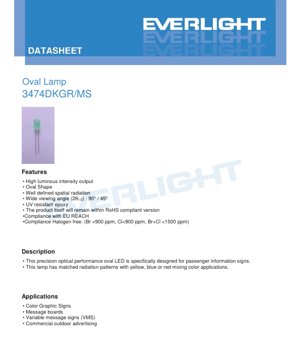
This document details the specifications for a precision oval LED lamp, model 3474DKGR/MS. This component is engineered specifically for applications requiring clear, high-visibility illumination in signage systems. Its primary design goal is to deliver reliable performance in passenger information signs, variable message boards, and commercial outdoor advertising.
1.1 Core Advantages and Target Market
The lamp's defining feature is its oval shape, which produces a well-defined spatial radiation pattern. This optical design is matched for applications involving color mixing, such as with yellow, blue, or red filters, making it ideal for multi-color graphic signs. The target markets are primarily transportation infrastructure (e.g., airports, train stations, highways for VMS) and commercial advertising, where long-term reliability and consistent color output are critical.
1.2 Key Features
- High Luminous Intensity Output: Delivers bright, visible light suitable for daytime viewing.
- Oval Shape & Defined Radiation: Creates a specific beam pattern optimized for signage illumination.
- Wide Viewing Angle: Asymmetric viewing angle of 90° (X-axis) / 45° (Y-axis) ensures visibility from various positions.
- Robust Material: Constructed with UV-resistant epoxy resin for enhanced durability in outdoor environments.
- Environmental Compliance: The product adheres to RoHS, EU REACH, and halogen-free standards (Br <900ppm, Cl <900ppm, Br+Cl <1500ppm).
2. Technical Parameter Deep Dive
2.1 Device Selection and Absolute Maximum Ratings
The LED utilizes an InGaN (Indium Gallium Nitride) chip material to emit a Brilliant Green color through a green diffused lens. Operating beyond the Absolute Maximum Ratings may cause permanent damage.
| Parameter | Symbol | Rating | Unit |
|---|---|---|---|
| Reverse Voltage | VR | 5 | V |
| Forward Current | IF | 30 | mA |
| Peak Forward Current (Duty 1/10 @1kHz) | IFP | 100 | mA |
| Power Dissipation | Pd | 110 | mW |
| Operating Temperature | Topr | -40 to +85 | °C |
| Storage Temperature | Tstg | -40 to +100 | °C |
| Soldering Temperature | Tsol | 260 (for 5 sec) | °C |
2.2 Electro-Optical Characteristics (Ta=25°C)
These parameters define the light output and electrical behavior under standard test conditions (Forward Current IF=20mA).
| Parameter | Symbol | Min. | Typ. | Max. | Unit | Condition |
|---|---|---|---|---|---|---|
| Luminous Intensity | Iv | 5020 | 6480 | 12000 | mcd | IF=20mA |
| Viewing Angle (2θ1/2) | -- | X:90, Y:45 | deg | IF=20mA | ||
| Peak Wavelength | λp | -- | 522 | -- | nm | IF=20mA |
| Dominant Wavelength | λd | 520 | 528 | 535 | nm | F=20mA|
| Spectrum Bandwidth | Δλ | -- | 20 | -- | nm | IF=20mA |
| Forward Voltage | VF | 2.4 | -- | 3.4 | V | IF=20mA |
| Reverse Current | IR | -- | -- | 50 | μA | VR=5V |
3. Binning System Explanation
To ensure consistency in mass production, LEDs are sorted into bins based on key performance metrics. Designers must account for these ranges when specifying components for a project.
3.1 Luminous Intensity Binning
LEDs are categorized into five bins (GA to GE) based on their measured luminous intensity at 20mA. The tolerance is ±10%.
| Bin Code | Min. Intensity (mcd) | Max. Intensity (mcd) |
|---|---|---|
| GA | 5020 | 6020 |
| GB | 6020 | 7220 |
| GC | 7220 | 8660 |
| GD | 8660 | 10400 |
| GE | 10400 | 12000 |
3.2 Dominant Wavelength Binning
The color (hue) is controlled by binning the dominant wavelength into five groups (G1 to G5) with a tolerance of ±1nm. This is crucial for color-matching in multi-LED signs.
| Bin Code | Min. Wavelength (nm) | Max. Wavelength (nm) |
|---|---|---|
| G1 | 520 | 523 |
| G2 | 523 | 526 |
| G3 | 526 | 529 |
| G4 | 529 | 532 |
| G5 | 532 | 535 |
4. Performance Curve Analysis
The following typical curves illustrate the device's behavior under varying conditions. These are essential for robust system design.
4.1 Spectral Distribution and Directivity
The Relative Intensity vs. Wavelength curve shows a peak around 522nm, confirming the brilliant green emission with a typical spectral bandwidth of 20nm. The Directivity plot visually represents the asymmetric 90°x45° viewing angle, showing how light intensity distributes spatially.
4.2 Electrical and Thermal Characteristics
The Forward Current vs. Forward Voltage (I-V Curve) demonstrates the diode's exponential characteristic. At the typical operating current of 20mA, the forward voltage falls within the 2.4V to 3.4V range. The Relative Intensity vs. Forward Current curve shows that light output increases with current but designers must not exceed the maximum ratings.
4.3 Temperature Dependence
The Relative Intensity vs. Ambient Temperature curve indicates a decrease in light output as temperature rises, a common trait in LEDs. The Forward Current vs. Ambient Temperature curve (likely under constant voltage) may show changes in current draw with temperature. These graphs are critical for designing thermal management and drive circuits for stable performance over the specified -40°C to +85°C range.
5. Mechanical and Package Information
5.1 Package Dimensions
The oval lamp has a specific footprint and profile. Key dimensional notes include: all dimensions are in millimeters with a standard tolerance of ±0.25mm unless otherwise specified. The maximum protrusion of resin under the flange is 1.5mm. Precise dimensions are provided in the package drawing for PCB layout and mechanical fitting.
5.2 Polarity Identification and Mounting
The component has two leads. Correct polarity must be observed during installation to ensure proper operation and prevent damage from reverse bias. The PCB hole pattern must align exactly with the lead positions to avoid imposing mechanical stress on the epoxy body during soldering.
6. Soldering and Assembly Guidelines
6.1 Lead Forming and Handling
- Bending must occur at least 3mm from the base of the epoxy bulb.
- Form leads before soldering.
- Avoid stressing the package; improper force can damage internal connections or crack the epoxy.
- Cut leadframes at room temperature.
- Ensure perfect alignment with PCB holes to prevent stress.
6.2 Soldering Process
The maximum soldering temperature is 260°C for 5 seconds. The solder joint must be maintained more than 3mm away from the epoxy bulb to prevent thermal damage to the resin and the semiconductor die.
6.3 Storage Conditions
- Post-shipment, store at ≤30°C and ≤70% Relative Humidity (RH). The shelf life under these conditions is 3 months.
- For storage beyond 3 months and up to one year, place the LEDs in a sealed container with a nitrogen atmosphere and moisture-absorbent desiccant.
- Avoid rapid temperature changes in humid environments to prevent condensation on the components.
7. Packaging and Ordering Information
7.1 Moisture Resistant Packing
The LEDs are supplied in moisture-resistant packaging. They are typically loaded into carrier tapes, which are then placed in inner cartons and finally into outer shipping cartons.
7.2 Packing Quantities and Taping Specifications
- Standard packing: 2500 pieces per inner carton.
- 10 inner cartons per master (outside) carton (25,000 pieces total).
- Detailed carrier tape dimensions are provided, including feed hole pitch (P=12.70mm), component pocket pitch (F=2.54mm), and overall tape width (W3=18.00mm).
7.3 Label Explanation and Model Numbering
The packaging label includes fields for Customer's Product Number (CPN), Product Number (P/N), Quantity (QTY), and the specific Binning Codes for Luminous Intensity (CAT), Dominant Wavelength (HUE), and Forward Voltage (REF). The full product designation follows a structured format: 3474 D K G R - [Intensity Bin] [Wavelength Bin] [Voltage Bin] [Optional Code], allowing precise selection of performance parameters.
8. Application Suggestions
8.1 Typical Application Scenarios
- Passenger Information Signs: In airports, train, and bus stations.
- Variable Message Signs (VMS): On highways for traffic alerts and guidance.
- Message Boards & Commercial Advertising: For indoor and outdoor digital displays.
- Color Graphic Signs: Where colored filters are used over a white or green light source to create multiple colors from a single LED type.
8.2 Design Considerations
- Drive Circuit: Use a constant current driver set to ≤30mA (typical 20mA) to ensure stable light output and long life. Include protection against voltage transients and reverse connection.
- Thermal Management: Although power dissipation is low (110mW max), ensure adequate PCB copper area or heatsinking if operating at high ambient temperatures or in enclosed spaces to maintain performance and reliability.
- Optical Design: Leverage the oval beam pattern and wide viewing angle. For color mixing applications, ensure the selected wavelength bin provides the desired hue after filtering.
- Binning for Consistency: For large displays, specify tight bins (CAT and HUE) to minimize visible differences in brightness and color between adjacent LEDs.
9. Technical Comparison and Differentiation
Compared to standard round LED lamps, this oval lamp offers a key advantage: its asymmetric radiation pattern (90°x45°) is inherently better suited for illuminating the rectangular pixels commonly found in character-based signs and message boards, potentially reducing optical waste and improving efficiency. The dedicated design for color-mixing applications also sets it apart from general-purpose indicator LEDs. Its compliance with the latest environmental standards (Halogen-Free, REACH) makes it suitable for modern, eco-conscious designs where older component formulations may be restricted.
10. Frequently Asked Questions (Based on Technical Parameters)
Q: What is the difference between Peak Wavelength (522nm Typ.) and Dominant Wavelength (528nm Typ.)?
A: Peak Wavelength is the point of highest intensity in the spectrum. Dominant Wavelength is the single wavelength of monochromatic light that would produce the same perceived color. Designers concerned with color appearance should focus on the Dominant Wavelength and its binning.
Q: Can I drive this LED at 30mA continuously?
A: Yes, 30mA is the Absolute Maximum Continuous Forward Current. However, operating at the maximum rating may reduce long-term reliability and increase junction temperature. The typical electro-optical data is given at 20mA, which is the recommended operating point for optimal performance and lifespan.
Q: How critical is the 3mm distance for lead bending and soldering?
A> It is very important. Bending or applying heat closer than 3mm to the epoxy body transfers mechanical or thermal stress directly to the internal wire bonds and the chip itself, significantly increasing the risk of immediate failure or latent reliability issues.
Q: Why is the storage condition so specific (3 months at 30°C/70%RH)?
A> LED packages can absorb moisture from the atmosphere. If subjected to high-temperature soldering (reflow) after absorption, the rapid vaporization of this moisture can cause internal delamination or cracking (\"popcorning\"). The specified storage limits and the requirement for dry-baking or nitrogen storage after 3 months are standard industry practices (based on MSL - Moisture Sensitivity Level ratings) to prevent this failure mode.
11. Practical Use Case Example
Scenario: Designing a Highway Variable Message Sign (VMS) Pixel.
A single pixel on a monochrome (green) VMS might use one or several of these oval LEDs. The designer would:
1. Select a luminous intensity bin (e.g., GC or GD) to ensure the sign meets minimum visibility standards in bright sunlight.
2. Select a dominant wavelength bin (e.g., G3) to guarantee a consistent green color across the entire sign face.
3. Design a PCB with a layout that matches the LED's mechanical drawing, providing sufficient copper area for heat dissipation.
4. Implement a constant-current driver circuit per pixel or per row/column, set to deliver 20mA ±5%.
5. Follow the assembly guidelines precisely, using automated equipment for lead insertion and soldering to maintain the 3mm clearance.
6. Conduct testing over the operational temperature range (-40°C to +85°C) to verify light output remains within acceptable limits.
12. Operational Principle Introduction
This LED operates on the principle of electroluminescence in a semiconductor. The core is a chip made of InGaN (Indium Gallium Nitride) materials. When a forward voltage is applied (exceeding the ~2.4V threshold), electrons and holes are injected into the active region of the semiconductor where they recombine. This recombination process releases energy in the form of photons (light). The specific composition of the InGaN alloy determines the bandgap energy, which in turn defines the wavelength (color) of the emitted light—in this case, green. The oval-shaped epoxy lens then encapsulates the chip, protects it from the environment, and shapes the emitted light into the desired radiation pattern.
13. Technology Trends and Context
LEDs for signage have evolved from simple indicators to high-performance optical components. The trend is towards higher efficiency (more lumens per watt), improved color consistency through tighter binning, and enhanced reliability for 24/7 outdoor operation. This oval lamp represents a specialized solution within that trend, optimizing form factor and beam pattern for a specific application niche. Future developments may include integrated driver electronics, higher temperature tolerance, and even narrower wavelength distributions for purer colors in full-color RGB displays. The emphasis on halogen-free and environmentally compliant materials reflects the broader industry shift towards sustainable electronics manufacturing.
LED Specification Terminology
Complete explanation of LED technical terms
Photoelectric Performance
| Term | Unit/Representation | Simple Explanation | Why Important |
|---|---|---|---|
| Luminous Efficacy | lm/W (lumens per watt) | Light output per watt of electricity, higher means more energy efficient. | Directly determines energy efficiency grade and electricity cost. |
| Luminous Flux | lm (lumens) | Total light emitted by source, commonly called "brightness". | Determines if the light is bright enough. |
| Viewing Angle | ° (degrees), e.g., 120° | Angle where light intensity drops to half, determines beam width. | Affects illumination range and uniformity. |
| CCT (Color Temperature) | K (Kelvin), e.g., 2700K/6500K | Warmth/coolness of light, lower values yellowish/warm, higher whitish/cool. | Determines lighting atmosphere and suitable scenarios. |
| CRI / Ra | Unitless, 0–100 | Ability to render object colors accurately, Ra≥80 is good. | Affects color authenticity, used in high-demand places like malls, museums. |
| SDCM | MacAdam ellipse steps, e.g., "5-step" | Color consistency metric, smaller steps mean more consistent color. | Ensures uniform color across same batch of LEDs. |
| Dominant Wavelength | nm (nanometers), e.g., 620nm (red) | Wavelength corresponding to color of colored LEDs. | Determines hue of red, yellow, green monochrome LEDs. |
| Spectral Distribution | Wavelength vs intensity curve | Shows intensity distribution across wavelengths. | Affects color rendering and quality. |
Electrical Parameters
| Term | Symbol | Simple Explanation | Design Considerations |
|---|---|---|---|
| Forward Voltage | Vf | Minimum voltage to turn on LED, like "starting threshold". | Driver voltage must be ≥Vf, voltages add up for series LEDs. |
| Forward Current | If | Current value for normal LED operation. | Usually constant current drive, current determines brightness & lifespan. |
| Max Pulse Current | Ifp | Peak current tolerable for short periods, used for dimming or flashing. | Pulse width & duty cycle must be strictly controlled to avoid damage. |
| Reverse Voltage | Vr | Max reverse voltage LED can withstand, beyond may cause breakdown. | Circuit must prevent reverse connection or voltage spikes. |
| Thermal Resistance | Rth (°C/W) | Resistance to heat transfer from chip to solder, lower is better. | High thermal resistance requires stronger heat dissipation. |
| ESD Immunity | V (HBM), e.g., 1000V | Ability to withstand electrostatic discharge, higher means less vulnerable. | Anti-static measures needed in production, especially for sensitive LEDs. |
Thermal Management & Reliability
| Term | Key Metric | Simple Explanation | Impact |
|---|---|---|---|
| Junction Temperature | Tj (°C) | Actual operating temperature inside LED chip. | Every 10°C reduction may double lifespan; too high causes light decay, color shift. |
| Lumen Depreciation | L70 / L80 (hours) | Time for brightness to drop to 70% or 80% of initial. | Directly defines LED "service life". |
| Lumen Maintenance | % (e.g., 70%) | Percentage of brightness retained after time. | Indicates brightness retention over long-term use. |
| Color Shift | Δu′v′ or MacAdam ellipse | Degree of color change during use. | Affects color consistency in lighting scenes. |
| Thermal Aging | Material degradation | Deterioration due to long-term high temperature. | May cause brightness drop, color change, or open-circuit failure. |
Packaging & Materials
| Term | Common Types | Simple Explanation | Features & Applications |
|---|---|---|---|
| Package Type | EMC, PPA, Ceramic | Housing material protecting chip, providing optical/thermal interface. | EMC: good heat resistance, low cost; Ceramic: better heat dissipation, longer life. |
| Chip Structure | Front, Flip Chip | Chip electrode arrangement. | Flip chip: better heat dissipation, higher efficacy, for high-power. |
| Phosphor Coating | YAG, Silicate, Nitride | Covers blue chip, converts some to yellow/red, mixes to white. | Different phosphors affect efficacy, CCT, and CRI. |
| Lens/Optics | Flat, Microlens, TIR | Optical structure on surface controlling light distribution. | Determines viewing angle and light distribution curve. |
Quality Control & Binning
| Term | Binning Content | Simple Explanation | Purpose |
|---|---|---|---|
| Luminous Flux Bin | Code e.g., 2G, 2H | Grouped by brightness, each group has min/max lumen values. | Ensures uniform brightness in same batch. |
| Voltage Bin | Code e.g., 6W, 6X | Grouped by forward voltage range. | Facilitates driver matching, improves system efficiency. |
| Color Bin | 5-step MacAdam ellipse | Grouped by color coordinates, ensuring tight range. | Guarantees color consistency, avoids uneven color within fixture. |
| CCT Bin | 2700K, 3000K etc. | Grouped by CCT, each has corresponding coordinate range. | Meets different scene CCT requirements. |
Testing & Certification
| Term | Standard/Test | Simple Explanation | Significance |
|---|---|---|---|
| LM-80 | Lumen maintenance test | Long-term lighting at constant temperature, recording brightness decay. | Used to estimate LED life (with TM-21). |
| TM-21 | Life estimation standard | Estimates life under actual conditions based on LM-80 data. | Provides scientific life prediction. |
| IESNA | Illuminating Engineering Society | Covers optical, electrical, thermal test methods. | Industry-recognized test basis. |
| RoHS / REACH | Environmental certification | Ensures no harmful substances (lead, mercury). | Market access requirement internationally. |
| ENERGY STAR / DLC | Energy efficiency certification | Energy efficiency and performance certification for lighting. | Used in government procurement, subsidy programs, enhances competitiveness. |