Table of Contents
- 1. Product Overview
- 1.1 Device Selection Guide
- 2. Technical Specifications and Objective Interpretation
- 2.1 Absolute Maximum Ratings
- 2.2 Electro-Optical Characteristics
- 3. Performance Curve Analysis
- 3.1 Forward Current vs. Ambient Temperature
- 3.2 Spectral Distribution
- 3.3 Relative Intensity vs. Forward Current
- 3.4 Forward Current vs. Forward Voltage
- 3.5 Angular Displacement
- 4. Mechanical and Packaging Information
- 4.1 Package Dimensions
- 4.2 Polarity Identification
- 4.3 Carrier Taping Dimensions
- 5. Soldering and Assembly Guidelines
- 5.1 Storage and Handling
- 5.2 Reflow Soldering Profile
- 5.3 Hand Soldering and Rework
- 5.4 Critical Precautions
- 6. Application Suggestions and Design Considerations
- 6.1 Typical Application Scenarios
- 6.2 Design Considerations
- 7. Technical Comparison and Differentiation
- 8. Frequently Asked Questions (Based on Technical Parameters)
- 8.1 Why is a current-limiting resistor absolutely necessary?
- 8.2 What does "spectral matching to Si photo detector" mean?
- 8.3 How critical is the 168-hour floor life?
- 9. Practical Use Case Example
- 10. Operating Principle Introduction
- 11. Industry Trends and Developments
1. Product Overview
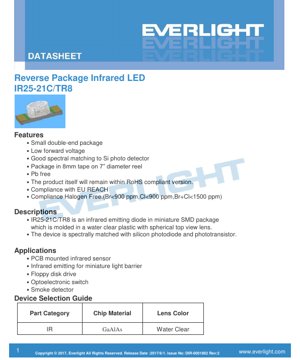
The IR25-21C/TR8 is a miniature surface-mount device (SMD) infrared emitting diode. It features a reverse package design molded in water-clear plastic with a spherical top lens. The primary function of this component is to emit infrared light, with its spectral output specifically matched to silicon photodiodes and phototransistors, making it an ideal source for various sensing applications.
Key advantages of this LED include its compact double-ended package, which facilitates PCB mounting and integration into space-constrained designs. It operates at a low forward voltage, contributing to energy efficiency. The device is compliant with major environmental and safety standards, including RoHS, EU REACH, and is halogen-free, ensuring its suitability for modern electronic manufacturing.
1.1 Device Selection Guide
The IR25-21C/TR8 belongs to the Infrared (IR) LED category. It utilizes a Gallium Aluminum Arsenide (GaAlAs) chip material, which is known for efficient infrared emission. The lens is water-clear, allowing for maximum transmission of the infrared light without color filtering.
2. Technical Specifications and Objective Interpretation
2.1 Absolute Maximum Ratings
The device's operational limits are defined under standard ambient temperature (Ta=25°C). Exceeding these ratings may cause permanent damage.
- Forward Current (IF): 100 mA - The maximum continuous current allowed through the LED.
- Reverse Voltage (VR): 5 V - The maximum voltage that can be applied in the reverse direction.
- Power Dissipation (Pd): 120 mW - The maximum power the package can dissipate as heat.
- Operating Temperature (Topr): -40°C to +85°C - The ambient temperature range for reliable operation.
- Storage Temperature (Tstg): -40°C to +85°C - The safe temperature range for storing the device when not powered.
- Soldering Temperature (Ts): 260°C for 5 seconds max - The peak temperature and duration the LED can withstand during reflow soldering.
2.2 Electro-Optical Characteristics
These parameters are measured at Ta=25°C and define the typical performance of the LED.
- Radiant Intensity (Ie): 40 mW/sr (Min) @ IF=20 mA - This is the optical power output per unit solid angle, a key measure of brightness for directional sources like LEDs.
- Peak Wavelength (λp): 940 nm (Typ.) - The wavelength at which the LED emits the most optical power. This aligns well with the peak sensitivity of common silicon photodetectors.
- Spectral Bandwidth (Δλ): 50 nm (Typ.) - The range of wavelengths emitted, measured at half the peak intensity (Full Width at Half Maximum).
- Forward Voltage (VF): 1.5 V (Typ.) @ IF=20 mA - The voltage drop across the LED when operating at the specified current. The low value is beneficial for low-voltage circuits.
- Viewing Angle (2θ1/2): ±20° (Typ.) - The angular span where the radiant intensity is at least half of the peak intensity. This defines the beam's width.
3. Performance Curve Analysis
The datasheet provides several graphs illustrating the device's behavior under different conditions.
3.1 Forward Current vs. Ambient Temperature
Figure 1 shows the derating of the maximum allowable forward current as ambient temperature increases. To prevent overheating, the current must be reduced when operating above 25°C. This curve is critical for thermal management design.
3.2 Spectral Distribution
Figure 2 plots relative intensity against wavelength, confirming the peak at approximately 940 nm and the ~50 nm bandwidth. This match with silicon detector responsivity (which peaks around 900-1000 nm) maximizes signal strength in sensor systems.
3.3 Relative Intensity vs. Forward Current
Figure 3 demonstrates the relationship between optical output and drive current. The output increases with current but may become sub-linear at very high currents due to heating and efficiency droop. Operating within the recommended range ensures stable performance.
3.4 Forward Current vs. Forward Voltage
Figure 4 is the I-V characteristic curve. It shows the exponential relationship typical of a diode. The curve highlights the importance of using a current-limiting resistor or constant-current driver, as a small increase in voltage beyond the knee point causes a large, potentially destructive, increase in current.
3.5 Angular Displacement
Figure 5 plots the relative radiant intensity against the angle from the central axis, defining the spatial emission pattern (Lambertian or otherwise). This is essential for optical design, determining how light is distributed in the target area.
4. Mechanical and Packaging Information
4.1 Package Dimensions
The LED has a compact SMD footprint. Key dimensions include a body size of approximately 2.0mm x 1.25mm, with a height of around 0.8mm. Detailed drawings specify pad layout, terminal spacing, and lens geometry. Tolerances are typically ±0.1mm unless otherwise noted. A suggested land pattern (pad layout) is provided for PCB design but should be optimized based on specific manufacturing processes and thermal requirements.
4.2 Polarity Identification
The component features a reverse package. Polarity is indicated by a mark on the body or by the shape of the package footprint. Correct orientation is crucial for circuit operation.
4.3 Carrier Taping Dimensions
The device is supplied on 8mm wide embossed carrier tape wound on a 7-inch diameter reel. The tape pitch and pocket dimensions are specified to ensure compatibility with automated pick-and-place assembly equipment. Each reel contains 2000 pieces.
5. Soldering and Assembly Guidelines
5.1 Storage and Handling
The LEDs are moisture-sensitive (MSL). Unopened moisture barrier bags must be stored below 30°C and 90% RH. Once opened, the "floor life" is 168 hours (7 days) when stored at ≤60% RH. Exceeding this requires baking (e.g., 96 hours at 60°C) before reflow to prevent "popcorning" damage during soldering.
5.2 Reflow Soldering Profile
A lead-free (Pb-free) reflow temperature profile is recommended. Key parameters include a preheat zone, a gradual temperature ramp, a peak temperature not exceeding 260°C for a maximum of 5 seconds, and a controlled cooling phase. Reflow should not be performed more than two times on the same device.
5.3 Hand Soldering and Rework
If manual soldering is necessary, a soldering iron with a tip temperature below 350°C and power below 25W should be used. Contact time per terminal must be less than 3 seconds. For rework, a dual-head soldering iron is suggested to simultaneously heat both terminals and avoid mechanical stress. The impact on device characteristics should be verified after any rework.
5.4 Critical Precautions
- Current Protection: An external series resistor is mandatory to limit forward current. The steep I-V curve means minor voltage fluctuations can cause catastrophic overcurrent.
- Mechanical Stress: Avoid applying force to the LED body during or after soldering. Do not bend the PCB in the vicinity of the mounted LED.
6. Application Suggestions and Design Considerations
6.1 Typical Application Scenarios
- PCB-Mounted Infrared Sensors: Used as the light source in proximity sensors, object detection, and position encoding.
- Miniature Light Barriers/Optical Switches: Paired with a photodetector to create an interruptible beam for counting, safety curtains, or limit switches.
- Floppy Disk Drives (Legacy): Historically used for track detection.
- Smoke Detectors: Employed in obscuration-type detectors where smoke particles scatter a beam of light.
6.2 Design Considerations
- Drive Circuit: Implement a constant current source or a voltage source with a precisely calculated current-limiting resistor (R = (Vsupply - VF) / IF).
- Optical Alignment: The ±20° viewing angle requires careful alignment with the receiving detector for optimal signal coupling, especially in narrow-beam applications.
- Thermal Management: Ensure adequate PCB copper area or thermal vias to dissipate heat, especially when driving at higher currents or in elevated ambient temperatures.
- Electrical Noise: In sensitive analog sensing circuits, consider shielding or modulating the LED drive signal to distinguish it from ambient light and electrical noise.
7. Technical Comparison and Differentiation
Compared to standard infrared LEDs, the IR25-21C/TR8's reverse package offers a potentially lower profile and a different radiation pattern. Its key differentiator is the specific spectral matching to silicon, which can yield higher signal-to-noise ratios in detector systems than LEDs with off-peak wavelengths. The compliance with halogen-free and modern environmental standards makes it suitable for green electronics initiatives.
8. Frequently Asked Questions (Based on Technical Parameters)
8.1 Why is a current-limiting resistor absolutely necessary?
The diode's exponential I-V characteristic means that beyond the forward voltage knee (around 1.5V), current increases dramatically with minimal voltage increase. Without a resistor to set the operating point, minor power supply variations or temperature changes can push the current beyond the 100mA maximum, instantly destroying the LED.
8.2 What does "spectral matching to Si photo detector" mean?
Silicon-based photodiodes and phototransistors have a specific responsivity curve; they are most sensitive to light around 800-1000 nm. This LED's peak emission at 940 nm falls directly within this high-sensitivity region, ensuring the detector converts the maximum amount of the LED's optical power into electrical current, improving system efficiency and range.
8.3 How critical is the 168-hour floor life?
It is very critical for reliable assembly. Moisture absorbed into the plastic package can vaporize rapidly during the high-temperature reflow soldering process, causing internal delamination, cracks, or bond wire damage ("popcorning"). Adhering to the floor life or performing proper baking prevents this failure mode.
9. Practical Use Case Example
Designing a Paper Sheet Counter: In an office machine, the IR25-21C/TR8 can be mounted on one side of a paper path, directly facing a phototransistor on the other side. When no paper is present, the infrared beam reaches the detector, generating a high signal. When a sheet of paper passes through, it interrupts the beam, causing the detector signal to drop. This event is counted by a microcontroller. The 940nm wavelength is invisible and unaffected by ambient room light. The low forward voltage allows the system to be powered by a 3.3V or 5V logic supply, with a simple series resistor (e.g., (5V - 1.5V)/0.02A = 175Ω) setting the LED current to a safe 20mA.
10. Operating Principle Introduction
An Infrared Light Emitting Diode (IR LED) is a semiconductor p-n junction diode. When forward biased, electrons from the n-region and holes from the p-region are injected into the junction region. When these charge carriers recombine, they release energy. In a GaAlAs material system, this energy is released primarily as photons (light particles) in the infrared spectrum (wavelengths longer than visible red light, typically 700nm to 1mm). The specific composition of the Gallium, Aluminum, and Arsenide layers determines the peak emission wavelength. The water-clear epoxy package acts as a lens, shaping the emitted light into a defined beam pattern.
11. Industry Trends and Developments
The trend in optoelectronics for sensing continues toward miniaturization, higher efficiency, and integration. While discrete LEDs like the IR25-21C/TR8 remain vital for flexibility and performance, there is a growing market for integrated sensor modules that combine the emitter, detector, and signal conditioning circuitry in a single package. These modules simplify design but may offer less optimization for specific applications. Another trend is the demand for higher-speed modulation for data communication applications (like IR remote controls), which requires LEDs with fast rise/fall times. Environmental compliance (RoHS, REACH, halogen-free) has become a standard requirement rather than a differentiator. The underlying technology for efficient infrared emission continues to be refined, with research into new material systems like InGaN for different wavelength ranges.
LED Specification Terminology
Complete explanation of LED technical terms
Photoelectric Performance
| Term | Unit/Representation | Simple Explanation | Why Important |
|---|---|---|---|
| Luminous Efficacy | lm/W (lumens per watt) | Light output per watt of electricity, higher means more energy efficient. | Directly determines energy efficiency grade and electricity cost. |
| Luminous Flux | lm (lumens) | Total light emitted by source, commonly called "brightness". | Determines if the light is bright enough. |
| Viewing Angle | ° (degrees), e.g., 120° | Angle where light intensity drops to half, determines beam width. | Affects illumination range and uniformity. |
| CCT (Color Temperature) | K (Kelvin), e.g., 2700K/6500K | Warmth/coolness of light, lower values yellowish/warm, higher whitish/cool. | Determines lighting atmosphere and suitable scenarios. |
| CRI / Ra | Unitless, 0–100 | Ability to render object colors accurately, Ra≥80 is good. | Affects color authenticity, used in high-demand places like malls, museums. |
| SDCM | MacAdam ellipse steps, e.g., "5-step" | Color consistency metric, smaller steps mean more consistent color. | Ensures uniform color across same batch of LEDs. |
| Dominant Wavelength | nm (nanometers), e.g., 620nm (red) | Wavelength corresponding to color of colored LEDs. | Determines hue of red, yellow, green monochrome LEDs. |
| Spectral Distribution | Wavelength vs intensity curve | Shows intensity distribution across wavelengths. | Affects color rendering and quality. |
Electrical Parameters
| Term | Symbol | Simple Explanation | Design Considerations |
|---|---|---|---|
| Forward Voltage | Vf | Minimum voltage to turn on LED, like "starting threshold". | Driver voltage must be ≥Vf, voltages add up for series LEDs. |
| Forward Current | If | Current value for normal LED operation. | Usually constant current drive, current determines brightness & lifespan. |
| Max Pulse Current | Ifp | Peak current tolerable for short periods, used for dimming or flashing. | Pulse width & duty cycle must be strictly controlled to avoid damage. |
| Reverse Voltage | Vr | Max reverse voltage LED can withstand, beyond may cause breakdown. | Circuit must prevent reverse connection or voltage spikes. |
| Thermal Resistance | Rth (°C/W) | Resistance to heat transfer from chip to solder, lower is better. | High thermal resistance requires stronger heat dissipation. |
| ESD Immunity | V (HBM), e.g., 1000V | Ability to withstand electrostatic discharge, higher means less vulnerable. | Anti-static measures needed in production, especially for sensitive LEDs. |
Thermal Management & Reliability
| Term | Key Metric | Simple Explanation | Impact |
|---|---|---|---|
| Junction Temperature | Tj (°C) | Actual operating temperature inside LED chip. | Every 10°C reduction may double lifespan; too high causes light decay, color shift. |
| Lumen Depreciation | L70 / L80 (hours) | Time for brightness to drop to 70% or 80% of initial. | Directly defines LED "service life". |
| Lumen Maintenance | % (e.g., 70%) | Percentage of brightness retained after time. | Indicates brightness retention over long-term use. |
| Color Shift | Δu′v′ or MacAdam ellipse | Degree of color change during use. | Affects color consistency in lighting scenes. |
| Thermal Aging | Material degradation | Deterioration due to long-term high temperature. | May cause brightness drop, color change, or open-circuit failure. |
Packaging & Materials
| Term | Common Types | Simple Explanation | Features & Applications |
|---|---|---|---|
| Package Type | EMC, PPA, Ceramic | Housing material protecting chip, providing optical/thermal interface. | EMC: good heat resistance, low cost; Ceramic: better heat dissipation, longer life. |
| Chip Structure | Front, Flip Chip | Chip electrode arrangement. | Flip chip: better heat dissipation, higher efficacy, for high-power. |
| Phosphor Coating | YAG, Silicate, Nitride | Covers blue chip, converts some to yellow/red, mixes to white. | Different phosphors affect efficacy, CCT, and CRI. |
| Lens/Optics | Flat, Microlens, TIR | Optical structure on surface controlling light distribution. | Determines viewing angle and light distribution curve. |
Quality Control & Binning
| Term | Binning Content | Simple Explanation | Purpose |
|---|---|---|---|
| Luminous Flux Bin | Code e.g., 2G, 2H | Grouped by brightness, each group has min/max lumen values. | Ensures uniform brightness in same batch. |
| Voltage Bin | Code e.g., 6W, 6X | Grouped by forward voltage range. | Facilitates driver matching, improves system efficiency. |
| Color Bin | 5-step MacAdam ellipse | Grouped by color coordinates, ensuring tight range. | Guarantees color consistency, avoids uneven color within fixture. |
| CCT Bin | 2700K, 3000K etc. | Grouped by CCT, each has corresponding coordinate range. | Meets different scene CCT requirements. |
Testing & Certification
| Term | Standard/Test | Simple Explanation | Significance |
|---|---|---|---|
| LM-80 | Lumen maintenance test | Long-term lighting at constant temperature, recording brightness decay. | Used to estimate LED life (with TM-21). |
| TM-21 | Life estimation standard | Estimates life under actual conditions based on LM-80 data. | Provides scientific life prediction. |
| IESNA | Illuminating Engineering Society | Covers optical, electrical, thermal test methods. | Industry-recognized test basis. |
| RoHS / REACH | Environmental certification | Ensures no harmful substances (lead, mercury). | Market access requirement internationally. |
| ENERGY STAR / DLC | Energy efficiency certification | Energy efficiency and performance certification for lighting. | Used in government procurement, subsidy programs, enhances competitiveness. |