Table of Contents
- 1. Product Overview
- 1.1 Core Advantages and Target Market
- 2. Technical Parameter Deep Dive
- 2.1 Absolute Maximum Ratings
- 2.2 Electro-Optical Characteristics
- 3. Binning System Explanation
- 4. Performance Curve Analysis
- 4.1 Spectrum Distribution
- 4.2 Forward Current vs. Forward Voltage (IV Curve)
- 4.3 Forward Current Derating Curve
- 5. Mechanical and Package Information
- 5.1 Package Dimensions and Drawing
- 5.2 Internal Circuit Diagram and Polarity
- 6. Soldering and Assembly Guidelines
- 7. Packaging and Ordering Information
- 7.1 Packaging Specification
- 7.2 Label Explanation
- 8. Application Design Suggestions
- 8.1 Typical Application Circuits
- 8.2 Design Considerations and Notes
- 9. Technical Comparison and Differentiation
- 10. Frequently Asked Questions (Based on Technical Parameters)
- 11. Practical Application Example
- 12. Operating Principle Introduction
- 13. Technology Trends and Context
- LED Specification Terminology
- Photoelectric Performance
- Electrical Parameters
- Thermal Management & Reliability
- Packaging & Materials
- Quality Control & Binning
- Testing & Certification
1. Product Overview
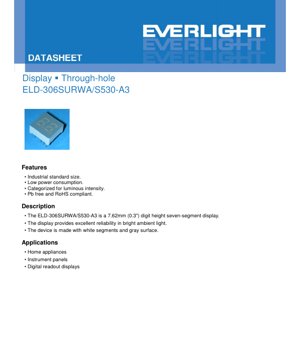
This document details the technical specifications for a 7.62mm (0.3 inch) digit height, seven-segment alphanumeric display. The device is designed for through-hole mounting (THT) and features white light-emitting segments against a gray background surface. This combination provides high contrast and excellent readability, making it suitable for applications where clear numeric or limited alphanumeric information needs to be displayed under various lighting conditions.
1.1 Core Advantages and Target Market
The primary advantages of this display include its compliance with industrial standard sizing, which ensures compatibility with existing panel cutouts and designs. It offers low power consumption, contributing to energy-efficient end products. The device is categorized (binned) for luminous intensity, allowing for consistent brightness across multiple units in an assembly. Furthermore, it is constructed using lead-free (Pb-free) materials and is compliant with the RoHS (Restriction of Hazardous Substances) directive, meeting modern environmental and regulatory standards.
The target applications are broad and include home appliances, various instrument panels, and general-purpose digital readout displays. Its reliability in bright ambient light makes it a robust choice for both consumer and industrial interfaces.
2. Technical Parameter Deep Dive
This section provides a detailed, objective analysis of the device's electrical, optical, and thermal characteristics as defined by its absolute maximum ratings and typical operating parameters.
2.1 Absolute Maximum Ratings
These ratings define the limits beyond which permanent damage to the device may occur. They are not conditions for normal operation.
- Reverse Voltage (VR): 5V. Exceeding this voltage in the reverse direction can cause junction breakdown.
- Continuous Forward Current (IF): 25mA. This is the maximum DC current that can be applied continuously through the LED segment.
- Peak Forward Current (IFP): 60mA. This higher current is permissible only under pulsed conditions, specifically at a duty cycle of 1/10 and a frequency of 1kHz. It allows for brief periods of higher brightness, for example in multiplexed displays.
- Power Dissipation (Pd): 60mW. This is the maximum power the device can dissipate as heat, calculated as Forward Voltage (VF) multiplied by Forward Current (IF).
- Operating Temperature (Topr): -40°C to +85°C. The device is guaranteed to function within this ambient temperature range.
- Storage Temperature (Tstg): -40°C to +100°C. The device can be stored without operation within this wider range.
- Soldering Temperature (Tsol): 260°C for a maximum of 5 seconds. This defines the wave or reflow soldering profile limit to prevent damage to the plastic package and internal bonds.
2.2 Electro-Optical Characteristics
These parameters are measured at a standard ambient temperature of 25°C and define the typical performance of the device under normal operating conditions.
- Luminous Intensity (Iv): The typical value is 6.4 millicandelas (mcd) per segment when driven at a forward current (IF) of 10mA. The minimum specified value is 4.0 mcd. The datasheet notes a tolerance of ±10% on this parameter. The value is an average measured across one representative 7-segment character.
- Peak Wavelength (λp): 632 nanometers (nm) typical at IF=20mA. This is the wavelength at which the spectral power distribution of the emitted white light is at its maximum. The white color is achieved using a chip material of AlGaInP (for red/orange emission) combined with a white diffusion resin, which likely contains phosphors to broaden the spectrum.
- Dominant Wavelength (λd): 624 nm typical at IF=20mA. This is the single wavelength of monochromatic light that matches the perceived color of the source most closely. The difference between peak and dominant wavelength indicates the spectral shape is not perfectly symmetrical.
- Spectral Radiation Bandwidth (Δλ): 20 nm typical. This quantifies the width of the emitted spectrum at half of its maximum power (Full Width at Half Maximum - FWHM).
- Forward Voltage (VF): 2.0V typical, with a maximum of 2.4V at IF=20mA. A tolerance of ±0.1V is noted. This parameter is critical for designing the current-limiting circuitry (usually a series resistor).
- Reverse Current (IR): Maximum of 100 µA at a reverse bias voltage (VR) of 5V. This is the small leakage current that flows when the device is reverse-biased within its maximum rating.
3. Binning System Explanation
The datasheet indicates that the devices are \"Categorized for luminous intensity.\" This refers to a binning or sorting process post-manufacturing. Due to natural variations in the semiconductor fabrication and assembly process, individual LEDs will have slightly different performance. To ensure consistency for the end-user, manufacturers measure the luminous output of each unit and sort them into groups (bins) with tight tolerances around a target value (e.g., 6.4 mcd ±10%). This allows designers to source displays that will have uniform brightness across all digits in a multi-digit assembly, which is crucial for aesthetic and readability purposes. The specific bin codes or categories are likely detailed in separate ordering information.
4. Performance Curve Analysis
The datasheet references typical performance curves which provide a graphical representation of how key parameters change with operating conditions.
4.1 Spectrum Distribution
The spectrum distribution curve (at Ta=25°C) would show the relative luminous intensity plotted against wavelength (λp in nm). For this white LED display, the curve would not be a single narrow spike but a broader spectrum, peaking around 632 nm due to the underlying AlGaInP chip, with additional emission in other wavelengths provided by the phosphors in the white diffusion resin to create the white appearance. The 20 nm bandwidth indicates the width of the primary emission peak.
4.2 Forward Current vs. Forward Voltage (IV Curve)
This curve plots Forward Current (IF in mA) against Forward Voltage (VF in V) at 25°C. It demonstrates the exponential relationship characteristic of a diode. The curve is essential for understanding the dynamic resistance of the LED and for designing precise constant-current drivers, especially for applications requiring dimming or precise brightness control. The typical VF of 2.0V at 20mA is a point on this curve.
4.3 Forward Current Derating Curve
This is a critical graph for thermal management. It plots the maximum allowable continuous Forward Current (IF in mA) against the Ambient Temperature (°C). As the ambient temperature rises, the internal junction temperature of the LED increases. To prevent overheating and accelerated degradation (lumen depreciation) or failure, the maximum permissible current must be reduced. This curve provides the derating factor, showing how much the 25mA rating must be decreased for reliable operation at elevated temperatures (up to the maximum 85°C operating temperature).
5. Mechanical and Package Information
5.1 Package Dimensions and Drawing
The device features a standard through-hole DIP (Dual In-line Package) style. The package dimension drawing provides all critical mechanical measurements: overall height, width, and length; the digit window size and position; the lead (pin) spacing, diameter, and length; and the seating plane. The drawing specifies a general tolerance of ±0.25mm unless otherwise noted, with all dimensions provided in millimeters (mm). Accurate interpretation of this drawing is necessary for designing the PCB footprint, panel cutout, and ensuring proper alignment and mounting.
5.2 Internal Circuit Diagram and Polarity
The datasheet includes an internal circuit diagram. For a common-cathode seven-segment display (implied by the application), this diagram shows all eight LEDs (segments a through g, plus the decimal point DP) with their anodes connected to individual pins and their cathodes connected together to a common pin (or two pins internally tied). This diagram is essential for correctly wiring the display. The pinout, which identifies which pin controls which segment and the common connection, is defined in this section or the dimension drawing. Incorrect connection can prevent the display from lighting or cause permanent damage.
6. Soldering and Assembly Guidelines
The key soldering parameter provided is the maximum soldering temperature of 260°C for a duration not exceeding 5 seconds. This is typical for wave soldering processes. For manual soldering with an iron, care should be taken to minimize the heat exposure time on each pin to prevent melting the plastic package or damaging the internal wire bonds. The device should be stored within the specified -40°C to +100°C range in a dry environment prior to use. A critical note in the application restrictions emphasizes Electrostatic Discharge (ESD) sensitivity. The LED dice are susceptible to damage from static electricity. Recommended handling precautions include using grounded wrist straps, ESD-safe workstations and flooring, conductive mats, and proper grounding of all equipment. Ionizers can be used to neutralize charge on non-conductive materials.
7. Packaging and Ordering Information
7.1 Packaging Specification
The device follows a specific packing process: 32 pieces are mounted on a single plate (likely an anti-static tray or tape-and-reel). 64 of these plates are then packed into one box. Finally, 4 boxes are combined into a master shipping carton. Therefore, one full carton contains 32 x 64 x 4 = 8,192 pieces. This information is vital for logistics, inventory management, and production planning.
7.2 Label Explanation
The packing materials include labels with specific codes: CPN (Customer's Product Number), P/N (Manufacturer's Product Number, e.g., ELD-306SURWA/S530-A3), QTY (Packing Quantity), CAT (Luminous Intensity Rank or bin category), HUE (color reference), REF (general reference), LOT No (traceable manufacturing lot number), and a REFERENCE volume label code. Understanding these labels is important for correct part identification, quality traceability, and ensuring the received components match the ordered specification, particularly the luminous intensity bin (CAT).
8. Application Design Suggestions
8.1 Typical Application Circuits
In a typical application, each segment anode pin is connected to a microcontroller I/O pin or a driver IC (like a 74HC595 shift register or a dedicated LED driver) through a current-limiting resistor. The value of this resistor is calculated using Ohm's Law: R = (Vsupply - VF) / IF. For a 5V supply, a VF of 2.0V, and a desired IF of 10mA, the resistor would be (5 - 2.0) / 0.01 = 300 Ohms. The common cathode pin(s) are connected to ground. For multiplexing multiple digits, the common cathodes are switched by transistors, and the segment data is presented sequentially at a high frequency.
8.2 Design Considerations and Notes
- Current Limiting: Always use a series resistor or constant-current driver. Connecting the LED directly to a voltage source will cause excessive current and immediate failure.
- Heat Dissipation: Observe the derating curve for high-temperature environments. Adequate ventilation around the display may be necessary in enclosed spaces.
- Viewing Angle: While not specified in this datasheet, the gray background and diffused resin typically provide a wide viewing angle. Confirm if specific viewing angle data is needed for the application.
- ESD Protection: Implement ESD protection diodes on input lines if the display is in a user-accessible area, and follow the ESD handling guidelines during assembly.
9. Technical Comparison and Differentiation
Compared to generic, uncategorized displays, the key differentiator of this product is the luminous intensity binning, ensuring brightness uniformity. Compared to surface-mount device (SMD) alternatives, this through-hole version offers superior mechanical strength for applications subject to vibration or physical stress, and easier manual assembly or prototyping. The use of AlGaInP chip material combined with a white diffusion resin typically offers good color stability and longevity compared to older technologies. The specified operating temperature range of -40°C to +85°C is robust and suitable for industrial and automotive environments, unlike many consumer-grade displays with a narrower range like 0°C to 70°C.
10. Frequently Asked Questions (Based on Technical Parameters)
Q: Can I drive this display with 20mA continuously on all segments simultaneously?
A: Yes, but you must consider total power dissipation. With a VF of 2.0V and IF of 20mA, one segment dissipates 40mW. With all 8 segments (7+DP) on, the total could be 320mW, which exceeds the device's absolute maximum power dissipation rating of 60mW. Therefore, you cannot illuminate all segments continuously at 20mA. You must either reduce the current per segment or use multiplexing, where segments are lit one at a time very quickly, keeping the instantaneous power within limits.
Q: What is the difference between Peak Wavelength (632nm) and the white appearance?
A: The peak wavelength refers to the dominant color emitted by the LED chip itself (AlGaInP, red/orange). The white color is created by coating this chip with a phosphor-containing white diffusion resin. The phosphor absorbs some of the blue/green light from the chip and re-emits a broader spectrum of light, mixing with the chip's emission to produce white light to the human eye. The 632nm peak is a remnant of the underlying chip's emission.
Q: How do I identify the common cathode pin?
A> The internal circuit diagram in the datasheet is definitive. Typically, for a common-cathode display, using a multimeter in diode test mode, placing the red probe on a segment pin and the black probe on different pins will light the segment when the black probe is on the common cathode. The pinout in the dimension drawing will label this pin (often as \"CC\" or \"Com. Cath.\").
11. Practical Application Example
Scenario: Designing a 4-digit temperature readout for an industrial oven.
1. Circuit Design: Use a microcontroller with sufficient I/O pins or a shift register to control the 7 segment lines (8 with DP). Use four NPN transistors (e.g., 2N3904) to switch the common cathode of each digit to ground. The microcontroller will multiplex the display: it turns on transistor for Digit 1, sends the segment pattern for the first digit, waits a short time (1-5ms), turns off Digit 1, turns on Digit 2, sends the second digit's pattern, and so on, cycling rapidly.
2. Component Calculation: For a 5V system and a target segment current of 10mA for good brightness, calculate the series resistor: R = (5V - 2.0V) / 0.01A = 300Ω. Use 330Ω as a standard value, resulting in IF ≈ 9.1mA.
3. Thermal Consideration: The oven ambient may reach 70°C. Consult the forward current derating curve. The maximum allowable continuous current at 70°C might be derated to, for example, 18mA. Since we are using 9.1mA and multiplexing (duty cycle of 1/4 for each digit), the effective average current per segment is even lower, ensuring reliable operation.
4. PCB Layout: Follow the package dimension drawing precisely for the footprint. Ensure the panel cutout matches the display's bezel size. Place current-limiting resistors and driver transistors close to the display connectors to minimize noise.
12. Operating Principle Introduction
A seven-segment display is an assembly of seven (or eight, including a decimal point) light-emitting diodes (LEDs) arranged in a figure-eight pattern. Each LED forms one segment (labeled a through g). By selectively illuminating specific combinations of these segments, all decimal digits (0-9) and some letters (like A, C, E, F) can be formed. In a common-cathode configuration, all the cathodes (negative sides) of the LEDs are connected internally to one or more common pins. To light a segment, a positive voltage (through a current-limiting resistor) is applied to its individual anode pin, while the common cathode pin is connected to ground (0V). This allows independent control of each segment. The white light emission principle involves electroluminescence in a semiconductor chip (AlGaInP), where electrons recombine with holes across a bandgap, releasing energy as photons. The color of these photons is then modified by a phosphor layer to produce white light.
13. Technology Trends and Context
While through-hole displays like this one remain vital for reliability, serviceability, and high-power/industrial applications, the overall trend in electronics is toward miniaturization and automated assembly, favoring surface-mount technology (SMT). SMD seven-segment displays offer smaller footprints, lower profile, and are better suited for high-speed pick-and-place manufacturing. Furthermore, there is a growing adoption of dot-matrix displays and OLEDs, which offer greater flexibility in displaying graphics and alphanumeric characters beyond the limited set of a 7-segment device. However, for simple, bright, low-cost numeric readouts, especially in harsh environments or where through-hole mounting is preferred for mechanical reasons, displays of this type continue to have a strong and enduring market position. The integration of driver ICs directly into the display module (intelligent displays) is another trend, simplifying the interface for the host microcontroller.
LED Specification Terminology
Complete explanation of LED technical terms
Photoelectric Performance
| Term | Unit/Representation | Simple Explanation | Why Important |
|---|---|---|---|
| Luminous Efficacy | lm/W (lumens per watt) | Light output per watt of electricity, higher means more energy efficient. | Directly determines energy efficiency grade and electricity cost. |
| Luminous Flux | lm (lumens) | Total light emitted by source, commonly called "brightness". | Determines if the light is bright enough. |
| Viewing Angle | ° (degrees), e.g., 120° | Angle where light intensity drops to half, determines beam width. | Affects illumination range and uniformity. |
| CCT (Color Temperature) | K (Kelvin), e.g., 2700K/6500K | Warmth/coolness of light, lower values yellowish/warm, higher whitish/cool. | Determines lighting atmosphere and suitable scenarios. |
| CRI / Ra | Unitless, 0–100 | Ability to render object colors accurately, Ra≥80 is good. | Affects color authenticity, used in high-demand places like malls, museums. |
| SDCM | MacAdam ellipse steps, e.g., "5-step" | Color consistency metric, smaller steps mean more consistent color. | Ensures uniform color across same batch of LEDs. |
| Dominant Wavelength | nm (nanometers), e.g., 620nm (red) | Wavelength corresponding to color of colored LEDs. | Determines hue of red, yellow, green monochrome LEDs. |
| Spectral Distribution | Wavelength vs intensity curve | Shows intensity distribution across wavelengths. | Affects color rendering and quality. |
Electrical Parameters
| Term | Symbol | Simple Explanation | Design Considerations |
|---|---|---|---|
| Forward Voltage | Vf | Minimum voltage to turn on LED, like "starting threshold". | Driver voltage must be ≥Vf, voltages add up for series LEDs. |
| Forward Current | If | Current value for normal LED operation. | Usually constant current drive, current determines brightness & lifespan. |
| Max Pulse Current | Ifp | Peak current tolerable for short periods, used for dimming or flashing. | Pulse width & duty cycle must be strictly controlled to avoid damage. |
| Reverse Voltage | Vr | Max reverse voltage LED can withstand, beyond may cause breakdown. | Circuit must prevent reverse connection or voltage spikes. |
| Thermal Resistance | Rth (°C/W) | Resistance to heat transfer from chip to solder, lower is better. | High thermal resistance requires stronger heat dissipation. |
| ESD Immunity | V (HBM), e.g., 1000V | Ability to withstand electrostatic discharge, higher means less vulnerable. | Anti-static measures needed in production, especially for sensitive LEDs. |
Thermal Management & Reliability
| Term | Key Metric | Simple Explanation | Impact |
|---|---|---|---|
| Junction Temperature | Tj (°C) | Actual operating temperature inside LED chip. | Every 10°C reduction may double lifespan; too high causes light decay, color shift. |
| Lumen Depreciation | L70 / L80 (hours) | Time for brightness to drop to 70% or 80% of initial. | Directly defines LED "service life". |
| Lumen Maintenance | % (e.g., 70%) | Percentage of brightness retained after time. | Indicates brightness retention over long-term use. |
| Color Shift | Δu′v′ or MacAdam ellipse | Degree of color change during use. | Affects color consistency in lighting scenes. |
| Thermal Aging | Material degradation | Deterioration due to long-term high temperature. | May cause brightness drop, color change, or open-circuit failure. |
Packaging & Materials
| Term | Common Types | Simple Explanation | Features & Applications |
|---|---|---|---|
| Package Type | EMC, PPA, Ceramic | Housing material protecting chip, providing optical/thermal interface. | EMC: good heat resistance, low cost; Ceramic: better heat dissipation, longer life. |
| Chip Structure | Front, Flip Chip | Chip electrode arrangement. | Flip chip: better heat dissipation, higher efficacy, for high-power. |
| Phosphor Coating | YAG, Silicate, Nitride | Covers blue chip, converts some to yellow/red, mixes to white. | Different phosphors affect efficacy, CCT, and CRI. |
| Lens/Optics | Flat, Microlens, TIR | Optical structure on surface controlling light distribution. | Determines viewing angle and light distribution curve. |
Quality Control & Binning
| Term | Binning Content | Simple Explanation | Purpose |
|---|---|---|---|
| Luminous Flux Bin | Code e.g., 2G, 2H | Grouped by brightness, each group has min/max lumen values. | Ensures uniform brightness in same batch. |
| Voltage Bin | Code e.g., 6W, 6X | Grouped by forward voltage range. | Facilitates driver matching, improves system efficiency. |
| Color Bin | 5-step MacAdam ellipse | Grouped by color coordinates, ensuring tight range. | Guarantees color consistency, avoids uneven color within fixture. |
| CCT Bin | 2700K, 3000K etc. | Grouped by CCT, each has corresponding coordinate range. | Meets different scene CCT requirements. |
Testing & Certification
| Term | Standard/Test | Simple Explanation | Significance |
|---|---|---|---|
| LM-80 | Lumen maintenance test | Long-term lighting at constant temperature, recording brightness decay. | Used to estimate LED life (with TM-21). |
| TM-21 | Life estimation standard | Estimates life under actual conditions based on LM-80 data. | Provides scientific life prediction. |
| IESNA | Illuminating Engineering Society | Covers optical, electrical, thermal test methods. | Industry-recognized test basis. |
| RoHS / REACH | Environmental certification | Ensures no harmful substances (lead, mercury). | Market access requirement internationally. |
| ENERGY STAR / DLC | Energy efficiency certification | Energy efficiency and performance certification for lighting. | Used in government procurement, subsidy programs, enhances competitiveness. |