1. Product Overview
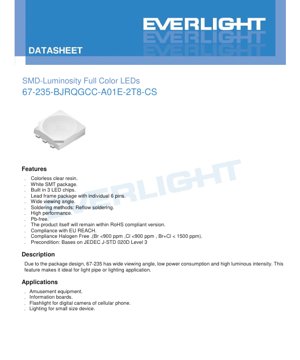
The 67-235 is a surface-mount device (SMD) full-color LED designed for applications requiring compact size, high brightness, and color mixing capabilities. It integrates three individual LED chips (Red, Green, Blue) within a single, colorless clear resin package, enabling the generation of a wide spectrum of colors. The device features a white SMT package with a lead frame and six individual pins for independent control of each color channel. Its primary advantages include a wide viewing angle, low power consumption, and high luminous intensity, making it suitable for backlighting and indicator applications in space-constrained electronic devices.
1.1 Core Features and Compliance
- Package: White SMT, colorless clear resin.
- Chip Configuration: Built-in 3 LED chips (Red RQ, Green GC, Blue BJ).
- Electrical Interface: Lead frame package with individual 6 pins.
- Optical Performance: Wide viewing angle, high luminous intensity.
- Manufacturing: Compatible with reflow soldering processes.
- Environmental Compliance: Pb-free, RoHS compliant, compliant with EU REACH regulations.
- Halogen Free: Bromine (Br) <900 ppm, Chlorine (Cl) <900 ppm, Br+Cl < 1500 ppm.
- Preconditioning: Based on JEDEC J-STD-020D Level 3.
1.2 Target Applications
This LED is ideal for applications where space, efficiency, and color capability are critical. Typical use cases include amusement equipment, information boards and signage, flashlight modules for digital cameras or cellular phones, and general lighting for small electronic devices. Its design is particularly well-suited for use with light pipes.
2. Technical Parameters: In-Depth Objective Interpretation
2.1 Absolute Maximum Ratings
These ratings define the limits beyond which permanent damage to the device may occur. Operation under or at these conditions is not guaranteed.
- Reverse Voltage (VR): 12V for Red (RQ), 5V for Green (GC) and Blue (BJ).
- Forward Current (IF): 50mA for RQ, 30mA for GC and BJ.
- Peak Forward Current (IFP): 100mA (Duty 1/10 @1KHz).
- Power Dissipation (Pd): 120mW for RQ, 110mW for GC/BJ.
- Thermal Limits: Junction Temperature (Tj) max 125°C. Operating Temperature (Topr) range -40°C to +100°C. Storage Temperature (Tstg) range -40°C to +110°C.
- Thermal Resistance (Rth): Junction-to-Ambient is 500 K/W (RQ) and 600 K/W (GC/BJ). Junction-to-Solder Point is 300 K/W (RQ) and 400 K/W (GC/BJ).
- ESD Withstand: 2000V for RQ, 500V for GC/BJ (presumably Human Body Model).
- Soldering Temperature: Reflow soldering at 260°C for 30 seconds maximum. Hand soldering at 350°C for 3 seconds maximum.
2.2 Electro-Optical Characteristics (Ta=25°C)
These are the typical performance parameters measured under standard test conditions (Forward Current IF=20mA).
- Luminous Intensity (Iv): Red (RQ): 450-1400 mcd. Green (GC): 1120-2240 mcd. Blue (BJ): 225-450 mcd.
- Viewing Angle (2θ1/2): 120 degrees (typical).
- Wavelength: Peak Wavelength (λp): RQ~632nm, GC~518nm, BJ~468nm. Dominant Wavelength (λd): RQ 617.5-629.5nm, GC 525-535nm, BJ 465-475nm.
- Spectral Bandwidth (Δλ): RQ~20nm, GC~35nm, BJ~25nm.
- Forward Voltage (VF): RQ: 1.75-2.75V. GC/BJ: 2.75-3.65V.
- Reverse Current (IR): ≤10 μA at rated VR for all chips.
Note on Tolerances: Luminous Intensity ±11%, Dominant Wavelength ±1nm, Forward Voltage ±0.1V.
3. Binning System Explanation
The product is classified into bins based on key performance parameters to ensure consistency in mass production. Designers must specify the required bin codes when ordering.
3.1 Luminous Intensity Binning
Measured at IF=20mA. Codes range from lower to higher intensity.
- Red (RQ): U1 (450-560 mcd), U2 (560-710), V1 (710-900), V2 (900-1120), AA (1120-1400).
- Green (GC): AA (1120-1400 mcd), AB (1400-1800), BA (1800-2240).
- Blue (BJ): S2 (225-285 mcd), T1 (285-360), T2 (360-450).
3.2 Dominant Wavelength Binning
Defines the color point of each chip.
- Red (RQ): E4 (617.5-621.5 nm), E5 (621.5-625.5), E6 (625.5-629.5).
- Green (GC): Y (525-530 nm), Z (530-535).
- Blue (BJ): X (465-470 nm), Y (470-475).
3.3 Forward Voltage Binning
Important for driver design and power management.
- Red (RQ): 0 (1.75-1.95V), 1 (1.95-2.15), 2 (2.15-2.35), 3 (2.35-2.55), 4 (2.55-2.75).
- Green (GC) / Blue (BJ): 5 (2.75-3.05V), 6 (3.05-3.35), 7 (3.35-3.65).
4. Performance Curve Analysis
The datasheet provides typical characteristic curves which are essential for understanding device behavior under non-standard conditions.
4.1 Spectral Distribution
The curves show the relative light output as a function of wavelength for each chip. The Red chip (RQ) has a narrow bandwidth (~20nm) centered around 632nm. The Green (GC) has a broader bandwidth (~35nm) centered near 518nm, and the Blue (BJ) has a medium bandwidth (~25nm) near 468nm. This data is crucial for color mixing calculations and filter design.
4.2 Radiation Pattern
The diagram illustrates the spatial distribution of light, confirming the wide 120-degree viewing angle. The intensity is relatively uniform across the central viewing cone, which is beneficial for applications requiring even illumination.
4.3 Current-Voltage (I-V) Relationship
Separate curves for RQ, GC, and BJ show the non-linear relationship between forward current (IF) and forward voltage (VF). The curves demonstrate the typical exponential characteristic of a diode. The Red chip has a lower turn-on voltage (~1.8V) compared to the Green and Blue chips (~2.8V). This must be accounted for in circuit design, especially when driving the chips from a common voltage source.
4.4 Wavelength vs. Current and Intensity vs. Current
The Dominant Wavelength vs. Forward Current graphs show minimal shift with increasing current, indicating good color stability. The Relative Luminous Intensity vs. Forward Current graphs are approximately linear within the recommended operating range, but will saturate at higher currents due to thermal effects.
4.5 Derating and Thermal Management
The Max. Permissible Forward Current vs. Temperature graph is critical for reliability. It shows how the maximum safe operating current must be reduced as the ambient or solder point temperature increases. For example, at 100°C, the permissible current is significantly lower than at 25°C. Proper PCB layout for heat sinking is necessary to maintain performance and longevity.
5. Mechanical and Package Information
5.1 Package Dimensions
The LED has a compact SMD footprint. Key dimensions (in mm, tolerance ±0.1mm unless specified) are: Overall length 3.2mm, width 2.8mm, and height 1.9mm. The detailed drawing specifies pad locations, component outline, and pin identification (1 through 6). Pin 1 is typically the cathode for the Red chip, with other pins assigned to the anodes and cathodes of the Green and Blue chips. The exact pinout must be verified from the dimension diagram for correct PCB layout.
6. Soldering and Assembly Guidelines
6.1 Soldering Parameters
- Reflow Soldering (Recommended): Maximum peak temperature of 260°C for 30 seconds. A standard lead-free reflow profile is suitable.
- Hand Soldering: If necessary, iron temperature should not exceed 350°C, and contact time should be limited to 3 seconds per joint.
6.2 Handling and Storage Precautions
- These devices are sensitive to electrostatic discharge (ESD). Use standard ESD precautions during handling and assembly.
- Store in a dry environment. The moisture sensitivity level (MSL) is implied by the JEDEC J-STD-020D Level 3 preconditioning, which typically corresponds to MSL 3. This means the package can be exposed to floor conditions for up to 168 hours before it requires baking prior to reflow.
- Avoid mechanical stress on the lens during placement.
7. Packaging and Ordering Information
7.1 Moisture Resistant Packing
The devices are supplied in moisture-resistant packaging, such as tape and reel, to maintain shelf life and prevent moisture absorption.
7.2 Label Explanation
The reel label contains key information for traceability and verification: Customer's Product Number (CPN), Product Number (P/N), Packing Quantity (QTY), and the specific Binning Codes for Luminous Intensity (CAT), Dominant Wavelength (HUE), and Forward Voltage (REF). The LOT No. provides manufacturing traceability.
8. Application Suggestions and Design Considerations
8.1 Typical Application Circuits
Each color channel should be driven independently using a constant current source or a current-limiting resistor in series with a voltage source. Due to the different forward voltages, separate current-setting resistors are required for the Red channel and the combined Green/Blue channels if using a common voltage supply. Pulse-width modulation (PWM) is the recommended method for dimming and color mixing, as it maintains a constant forward current and thus stable color coordinates.
8.2 Thermal Design
Given the power dissipation (up to 120mW) and thermal resistance, the PCB acts as the primary heat sink. Use adequate copper area (thermal pads) connected to the LED's solder points, and consider using thermal vias to inner or bottom layers to improve heat dissipation, especially in high-current or high-ambient-temperature applications.
8.3 Optical Design
The wide viewing angle makes this LED suitable for applications requiring broad illumination. For light pipe applications, ensure the pipe entrance is properly aligned and sized to capture the emitted light cone. The clear resin allows for good color mixing when the chips are placed close to a diffusing surface.
9. Technical Comparison and Differentiation
The 67-235's key differentiators in its class are the integration of three distinct high-performance chips (AlGaInP for Red, InGaN for Green and Blue) in a very compact 3.2x2.8mm package, combined with a wide 120-degree viewing angle. Compared to simpler two-pin RGB LEDs, the six-pin configuration allows for fully independent control of each color, enabling a much wider gamut of colors and more sophisticated lighting effects. Its compliance with stringent environmental standards (RoHS, REACH, Halogen-Free) makes it suitable for global markets with strict regulations.
10. Frequently Asked Questions (Based on Technical Parameters)
10.1 Can I drive all three colors with the same current-limiting resistor?
No. The forward voltage (VF) of the Red chip (1.75-2.75V) is significantly lower than that of the Green and Blue chips (2.75-3.65V). Using a single resistor from a common voltage supply would result in excessive current through the Red chip or insufficient current for the Green/Blue chips, leading to incorrect color balance and potential overstress. Use separate current control for each channel.
10.2 What is the meaning of the bin codes (CAT, HUE, REF)?
These are quality classification codes. CAT refers to the Luminous Intensity bin (e.g., U1, AA). HUE refers to the Dominant Wavelength bin (e.g., E4, Y). REF refers to the Forward Voltage bin (e.g., 0, 5). Specifying bins ensures you receive LEDs with tightly grouped electrical and optical characteristics, which is vital for consistent performance in multi-LED arrays or color-critical applications.
10.3 How do I achieve white light with this RGB LED?
White light is created by mixing the three primary colors (Red, Green, Blue) in specific intensity ratios. The exact ratios depend on the target white point (e.g., cool white, warm white) and the specific spectral output of the individual LED bins. This typically requires calibration and drive electronics capable of fine-tuning the current to each channel. It is not a simple plug-and-play solution for white light without proper control circuitry.
11. Practical Design and Usage Case
Case: Status Indicator for a Portable Device
A designer needs a multi-color status indicator for a handheld medical device. Space is extremely limited. The 67-235 LED is selected. The Red channel is programmed to indicate a low-battery warning (flashing), the Green for normal operation (steady), and the Blue to show Bluetooth connectivity (pulsing). A small microcontroller with three PWM outputs drives the LED through simple transistor switches. The wide viewing angle ensures the status is visible from various angles without needing a complex lens. The low power consumption of each channel (20mA typical) helps conserve battery life. The six-pin design allows the microcontroller to control each color independently without extra multiplexing circuitry.
12. Operating Principle Introduction
Light Emitting Diodes (LEDs) are semiconductor devices that emit light when an electric current passes through them. This phenomenon is called electroluminescence. In the 67-235, three different semiconductor materials are used: AlGaInP (Aluminum Gallium Indium Phosphide) for the Red chip, and InGaN (Indium Gallium Nitride) for the Green and Blue chips. The specific composition of these materials determines the bandgap energy of the semiconductor, which directly dictates the wavelength (color) of the emitted light. When forward-biased, electrons and holes recombine in the active region of the semiconductor, releasing energy in the form of photons. The clear epoxy resin package serves to protect the delicate semiconductor chips, acts as a lens to shape the light output, and may contain phosphors (though not in this clear version) to modify the color.
13. Technology Trends and Context
The 67-235 represents a mature technology in the field of SMD RGB LEDs. Current trends in the industry are pushing towards several directions simultaneously: 1) Increased Efficiency and Luminance: New epitaxial structures and packaging techniques continue to improve lumen output per watt (efficacy). 2) Miniaturization: Even smaller package sizes (e.g., 2.0x1.6mm, 1.6x1.6mm) are becoming common for ultra-compact devices. 3) Improved Color Rendering and Gamut: Developments in phosphor-converted LEDs and direct-emission materials aim to expand the color gamut for displays and achieve higher Color Rendering Index (CRI) for lighting. 4) Integrated Intelligence: The market is seeing growth in LEDs with built-in control ICs (addressable RGB LEDs), simplifying system design. While the 67-235 is a discrete component, understanding these trends helps in selecting the right technology for future-proof designs, balancing cost, performance, and integration level.
LED Specification Terminology
Complete explanation of LED technical terms
Photoelectric Performance
| Term | Unit/Representation | Simple Explanation | Why Important |
|---|---|---|---|
| Luminous Efficacy | lm/W (lumens per watt) | Light output per watt of electricity, higher means more energy efficient. | Directly determines energy efficiency grade and electricity cost. |
| Luminous Flux | lm (lumens) | Total light emitted by source, commonly called "brightness". | Determines if the light is bright enough. |
| Viewing Angle | ° (degrees), e.g., 120° | Angle where light intensity drops to half, determines beam width. | Affects illumination range and uniformity. |
| CCT (Color Temperature) | K (Kelvin), e.g., 2700K/6500K | Warmth/coolness of light, lower values yellowish/warm, higher whitish/cool. | Determines lighting atmosphere and suitable scenarios. |
| CRI / Ra | Unitless, 0–100 | Ability to render object colors accurately, Ra≥80 is good. | Affects color authenticity, used in high-demand places like malls, museums. |
| SDCM | MacAdam ellipse steps, e.g., "5-step" | Color consistency metric, smaller steps mean more consistent color. | Ensures uniform color across same batch of LEDs. |
| Dominant Wavelength | nm (nanometers), e.g., 620nm (red) | Wavelength corresponding to color of colored LEDs. | Determines hue of red, yellow, green monochrome LEDs. |
| Spectral Distribution | Wavelength vs intensity curve | Shows intensity distribution across wavelengths. | Affects color rendering and quality. |
Electrical Parameters
| Term | Symbol | Simple Explanation | Design Considerations |
|---|---|---|---|
| Forward Voltage | Vf | Minimum voltage to turn on LED, like "starting threshold". | Driver voltage must be ≥Vf, voltages add up for series LEDs. |
| Forward Current | If | Current value for normal LED operation. | Usually constant current drive, current determines brightness & lifespan. |
| Max Pulse Current | Ifp | Peak current tolerable for short periods, used for dimming or flashing. | Pulse width & duty cycle must be strictly controlled to avoid damage. |
| Reverse Voltage | Vr | Max reverse voltage LED can withstand, beyond may cause breakdown. | Circuit must prevent reverse connection or voltage spikes. |
| Thermal Resistance | Rth (°C/W) | Resistance to heat transfer from chip to solder, lower is better. | High thermal resistance requires stronger heat dissipation. |
| ESD Immunity | V (HBM), e.g., 1000V | Ability to withstand electrostatic discharge, higher means less vulnerable. | Anti-static measures needed in production, especially for sensitive LEDs. |
Thermal Management & Reliability
| Term | Key Metric | Simple Explanation | Impact |
|---|---|---|---|
| Junction Temperature | Tj (°C) | Actual operating temperature inside LED chip. | Every 10°C reduction may double lifespan; too high causes light decay, color shift. |
| Lumen Depreciation | L70 / L80 (hours) | Time for brightness to drop to 70% or 80% of initial. | Directly defines LED "service life". |
| Lumen Maintenance | % (e.g., 70%) | Percentage of brightness retained after time. | Indicates brightness retention over long-term use. |
| Color Shift | Δu′v′ or MacAdam ellipse | Degree of color change during use. | Affects color consistency in lighting scenes. |
| Thermal Aging | Material degradation | Deterioration due to long-term high temperature. | May cause brightness drop, color change, or open-circuit failure. |
Packaging & Materials
| Term | Common Types | Simple Explanation | Features & Applications |
|---|---|---|---|
| Package Type | EMC, PPA, Ceramic | Housing material protecting chip, providing optical/thermal interface. | EMC: good heat resistance, low cost; Ceramic: better heat dissipation, longer life. |
| Chip Structure | Front, Flip Chip | Chip electrode arrangement. | Flip chip: better heat dissipation, higher efficacy, for high-power. |
| Phosphor Coating | YAG, Silicate, Nitride | Covers blue chip, converts some to yellow/red, mixes to white. | Different phosphors affect efficacy, CCT, and CRI. |
| Lens/Optics | Flat, Microlens, TIR | Optical structure on surface controlling light distribution. | Determines viewing angle and light distribution curve. |
Quality Control & Binning
| Term | Binning Content | Simple Explanation | Purpose |
|---|---|---|---|
| Luminous Flux Bin | Code e.g., 2G, 2H | Grouped by brightness, each group has min/max lumen values. | Ensures uniform brightness in same batch. |
| Voltage Bin | Code e.g., 6W, 6X | Grouped by forward voltage range. | Facilitates driver matching, improves system efficiency. |
| Color Bin | 5-step MacAdam ellipse | Grouped by color coordinates, ensuring tight range. | Guarantees color consistency, avoids uneven color within fixture. |
| CCT Bin | 2700K, 3000K etc. | Grouped by CCT, each has corresponding coordinate range. | Meets different scene CCT requirements. |
Testing & Certification
| Term | Standard/Test | Simple Explanation | Significance |
|---|---|---|---|
| LM-80 | Lumen maintenance test | Long-term lighting at constant temperature, recording brightness decay. | Used to estimate LED life (with TM-21). |
| TM-21 | Life estimation standard | Estimates life under actual conditions based on LM-80 data. | Provides scientific life prediction. |
| IESNA | Illuminating Engineering Society | Covers optical, electrical, thermal test methods. | Industry-recognized test basis. |
| RoHS / REACH | Environmental certification | Ensures no harmful substances (lead, mercury). | Market access requirement internationally. |
| ENERGY STAR / DLC | Energy efficiency certification | Energy efficiency and performance certification for lighting. | Used in government procurement, subsidy programs, enhances competitiveness. |