1. Product Overview
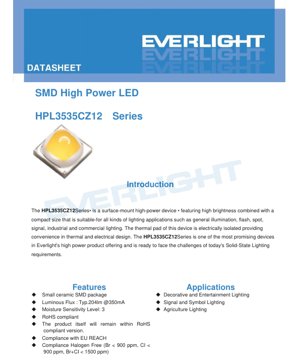
The HPL3535CZ12 Series is a surface-mount high-power LED device engineered for demanding lighting applications. It combines high luminous output with a compact ceramic package, making it a versatile component for modern solid-state lighting designs. A key feature is its electrically isolated thermal pad, which simplifies thermal management and electrical layout by allowing greater flexibility in PCB design. This series is positioned as a robust solution capable of meeting the stringent requirements of general, commercial, and specialized illumination.
1.1 Core Advantages and Target Market
The primary advantages of this LED include its small ceramic SMD form factor, which enhances reliability and thermal performance, and a high typical luminous flux of 204 lumens at 350mA. It is compliant with RoHS, EU REACH, and halogen-free standards, ensuring environmental and regulatory compatibility. The target markets are diverse, encompassing Decorative and Entertainment Lighting, Signal and Symbol Lighting, and Agriculture Lighting. Its performance characteristics make it suitable for applications requiring consistent, bright, and efficient light output in a reliable package.
2. In-Depth Technical Parameter Analysis
This section provides a detailed, objective interpretation of the key electrical, optical, and thermal parameters specified in the datasheet.
2.1 Absolute Maximum Ratings
The device is rated for a maximum continuous forward current (I_F) of 2000 mA, contingent on the thermal pad being maintained at 25°C. This highlights the critical importance of effective heat sinking in real-world applications to prevent performance degradation or failure. The peak pulse current rating is 2400 mA at a 1/10 duty cycle and 1 kHz. The maximum junction temperature (T_J) is 150°C, which is the ultimate limit for the semiconductor die. The operating temperature range is specified from -40°C to +105°C, indicating suitability for harsh environments. A low thermal resistance (R_th) of 3°C/W is specified for the LED itself, which is excellent for power dissipation but note this is the junction-to-pad resistance; system thermal resistance will be higher. The device can withstand a maximum soldering temperature of 260°C and is rated for a maximum of 2 reflow cycles, which is a standard rating for such components.
2.2 Photometric Characteristics
The datasheet provides detailed luminous flux data for different Correlated Color Temperatures (CCTs): 3000K, 4000K, 5000K, 5700K, and 6500K, all with a Color Rendering Index (CRI) of 70. The typical flux at 350mA and 25°C junction temperature ranges from 194 lm (3000K) to 204 lm (5000K, 5700K, 6500K). Crucially, the data includes performance at an elevated junction temperature of 85°C and at higher drive currents (700mA, 1000mA, 1200mA). For example, the 5000K variant's typical flux drops from 204 lm (350mA, 25°C) to 184 lm (350mA, 85°C), demonstrating the negative impact of temperature on light output. At 1200mA and 85°C, the typical output is 536 lm, but the efficacy (lumens per watt) decreases compared to lower currents. All radiometric power measurements have a stated tolerance of ±10%.
3. Binning System Explanation
The product is classified according to multiple parameters to ensure consistency in lighting designs.
3.1 Luminous Flux Binning
White LEDs are grouped into luminous flux bins with 20-lumen increments. The available bins are: 170L20 (170-190 lm), 190L20 (190-210 lm), 210L20 (210-230 lm), and 230L20 (230-250 lm). These bins are defined at the standard test condition of 350mA.
3.2 Forward Voltage Binning
Forward voltage (V_F) is binned in steps of approximately 0.2V, measured at 350mA. The bins are U1 (2.5-2.7V), U2 (2.7-2.9V), U3 (2.9-3.1V), U4 (3.1-3.2V), and U5 (3.2-3.3V). A lower V_F bin can lead to slightly lower power consumption and less heat generation for the same current.
3.3 White Color (CCT) Bin Structure
The white light output is meticulously categorized into Warm-White (2580K-3710K), Neutral-White (3710K-4745K), and Cool-White (4745K-7050K) groups. Within the Cool-White group, specific bins are defined for 5000K, 5700K, and 6500K CCTs, each with four sub-bins (e.g., 50K-1, 50K-2, 50K-3, 50K-4). Each sub-bin is defined by a quadrilateral area on the CIE 1931 chromaticity diagram, specified by four (x, y) coordinate pairs. This precise binning allows designers to select LEDs with very tight color consistency, which is critical for applications where uniform appearance is essential. The chromaticity coordinate measurement allowance is ±0.01.
4. Performance Curve Analysis
While the provided PDF excerpt does not contain graphical performance curves, the tabular data allows for critical analysis of key relationships.
4.1 Current vs. Luminous Flux (L-I Relationship)
The data tables clearly show a non-linear relationship between drive current and light output. Increasing the current from 350mA to 1200mA (a 3.43x increase) results in a flux increase from ~204 lm to ~536 lm (a ~2.63x increase) for the 5000K LED at 85°C. This sub-linear scaling indicates a decrease in efficacy at higher currents, primarily due to increased junction temperature and efficiency droop inherent in LED semiconductors.
4.2 Temperature vs. Luminous Flux (T-I Relationship)
The negative impact of temperature is starkly evident. For the same 5000K LED at 350mA, increasing the junction temperature from 25°C to 85°C causes the typical luminous flux to drop from 204 lm to 184 lm, a reduction of approximately 10%. This thermal derating must be accounted for in the thermal design of the final product to ensure consistent light output over the product's lifetime and operating conditions.
5. Mechanical and Packaging Information
The device uses a ceramic SMD package. The series name \"HPL3535CZ12\" suggests a package size of approximately 3.5mm x 3.5mm. Ceramic packages offer superior thermal conductivity and long-term reliability compared to plastic packages, especially under high-power operation and thermal cycling. The presence of an electrically isolated thermal pad is a significant feature, as noted in the overview.
6. Soldering and Assembly Guidelines
The device has a Moisture Sensitivity Level (MSL) of 3 according to the JEDEC standard. This means the packaged LEDs must be baked before soldering if they have been exposed to ambient conditions for more than 168 hours (7 days) at ≤30°C/85% RH. The baking (soak) requirement is 168 hours at 85°C/85% RH. Adherence to these conditions is critical to prevent \"popcorning\" or internal damage during the reflow soldering process. The maximum allowable soldering temperature is 260°C, and the component is rated for a maximum of 2 reflow cycles, which is typical for lead-free soldering processes.
7. Application Recommendations
7.1 Typical Application Scenarios
- Decorative and Entertainment Lighting: Ideal for architectural accent lighting, stage lighting, and mood lighting due to its high brightness and available color temperatures.
- Signal and Symbol Lighting: Suitable for exit signs, traffic signals, and indicator lights where reliability and consistent color are paramount.
- Agriculture Lighting: Can be used in horticultural lighting systems, particularly the higher CCT variants (5000K-6500K) which can supplement the blue spectrum for vegetative growth.
7.2 Design Considerations
- Thermal Management: The low 3°C/W thermal resistance is only effective if the heat is efficiently transferred from the thermal pad to the PCB and then to the environment. Use of a metal-core PCB (MCPCB) or a dedicated heatsink is strongly recommended, especially when operating above 700mA.
- Current Drive: Use a constant-current LED driver for stable operation. While the LED can handle up to 2000mA, operating at or below 1200mA as per the detailed tables is advisable for optimal efficacy and longevity.
- Optical Design: The typical viewing angle is 120°. Secondary optics (lenses, reflectors) may be required to achieve desired beam patterns for spot or directional lighting applications.
- Binning Selection: For applications requiring color consistency (e.g., panel lighting), specify tight CCT and flux bins. For applications where cost is a higher priority, broader bins may be acceptable.
8. Technical Comparison and Differentiation
Compared to standard mid-power LEDs, the HPL3535CZ12 Series offers significantly higher luminous flux per package, reducing the number of components needed for a given light output. The ceramic construction provides a key differentiation from plastic-packaged high-power LEDs, offering better resistance to thermal stress and potentially longer lifetime at high operating temperatures. The electrically isolated thermal pad is another competitive advantage, simplifying PCB design by removing the need to electrically isolate the heatsink, which is often required for non-isolated packages.
9. Frequently Asked Questions (Based on Technical Parameters)
Q: What is the actual power consumption of this LED?
A: Power (W) = Forward Current (A) x Forward Voltage (V). For example, at 1000mA (1A) and a typical V_F of 3.0V (from U3 bin), the power is approximately 3.0W.
Q: Why does the luminous flux decrease when the junction temperature increases?
A: This is a fundamental characteristic of LED semiconductors. Higher temperatures increase non-radiative recombination rates within the chip, reducing the internal quantum efficiency and thus the light output for a given current.
Q: How many of these LEDs do I need for a 1000-lumen light source?
A: At 350mA and 85°C, one 5000K LED produces ~184 lm. Therefore, you would need approximately 6 LEDs (1000/184 ≈ 5.43) to achieve 1000 lm, not accounting for optical losses. Driving at a higher current (e.g., 700mA) would require fewer LEDs but with more stringent thermal management.
Q: What does \"Moisture Sensitivity Level 3\" mean for my production process?
A> It means the components are sensitive to moisture absorption. If the sealed factory bag is opened, you have 168 hours (7 days) to complete soldering if stored at ≤ 30°C/85% RH. If this time is exceeded, the components must be baked at 85°C/85% RH for 168 hours to remove moisture before they can be safely reflow soldered.
10. Practical Design and Usage Case
Case: Designing a High-Bay Industrial Light Fixture
A designer needs to create a 10,000-lumen high-bay light for a warehouse. Targeting an efficacy of 150 lm/W at the system level, they need approximately 67 watts of LED power. Choosing the 5000K variant driven at 700mA and 85°C (typical flux 341 lm), they would require about 30 LEDs (10000/341). The total LED forward voltage would be around 90V (30 LEDs * ~3V each), suggesting a series-parallel or a high-voltage constant-current driver topology. The critical task is thermal management: with 30 LEDs dissipating ~90W (assuming 3W per LED), a large, finned aluminum heatsink and a metal-core PCB are essential to maintain the junction temperature as close to 85°C as possible to achieve the expected light output and ensure long-term reliability.
11. Operating Principle Introduction
Light Emitting Diodes (LEDs) are semiconductor devices that emit light through electroluminescence. When a forward voltage is applied across the p-n junction, electrons and holes are injected into the active region where they recombine. In a direct bandgap semiconductor like those used in white LEDs (typically based on Indium Gallium Nitride, InGaN), a portion of this recombination energy is released as photons (light). White light is commonly generated by using a blue-emitting LED chip coated with a phosphor layer. The phosphor absorbs a fraction of the blue light and re-emits it as a broader spectrum of yellow light. The combination of the remaining blue light and the phosphor-converted yellow light appears white to the human eye. The Correlated Color Temperature (CCT) is adjusted by modifying the phosphor composition.
12. Technology Trends
The solid-state lighting industry continues to evolve towards higher efficacy (lumens per watt), improved color quality (higher CRI and better R9 values for red rendition), and greater reliability. There is a trend in high-power LEDs towards chip-scale packages (CSP) and flip-chip designs that further reduce thermal resistance and package size. For ceramic-packaged LEDs like the HPL3535CZ12, ongoing developments focus on optimizing the phosphor for higher efficiency and better color consistency across the beam angle, as well as improving the light extraction efficiency from the chip and package. Furthermore, there is increasing integration of driver electronics and optics at the module level to simplify end-product design.
LED Specification Terminology
Complete explanation of LED technical terms
Photoelectric Performance
| Term | Unit/Representation | Simple Explanation | Why Important |
|---|---|---|---|
| Luminous Efficacy | lm/W (lumens per watt) | Light output per watt of electricity, higher means more energy efficient. | Directly determines energy efficiency grade and electricity cost. |
| Luminous Flux | lm (lumens) | Total light emitted by source, commonly called "brightness". | Determines if the light is bright enough. |
| Viewing Angle | ° (degrees), e.g., 120° | Angle where light intensity drops to half, determines beam width. | Affects illumination range and uniformity. |
| CCT (Color Temperature) | K (Kelvin), e.g., 2700K/6500K | Warmth/coolness of light, lower values yellowish/warm, higher whitish/cool. | Determines lighting atmosphere and suitable scenarios. |
| CRI / Ra | Unitless, 0–100 | Ability to render object colors accurately, Ra≥80 is good. | Affects color authenticity, used in high-demand places like malls, museums. |
| SDCM | MacAdam ellipse steps, e.g., "5-step" | Color consistency metric, smaller steps mean more consistent color. | Ensures uniform color across same batch of LEDs. |
| Dominant Wavelength | nm (nanometers), e.g., 620nm (red) | Wavelength corresponding to color of colored LEDs. | Determines hue of red, yellow, green monochrome LEDs. |
| Spectral Distribution | Wavelength vs intensity curve | Shows intensity distribution across wavelengths. | Affects color rendering and quality. |
Electrical Parameters
| Term | Symbol | Simple Explanation | Design Considerations |
|---|---|---|---|
| Forward Voltage | Vf | Minimum voltage to turn on LED, like "starting threshold". | Driver voltage must be ≥Vf, voltages add up for series LEDs. |
| Forward Current | If | Current value for normal LED operation. | Usually constant current drive, current determines brightness & lifespan. |
| Max Pulse Current | Ifp | Peak current tolerable for short periods, used for dimming or flashing. | Pulse width & duty cycle must be strictly controlled to avoid damage. |
| Reverse Voltage | Vr | Max reverse voltage LED can withstand, beyond may cause breakdown. | Circuit must prevent reverse connection or voltage spikes. |
| Thermal Resistance | Rth (°C/W) | Resistance to heat transfer from chip to solder, lower is better. | High thermal resistance requires stronger heat dissipation. |
| ESD Immunity | V (HBM), e.g., 1000V | Ability to withstand electrostatic discharge, higher means less vulnerable. | Anti-static measures needed in production, especially for sensitive LEDs. |
Thermal Management & Reliability
| Term | Key Metric | Simple Explanation | Impact |
|---|---|---|---|
| Junction Temperature | Tj (°C) | Actual operating temperature inside LED chip. | Every 10°C reduction may double lifespan; too high causes light decay, color shift. |
| Lumen Depreciation | L70 / L80 (hours) | Time for brightness to drop to 70% or 80% of initial. | Directly defines LED "service life". |
| Lumen Maintenance | % (e.g., 70%) | Percentage of brightness retained after time. | Indicates brightness retention over long-term use. |
| Color Shift | Δu′v′ or MacAdam ellipse | Degree of color change during use. | Affects color consistency in lighting scenes. |
| Thermal Aging | Material degradation | Deterioration due to long-term high temperature. | May cause brightness drop, color change, or open-circuit failure. |
Packaging & Materials
| Term | Common Types | Simple Explanation | Features & Applications |
|---|---|---|---|
| Package Type | EMC, PPA, Ceramic | Housing material protecting chip, providing optical/thermal interface. | EMC: good heat resistance, low cost; Ceramic: better heat dissipation, longer life. |
| Chip Structure | Front, Flip Chip | Chip electrode arrangement. | Flip chip: better heat dissipation, higher efficacy, for high-power. |
| Phosphor Coating | YAG, Silicate, Nitride | Covers blue chip, converts some to yellow/red, mixes to white. | Different phosphors affect efficacy, CCT, and CRI. |
| Lens/Optics | Flat, Microlens, TIR | Optical structure on surface controlling light distribution. | Determines viewing angle and light distribution curve. |
Quality Control & Binning
| Term | Binning Content | Simple Explanation | Purpose |
|---|---|---|---|
| Luminous Flux Bin | Code e.g., 2G, 2H | Grouped by brightness, each group has min/max lumen values. | Ensures uniform brightness in same batch. |
| Voltage Bin | Code e.g., 6W, 6X | Grouped by forward voltage range. | Facilitates driver matching, improves system efficiency. |
| Color Bin | 5-step MacAdam ellipse | Grouped by color coordinates, ensuring tight range. | Guarantees color consistency, avoids uneven color within fixture. |
| CCT Bin | 2700K, 3000K etc. | Grouped by CCT, each has corresponding coordinate range. | Meets different scene CCT requirements. |
Testing & Certification
| Term | Standard/Test | Simple Explanation | Significance |
|---|---|---|---|
| LM-80 | Lumen maintenance test | Long-term lighting at constant temperature, recording brightness decay. | Used to estimate LED life (with TM-21). |
| TM-21 | Life estimation standard | Estimates life under actual conditions based on LM-80 data. | Provides scientific life prediction. |
| IESNA | Illuminating Engineering Society | Covers optical, electrical, thermal test methods. | Industry-recognized test basis. |
| RoHS / REACH | Environmental certification | Ensures no harmful substances (lead, mercury). | Market access requirement internationally. |
| ENERGY STAR / DLC | Energy efficiency certification | Energy efficiency and performance certification for lighting. | Used in government procurement, subsidy programs, enhances competitiveness. |