Table of Contents
- 1. Product Overview
- 2. Technical Specifications and Objective Interpretation
- 2.1 Absolute Maximum Ratings
- 2.2 Electro-Optical Characteristics
- 3. Binning System Explanation
- 3.1 Luminous Intensity Binning
- 3.2 Forward Voltage Binning
- 3.3 Chromaticity Coordinate Binning
- 4. Performance Curve Analysis
- 5. Mechanical and Package Information
- 5.1 Package Dimensions
- 5.2 Polarity Identification
- 6. Soldering and Assembly Guidelines
- 6.1 Reflow Soldering Profile
- 6.2 Hand Soldering
- 6.3 Storage and Moisture Sensitivity
- 7. Packaging and Ordering Information
- 7.1 Reel and Tape Specifications
- 7.2 Label Explanation
- 8. Application Suggestions
- 8.1 Typical Application Scenarios
- 8.2 Design Considerations and Precautions
- 9. Technical Comparison and Differentiation
- 10. Frequently Asked Questions (Based on Technical Parameters)
- 10.1 Why is a series resistor absolutely necessary?
- 10.2 What do the bin codes (P2, Q1, 15, 16, etc.) mean for my design?
- 10.3 Can I drive this LED at 10mA continuously?
- 10.4 The viewing angle is 140 degrees. Is the light output uniform across this angle?
- 11. Practical Design and Usage Case
- 12. Operating Principle Introduction
- 13. Technology Trends and Developments
1. Product Overview
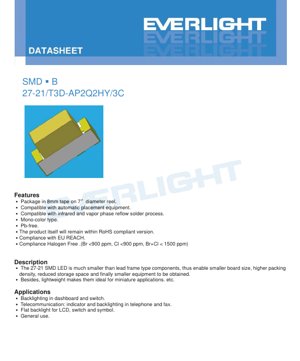
The 27-21 SMD LED is a compact, surface-mount light-emitting diode designed for modern electronic applications requiring miniaturization and high reliability. This component represents a significant advancement over traditional lead-frame type LEDs, enabling substantial reductions in board space, increased packing density, and ultimately contributing to the development of smaller, more efficient end-user equipment. Its lightweight construction makes it particularly suitable for applications where space and weight are critical constraints.
The LED emits a pure white light, achieved through an InGaN (Indium Gallium Nitride) chip material encapsulated in a yellow diffused resin. This combination provides a consistent and diffuse light output suitable for a variety of indicator and backlighting functions. The product is fully compliant with contemporary environmental and safety standards, including RoHS (Restriction of Hazardous Substances), EU REACH regulations, and is manufactured as a halogen-free component, with bromine and chlorine content kept below specified limits.
2. Technical Specifications and Objective Interpretation
2.1 Absolute Maximum Ratings
These ratings define the limits beyond which permanent damage to the device may occur. Operation under or at these conditions is not guaranteed and should be avoided in circuit design.
- Reverse Voltage (VR): 5V. Exceeding this voltage in reverse bias can cause junction breakdown.
- Forward Current (IF): 10mA (continuous). This is the maximum recommended DC current for reliable long-term operation.
- Peak Forward Current (IFP): 100mA. This is permissible only under pulsed conditions (duty cycle 1/10 @ 1kHz) and must not be used for continuous drive.
- Power Dissipation (Pd): 40mW. This is the maximum power the package can dissipate without exceeding its thermal limits, calculated as Forward Voltage (VF) * Forward Current (IF).
- Electrostatic Discharge (ESD) Human Body Model (HBM): 150V. This indicates a moderate sensitivity to ESD; proper handling procedures (e.g., grounded workstations, ESD-safe packaging) are essential.
- Operating Temperature (Topr): -40°C to +85°C. The device is rated for industrial temperature ranges.
- Storage Temperature (Tstg): -40°C to +90°C.
- Soldering Temperature (Tsol): Compatible with standard reflow profiles (peak 260°C for 10 sec) and hand soldering (350°C for 3 sec max per terminal).
2.2 Electro-Optical Characteristics
These parameters are measured at a standard test condition of 25°C ambient temperature and a forward current of 5mA, which serves as a common reference point for comparison and binning.
- Luminous Intensity (Iv): 57.0 - 112 mcd (millicandela). The wide range reflects the binning process, where LEDs are sorted into specific output groups (P2, Q1, Q2). The typical value is not stated, falling within this binned range.
- Viewing Angle (2θ1/2): 140 degrees (typical). This wide viewing angle is characteristic of the yellow diffused resin, which scatters light, making the LED suitable for applications requiring broad illumination rather than a focused beam.
- Forward Voltage (VF): 2.70V - 3.15V. This is the voltage drop across the LED when driven at 5mA. LEDs are also binned into specific voltage ranges (codes 15, 16, 17). A tolerance of ±0.1V is noted.
- Reverse Current (IR): 50 µA (max) at VR=5V. This parameter is for test purposes only; the device is not intended for operation in reverse bias.
Important Note: The datasheet explicitly warns that the reverse voltage condition is for test only and the LED must not be operated in reverse. Designers must ensure correct polarity in the circuit.
3. Binning System Explanation
To ensure consistency in mass production, LEDs are tested and sorted into "bins" based on key performance parameters. This allows designers to select components with tightly controlled characteristics for their specific application needs.
3.1 Luminous Intensity Binning
LEDs are categorized into three bins based on their light output at 5mA:
- Bin P2: 57.0 - 72.0 mcd
- Bin Q1: 72.0 - 90.0 mcd
- Bin Q2: 90.0 - 112 mcd
A general tolerance of ±11% on luminous intensity is also specified.
3.2 Forward Voltage Binning
To aid in current regulation design, LEDs are also binned by their forward voltage drop:
- Bin 15: 2.70V - 2.85V
- Bin 16: 2.85V - 3.00V
- Bin 17: 3.00V - 3.15V
A tolerance of ±0.1V is noted for forward voltage.
3.3 Chromaticity Coordinate Binning
For color consistency, the white light output is binned according to its coordinates on the CIE 1931 chromaticity diagram. The datasheet defines six bins (1 through 6), each specifying a quadrilateral region on the x,y color coordinate plot with a tolerance of ±0.01. This precise binning ensures that all LEDs within a chosen bin will exhibit nearly identical white color points, which is critical for applications like backlighting arrays where color uniformity is paramount.
4. Performance Curve Analysis
While the PDF references "Typical Electro-Optical Characteristics Curves," the specific graphs (e.g., IV vs. IF, IV vs. Temperature, Spectral Distribution) are not detailed in the provided text. Typically, such curves would show:
- Luminous Intensity vs. Forward Current (IV-IF): A non-linear relationship where light output increases with current but may saturate or degrade at higher currents beyond the rated maximum.
- Luminous Intensity vs. Ambient Temperature (IV-Ta): Light output generally decreases as junction temperature rises. The curve quantifies this derating, which is crucial for thermal management in the application.
- Forward Voltage vs. Junction Temperature (VF-Tj): VF typically has a negative temperature coefficient, decreasing as temperature increases.
- Spectral Power Distribution: A plot showing the relative intensity of light across the visible wavelength spectrum, defining the "white" color quality (e.g., cool white, warm white).
Designers should consult these curves when operating the LED outside the standard 5mA/25°C test condition to predict performance accurately.
5. Mechanical and Package Information
5.1 Package Dimensions
The 27-21 SMD LED has a compact footprint. The dimensional drawing indicates a package size with tolerances of ±0.1mm unless otherwise specified. Key features visible in the drawing include the component outline, electrode pad locations, and polarity marking (likely a cathode indicator). Precise dimensions (length, width, height) are critical for PCB land pattern design and ensuring proper placement by automated equipment.
5.2 Polarity Identification
The package includes a marking to identify the cathode (negative) terminal. Correct polarity must be observed during assembly to prevent reverse bias, which can damage the device.
6. Soldering and Assembly Guidelines
6.1 Reflow Soldering Profile
The LED is compatible with infrared and vapor phase reflow processes. A recommended Pb-free reflow profile is provided:
- Pre-heating: 150-200°C for 60-120 seconds.
- Time Above Liquidus (217°C): 60-150 seconds.
- Peak Temperature: 260°C maximum, held for no more than 10 seconds.
- Heating Rate: Maximum 6°C/sec.
- Time Above 255°C: Maximum 30 seconds.
- Cooling Rate: Maximum 3°C/sec.
Critical Rule: Reflow soldering should not be performed more than two times on the same LED assembly.
6.2 Hand Soldering
If hand soldering is necessary:
- Use a soldering iron with a tip temperature less than 350°C.
- Limit contact time to 3 seconds per terminal.
- Use an iron with a capacity of 25W or less.
- Allow an interval of at least 2 seconds between soldering each terminal to manage heat stress.
The datasheet cautions that damage often occurs during hand soldering, so extra care is required.
6.3 Storage and Moisture Sensitivity
The LEDs are packaged in moisture-resistant materials (carrier tape in an aluminum moisture-proof bag with desiccant).
- Before Opening: Store at ≤30°C and ≤90% Relative Humidity (RH).
- After Opening: The "floor life" is 1 year under conditions of ≤30°C and ≤60% RH. Unused components should be resealed in a moisture-proof package.
- Baking: If the desiccant indicates saturation or the storage time is exceeded, bake the LEDs at 60 ±5°C for 24 hours before use to remove absorbed moisture and prevent "popcorning" during reflow.
7. Packaging and Ordering Information
7.1 Reel and Tape Specifications
The LEDs are supplied in industry-standard packaging for automated assembly:
- Tape: 8mm wide tape on a 7-inch diameter reel.
- Quantity: 3000 pieces per reel.
- Detailed dimensional drawings for the carrier tape and reel are provided, with standard tolerances of ±0.1mm.
7.2 Label Explanation
The reel label contains several key codes for traceability and specification:
- P/N: Product Number (e.g., 27-21/T3D-AP2Q2HY/3C).
- QTY: Packing Quantity.
- CAT: Luminous Intensity Rank (e.g., P2, Q1, Q2).
- HUE: Chromaticity Coordinates & Dominant Wavelength Rank (e.g., Bin 1-6).
- REF: Forward Voltage Rank (e.g., 15, 16, 17).
- LOT No: Manufacturing Lot Number for traceability.
8. Application Suggestions
8.1 Typical Application Scenarios
The datasheet lists several primary applications, leveraging the LED's small size, diffuse light, and reliability:
- Backlighting: For instrument panel dashboards, switches, and keypads.
- Telecommunications Equipment: As status indicators and backlights in telephones and fax machines.
- LCD Displays: Providing flat, even backlighting for small LCD panels, switch legends, and symbols.
- General Indicator Use: Any application requiring a compact, bright, white indicator light.
8.2 Design Considerations and Precautions
The datasheet includes critical warnings for reliable operation:
- Current Limiting is Mandatory: An external current-limiting resistor must always be used in series with the LED. The forward voltage has a slight negative temperature coefficient, meaning that as the LED heats up, VF drops slightly. Without a resistor, this can lead to a significant increase in current (thermal runaway), potentially burning out the LED. The resistor stabilizes the current.
- Avoid Mechanical Stress: Do not apply stress to the LED body during soldering or in the final assembly. Avoid warping the PCB after soldering.
- Repairing: Repairing or reworking a board after the LEDs are soldered is strongly discouraged. If absolutely necessary, a specialized double-head soldering iron should be used to simultaneously heat both terminals, minimizing thermal stress. Single-point reheating can cause damage.
- ESD Protection: Implement standard ESD precautions during handling and assembly due to the device's 150V HBM rating.
9. Technical Comparison and Differentiation
While a direct comparison with other specific LED models is not provided in the datasheet, the 27-21 package offers clear advantages in specific contexts:
- vs. Leaded LEDs: The primary advantage is the dramatic reduction in board space and weight, enabling modern, miniaturized electronics. It also eliminates the need for lead bending and insertion, streamlining automated assembly.
- vs. Larger SMD LEDs (e.g., 3528, 5050): The 27-21 offers a smaller footprint for ultra-compact designs, though potentially at the expense of total light output or heat dissipation capability compared to larger packages.
- vs. Clear Lens LEDs: The yellow diffused resin provides a much wider viewing angle (140°) and a softer, more uniform appearance, making it superior for applications where the LED is directly viewed, as opposed to a clear lens which produces a more focused beam.
Its compliance with RoHS, REACH, and halogen-free standards is a baseline expectation for modern components but remains a key differentiator against older, non-compliant stock.
10. Frequently Asked Questions (Based on Technical Parameters)
10.1 Why is a series resistor absolutely necessary?
LEDs are current-driven devices, not voltage-driven. Their V-I curve is very steep. A small change in forward voltage (which can occur due to temperature changes or manufacturing variance) causes a large change in current. A series resistor acts as a simple, linear current regulator, stabilizing the operating point and preventing thermal runaway and destruction of the LED.
10.2 What do the bin codes (P2, Q1, 15, 16, etc.) mean for my design?
Binning ensures consistency. If your design requires uniform brightness across multiple LEDs (e.g., in a backlight array), you should specify LEDs from the same luminous intensity bin (CAT). If your power supply has tight voltage margins, specifying a tighter forward voltage bin (REF) can help. For color-critical applications, specifying the chromaticity bin (HUE) is essential. Using unbinned or mixed-bin LEDs can result in visible brightness or color variations in the final product.
10.3 Can I drive this LED at 10mA continuously?
Yes, 10mA is the rated maximum continuous forward current. However, operating at the absolute maximum rating may reduce long-term reliability and increase junction temperature. For optimal lifetime and stability, driving the LED at or below the test current of 5mA is recommended, especially if thermal management is limited.
10.4 The viewing angle is 140 degrees. Is the light output uniform across this angle?
The "viewing angle" (2θ1/2) is defined as the angle at which the luminous intensity is half of the intensity at 0 degrees (directly on-axis). The yellow diffused resin creates a Lambertian-like emission pattern, where intensity is highest on-axis and decreases towards the edges. It provides very good uniformity for wide-angle viewing compared to a clear lens LED, but perfect uniformity across the entire 140° is not achieved.
11. Practical Design and Usage Case
Scenario: Designing a backlit membrane switch panel.
- Selection: The 27-21 LED is chosen for its small size (fits behind switch icons), diffuse light (even illumination), and surface-mount compatibility (suitable for automated assembly onto the switch PCB).
- Circuit Design: A constant current of 5mA is chosen for a balance of brightness and longevity. Using a 3.3V supply and assuming a VF from Bin 16 (typ. 2.93V), the series resistor is calculated: R = (Vsupply - VF) / IF = (3.3V - 2.93V) / 0.005A = 74 Ohms. A standard 75-ohm resistor is selected.
- PCB Layout: The land pattern is designed exactly per the package dimension drawing. Adequate clearance is maintained between the LED and the membrane layer.
- Procurement: LEDs are ordered specifying Bin Q1 for brightness and Bin 2 or 3 for a consistent white color point across all switches on the panel.
- Assembly: Components are kept in sealed bags until use. The PCB undergoes a single reflow pass using the specified profile. Stress on the LEDs is avoided during handling.
12. Operating Principle Introduction
The 27-21 LED is a solid-state light source based on a semiconductor p-n junction. The active region uses an InGaN (Indium Gallium Nitride) compound semiconductor. When a forward voltage exceeding the diode's turn-on threshold (the forward voltage, VF) is applied, electrons and holes are injected into the active region where they recombine. In a direct bandgap semiconductor like InGaN, this recombination releases energy primarily in the form of photons (light). The specific bandgap energy of the InGaN alloy determines the wavelength of the emitted light. To produce white light from a blue/UV-emitting InGaN chip, a yellow phosphor (contained within the yellow diffused resin encapsulation) is used. Part of the blue light from the chip is absorbed by the phosphor and re-emitted as yellow light. The mixture of the remaining blue light and the converted yellow light is perceived by the human eye as white. The diffused resin contains scattering particles that randomize the direction of the emitted photons, creating the wide, uniform viewing angle.
13. Technology Trends and Developments
SMD LEDs like the 27-21 represent a mature and widely adopted technology. Current trends in the industry focus on several key areas that build upon this foundation:
- Increased Efficiency (Lumens per Watt): Ongoing improvements in epitaxial growth, chip design, and phosphor technology continue to push the luminous efficacy higher, allowing for brighter light output at the same current or the same light output with lower power consumption and less heat generation.
- Improved Color Quality and Consistency: Advances in phosphor formulations and more precise binning techniques (e.g., using 3-5 step MacAdam ellipses for tighter color control) enable LEDs with superior Color Rendering Index (CRI) and more consistent color points from batch to batch.
- Miniaturization: The drive for smaller devices continues, leading to even smaller package sizes (e.g., 2016, 1515) while maintaining or improving optical performance.
- Enhanced Reliability and Lifetime: Research into better packaging materials and thermal management techniques aims to increase the operational lifetime and stability of LEDs, especially under high-temperature or high-humidity conditions.
- Integrated Solutions: The trend is moving towards LEDs with built-in drivers, controllers, or even multiple color chips (RGB) in a single package, simplifying circuit design for the end user.
The 27-21 LED, with its standardized package and well-defined characteristics, serves as a reliable workhorse component within this evolving technological landscape.
LED Specification Terminology
Complete explanation of LED technical terms
Photoelectric Performance
| Term | Unit/Representation | Simple Explanation | Why Important |
|---|---|---|---|
| Luminous Efficacy | lm/W (lumens per watt) | Light output per watt of electricity, higher means more energy efficient. | Directly determines energy efficiency grade and electricity cost. |
| Luminous Flux | lm (lumens) | Total light emitted by source, commonly called "brightness". | Determines if the light is bright enough. |
| Viewing Angle | ° (degrees), e.g., 120° | Angle where light intensity drops to half, determines beam width. | Affects illumination range and uniformity. |
| CCT (Color Temperature) | K (Kelvin), e.g., 2700K/6500K | Warmth/coolness of light, lower values yellowish/warm, higher whitish/cool. | Determines lighting atmosphere and suitable scenarios. |
| CRI / Ra | Unitless, 0–100 | Ability to render object colors accurately, Ra≥80 is good. | Affects color authenticity, used in high-demand places like malls, museums. |
| SDCM | MacAdam ellipse steps, e.g., "5-step" | Color consistency metric, smaller steps mean more consistent color. | Ensures uniform color across same batch of LEDs. |
| Dominant Wavelength | nm (nanometers), e.g., 620nm (red) | Wavelength corresponding to color of colored LEDs. | Determines hue of red, yellow, green monochrome LEDs. |
| Spectral Distribution | Wavelength vs intensity curve | Shows intensity distribution across wavelengths. | Affects color rendering and quality. |
Electrical Parameters
| Term | Symbol | Simple Explanation | Design Considerations |
|---|---|---|---|
| Forward Voltage | Vf | Minimum voltage to turn on LED, like "starting threshold". | Driver voltage must be ≥Vf, voltages add up for series LEDs. |
| Forward Current | If | Current value for normal LED operation. | Usually constant current drive, current determines brightness & lifespan. |
| Max Pulse Current | Ifp | Peak current tolerable for short periods, used for dimming or flashing. | Pulse width & duty cycle must be strictly controlled to avoid damage. |
| Reverse Voltage | Vr | Max reverse voltage LED can withstand, beyond may cause breakdown. | Circuit must prevent reverse connection or voltage spikes. |
| Thermal Resistance | Rth (°C/W) | Resistance to heat transfer from chip to solder, lower is better. | High thermal resistance requires stronger heat dissipation. |
| ESD Immunity | V (HBM), e.g., 1000V | Ability to withstand electrostatic discharge, higher means less vulnerable. | Anti-static measures needed in production, especially for sensitive LEDs. |
Thermal Management & Reliability
| Term | Key Metric | Simple Explanation | Impact |
|---|---|---|---|
| Junction Temperature | Tj (°C) | Actual operating temperature inside LED chip. | Every 10°C reduction may double lifespan; too high causes light decay, color shift. |
| Lumen Depreciation | L70 / L80 (hours) | Time for brightness to drop to 70% or 80% of initial. | Directly defines LED "service life". |
| Lumen Maintenance | % (e.g., 70%) | Percentage of brightness retained after time. | Indicates brightness retention over long-term use. |
| Color Shift | Δu′v′ or MacAdam ellipse | Degree of color change during use. | Affects color consistency in lighting scenes. |
| Thermal Aging | Material degradation | Deterioration due to long-term high temperature. | May cause brightness drop, color change, or open-circuit failure. |
Packaging & Materials
| Term | Common Types | Simple Explanation | Features & Applications |
|---|---|---|---|
| Package Type | EMC, PPA, Ceramic | Housing material protecting chip, providing optical/thermal interface. | EMC: good heat resistance, low cost; Ceramic: better heat dissipation, longer life. |
| Chip Structure | Front, Flip Chip | Chip electrode arrangement. | Flip chip: better heat dissipation, higher efficacy, for high-power. |
| Phosphor Coating | YAG, Silicate, Nitride | Covers blue chip, converts some to yellow/red, mixes to white. | Different phosphors affect efficacy, CCT, and CRI. |
| Lens/Optics | Flat, Microlens, TIR | Optical structure on surface controlling light distribution. | Determines viewing angle and light distribution curve. |
Quality Control & Binning
| Term | Binning Content | Simple Explanation | Purpose |
|---|---|---|---|
| Luminous Flux Bin | Code e.g., 2G, 2H | Grouped by brightness, each group has min/max lumen values. | Ensures uniform brightness in same batch. |
| Voltage Bin | Code e.g., 6W, 6X | Grouped by forward voltage range. | Facilitates driver matching, improves system efficiency. |
| Color Bin | 5-step MacAdam ellipse | Grouped by color coordinates, ensuring tight range. | Guarantees color consistency, avoids uneven color within fixture. |
| CCT Bin | 2700K, 3000K etc. | Grouped by CCT, each has corresponding coordinate range. | Meets different scene CCT requirements. |
Testing & Certification
| Term | Standard/Test | Simple Explanation | Significance |
|---|---|---|---|
| LM-80 | Lumen maintenance test | Long-term lighting at constant temperature, recording brightness decay. | Used to estimate LED life (with TM-21). |
| TM-21 | Life estimation standard | Estimates life under actual conditions based on LM-80 data. | Provides scientific life prediction. |
| IESNA | Illuminating Engineering Society | Covers optical, electrical, thermal test methods. | Industry-recognized test basis. |
| RoHS / REACH | Environmental certification | Ensures no harmful substances (lead, mercury). | Market access requirement internationally. |
| ENERGY STAR / DLC | Energy efficiency certification | Energy efficiency and performance certification for lighting. | Used in government procurement, subsidy programs, enhances competitiveness. |