Table of Contents
- 1. Product Overview
- 1.1 Core Features and Compliance
- 1.2 Target Applications
- 2. Technical Specifications Deep Dive
- 2.1 Absolute Maximum Ratings
- 2.2 Electro-Optical Characteristics
- 3. Binning System Explanation
- 3.1 Luminous Intensity Binning
- 4. Performance Curve Analysis
- 4.1 Relative Luminous Intensity vs. Ambient Temperature
- 4.2 Relative Luminous Intensity vs. Forward Current
- 4.3 Forward Voltage vs. Forward Current
- 5. Mechanical and Package Information
- 5.1 Package Dimensions
- 6. Soldering and Assembly Guidelines
- 6.1 Reflow Soldering Profile
- 6.2 Hand Soldering Precautions
- 6.3 Storage and Moisture Sensitivity
- 7. Packaging and Ordering Information
- 7.1 Tape and Reel Specifications
- 7.2 Label Explanation
- 8. Application Design Considerations
- 8.1 Circuit Design Imperative
- 8.2 Thermal Management
- 8.3 ESD Protection
- 9. Technical Comparison and Differentiation
- 10. Frequently Asked Questions (FAQ)
- 10.1 Can I drive this LED without a resistor?
- 10.2 What is the difference between Peak Wavelength and Dominant Wavelength?
- 10.3 Why is the ESD rating different for Red and Green?
- 10.4 Can I use this for automotive interior lighting?
- 11. Practical Design Case Study
- 11.1 Designing a Dual-Color Status Indicator
- 12. Operating Principle
- 13. Technology Trends
1. Product Overview
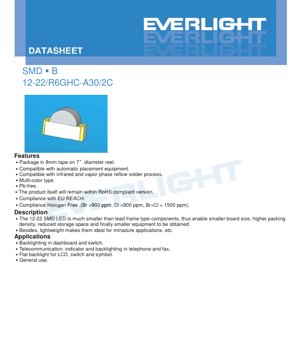
The 12-22 SMD LED is a compact, surface-mount light-emitting diode designed for high-density PCB applications. It is a multi-color type, available in brilliant red (using AlGaInP chip technology) and brilliant green (using InGaN chip technology). The primary advantage of this component is its significantly reduced footprint compared to traditional lead-frame LEDs, enabling miniaturization of end products, higher packing density on circuit boards, and reduced storage requirements. Its lightweight construction makes it particularly suitable for portable and miniature electronic devices.
1.1 Core Features and Compliance
- Packaged in 8mm tape on 7-inch diameter reels for automated pick-and-place assembly.
- Fully compatible with standard infrared and vapor phase reflow soldering processes.
- Constructed with Pb-free materials, ensuring compliance with environmental regulations.
- The product conforms to the EU RoHS (Restriction of Hazardous Substances) directive.
- Compliant with EU REACH (Registration, Evaluation, Authorisation and Restriction of Chemicals) regulations.
- Halogen-free construction: Bromine (Br) < 900 ppm, Chlorine (Cl) < 900 ppm, Br+Cl < 1500 ppm.
1.2 Target Applications
This LED is versatile and finds use in various illumination and indication roles:
- Backlighting: Ideal for dashboard indicators, switch backlighting, and symbol illumination.
- Telecommunication Equipment: Serves as status indicators and keypad backlights in devices like telephones and fax machines.
- Display Technology: Used for flat backlighting in LCD panels.
- General Purpose Indication: Suitable for a wide range of consumer and industrial electronics requiring compact, reliable status lights.
2. Technical Specifications Deep Dive
2.1 Absolute Maximum Ratings
These ratings define the limits beyond which permanent damage to the device may occur. Operation under these conditions is not guaranteed.
| Parameter | Symbol | Code | Rating | Unit |
|---|---|---|---|---|
| Reverse Voltage | VR | All | 5 | V |
| Forward Current | IF | R6 / GH | 25 | mA |
| Peak Forward Current (Duty 1/10 @1kHz) | IFP | R6 | 60 | mA |
| Peak Forward Current (Duty 1/10 @1kHz) | IFP | GH | 100 | mA |
| Power Dissipation | Pd | R6 | 60 | mW |
| Power Dissipation | Pd | GH | 95 | mW |
| Electrostatic Discharge (Human Body Model) | ESD (HBM) | R6 | 2000 | V |
| Electrostatic Discharge (Human Body Model) | ESD (HBM) | GH | 150 | V |
| Operating Temperature | Topr | All | -40 to +85 | °C |
| Storage Temperature | Tstg | All | -40 to +90 | °C |
| Soldering Temperature (Reflow) | Tsol | All | 260°C for 10 sec | - |
| Soldering Temperature (Hand) | Tsol | All | 350°C for 3 sec | - |
Key Analysis: The GH (Green) variant has a higher peak current tolerance but a significantly lower ESD withstand voltage (150V vs. 2000V for Red). This indicates the InGaN chip is more sensitive to electrostatic discharge and requires stricter handling precautions. Both variants support a wide industrial temperature range.
2.2 Electro-Optical Characteristics
Measured at an ambient temperature (Ta) of 25°C, these parameters define the typical performance.
| Parameter | Symbol | Code | Min. | Typ. | Max. | Unit | Condition |
|---|---|---|---|---|---|---|---|
| Luminous Intensity | Iv | R6 | 72.0 | - | 180.0 | mcd | IF=20mA |
| Luminous Intensity | Iv | GH | 112.0 | - | 285.0 | mcd | IF=20mA |
| Viewing Angle | 2θ1/2 | All | - | 120 | - | deg | - |
| Peak Wavelength | λp | R6 | - | 632 | - | nm | - |
| Peak Wavelength | λp | GH | - | 518 | - | nm | - |
| Dominant Wavelength | λd | R6 | - | 624 | - | nm | - |
| Dominant Wavelength | λd | GH | - | 525 | - | nm | - |
| Spectrum Bandwidth | △λ | R6 | - | 20 | - | nm | - |
| Spectrum Bandwidth | △λ | GH | - | 35 | - | nm | - |
| Forward Voltage | VF | R6 | 1.7 | 2.0 | 2.4 | V | - |
| Forward Voltage | VF | GH | 2.7 | 3.3 | 3.7 | V | - |
| Reverse Current | IR | R6 | - | - | 10 | μA | VR=5V |
| Reverse Current | IR | GH | - | - | 50 | μA | VR=5V |
Key Analysis: The green LED (GH) typically offers higher luminous intensity but at a higher forward voltage (~3.3V vs. ~2.0V for red). This has direct implications for power supply design. The wide 120-degree viewing angle provides a broad emission pattern suitable for area illumination. The forward voltage ranges must be considered when designing current-limiting circuits to ensure consistent brightness across production batches.
3. Binning System Explanation
To ensure consistency in brightness, the LEDs are sorted into bins based on their measured luminous intensity at 20mA.
3.1 Luminous Intensity Binning
R6 (Red AlGaInP):
- Bin Q: 72.0 mcd (Min) to 112.0 mcd (Max)
- Bin R: 112.0 mcd (Min) to 180.0 mcd (Max)
GH (Green InGaN):
- Bin R: 112.0 mcd (Min) to 180.0 mcd (Max)
- Bin S: 180.0 mcd (Min) to 285.0 mcd (Max)
Note: The datasheet specifies a tolerance of ±11% for luminous intensity. This binning allows designers to select parts that meet specific brightness requirements for their application, ensuring visual consistency in multi-LED arrays or matched indicator pairs.
4. Performance Curve Analysis
The datasheet provides typical characteristic curves for the R6 (Red) variant, illustrating the relationship between key parameters.
4.1 Relative Luminous Intensity vs. Ambient Temperature
The output of the LED decreases as the ambient temperature rises. This is a critical consideration for applications operating in high-temperature environments or where the LED self-heating is significant. Designers must derate the expected light output based on the junction temperature.
4.2 Relative Luminous Intensity vs. Forward Current
This curve shows that light output is not linearly proportional to current, especially at higher currents. Operating above the recommended continuous forward current (20mA) may yield diminishing returns in brightness while drastically increasing power dissipation and reducing lifespan.
4.3 Forward Voltage vs. Forward Current
The IV curve demonstrates the diode's characteristic exponential relationship. A small change in forward voltage can cause a large change in current. This underscores the absolute necessity of using a current-limiting resistor or constant-current driver in series with the LED to prevent thermal runaway and destruction.
5. Mechanical and Package Information
5.1 Package Dimensions
The 12-22 SMD LED has a compact rectangular body. Critical dimensions include the overall length, width, and height, as well as the solder pad land pattern recommendations. The cathode is typically indicated by a green marking or a notch on the package. Adherence to the specified pad layout is essential for reliable soldering and proper alignment during reflow.
6. Soldering and Assembly Guidelines
6.1 Reflow Soldering Profile
The component is rated for lead-free reflow soldering. The recommended temperature profile is crucial:
- Pre-heating: 150–200°C for 60–120 seconds.
- Time Above Liquidus (217°C): 60–150 seconds.
- Peak Temperature: 260°C maximum, held for no more than 10 seconds.
- Heating Rate: Maximum 6°C/second.
- Cooling Rate: Maximum 3°C/second.
Critical Rule: Reflow soldering should not be performed more than two times on the same LED assembly.
6.2 Hand Soldering Precautions
If hand soldering is unavoidable:
- Use a soldering iron with a tip temperature below 350°C.
- Limit contact time to 3 seconds per terminal.
- Use an iron with a power rating of 25W or less.
- Allow a cooling interval of at least 2 seconds between soldering each terminal.
- Avoid applying mechanical stress to the LED body during heating.
6.3 Storage and Moisture Sensitivity
The LEDs are packaged in moisture-resistant bags with desiccant.
- Before Opening: Store at ≤30°C and ≤90% Relative Humidity (RH).
- After Opening (Floor Life): 168 hours (7 days) at ≤30°C and ≤60% RH.
- Baking: If the floor life is exceeded or the desiccant indicates moisture, bake at 60 ±5°C for 24 hours before use.
7. Packaging and Ordering Information
7.1 Tape and Reel Specifications
The LEDs are supplied in embossed carrier tape wound onto 7-inch diameter reels.
- Carrier Tape Width: 8 mm.
- Pocket Pitch: Specified in the dimensional drawing.
- Quantity per Reel: 2000 pieces.
7.2 Label Explanation
Reel labels contain codes for traceability and specification:
- P/N: Product Number (e.g., 12-22/R6GHC-A30/2C).
- QTY: Packing Quantity.
- CAT: Luminous Intensity Rank (Bin Code: Q, R, S).
- HUE: Chromaticity Coordinates & Dominant Wavelength Rank.
- REF: Forward Voltage Rank.
- LOT No: Manufacturing Lot Number for traceability.
8. Application Design Considerations
8.1 Circuit Design Imperative
Current Limiting is Mandatory. An LED is a current-driven device. Connecting it directly to a voltage source will cause it to draw excessive current, leading to immediate failure. A series resistor must be calculated based on the supply voltage (Vs), the LED's forward voltage (Vf), and the desired forward current (If): R = (Vs - Vf) / If. Always use the maximum Vf from the datasheet for a conservative design.
8.2 Thermal Management
While small, power dissipation (up to 95mW for the green variant) must be considered, especially in sealed enclosures or high-density arrays. Ensure the PCB has adequate copper area or thermal vias to dissipate heat and prevent the LED's junction temperature from exceeding the maximum operating limit, which degrades light output and lifespan.
8.3 ESD Protection
Particularly for the GH (green) variant with a low 150V HBM ESD rating, implement ESD protection measures during handling and assembly. This includes the use of grounded workstations, wrist straps, and ionizers in production environments.
9. Technical Comparison and Differentiation
The 12-22 package offers a balance between size and performance. Compared to larger SMD LEDs (e.g., 3528, 5050), it provides less total light output but enables ultra-miniaturization. Compared to smaller chip LEDs (e.g., 0402, 0603), it is easier to handle and solder manually if needed, and often has better viewing angles and intensity due to its molded lens. The multi-color capability (red/green) in a single package footprint provides design flexibility for bi-color indicators.
10. Frequently Asked Questions (FAQ)
10.1 Can I drive this LED without a resistor?
No. This will almost certainly destroy the LED. The exponential IV characteristic means a slight over-voltage causes a massive over-current.
10.2 What is the difference between Peak Wavelength and Dominant Wavelength?
Peak Wavelength (λp): The single wavelength at which the emission spectrum has its maximum intensity.
Dominant Wavelength (λd): The wavelength of monochromatic light that matches the perceived color of the LED. It is calculated based on the human eye's color response (CIE chart). Dominant wavelength is more relevant for color specification.
10.3 Why is the ESD rating different for Red and Green?
The different semiconductor materials (AlGaInP vs. InGaN) and chip structures have inherent differences in their sensitivity to electrostatic discharge. InGaN-based LEDs (blue, green, white) are generally more ESD-sensitive than AlGaInP-based LEDs (red, amber).
10.4 Can I use this for automotive interior lighting?
While it may be technically suitable for some interior applications (like switch backlighting), the datasheet includes an "Application Restrictions" note advising against use in high-reliability automotive safety/security systems without further qualification. For non-critical interior lighting, it may be acceptable, but the wide operating temperature range (-40°C to +85°C) is a positive factor.
11. Practical Design Case Study
11.1 Designing a Dual-Color Status Indicator
Scenario: Create a compact PCB status light that shows red for "Fault" and green for "Normal."
Solution: Use one 12-22/R6 (red) and one 12-22/GH (green) LED placed side-by-side.
Circuit: Design two independent driver circuits. For a 5V supply:
For Red (Vf max = 2.4V, If = 20mA): Rred = (5V - 2.4V) / 0.020A = 130 Ω. Use a standard 130Ω or 150Ω resistor.
For Green (Vf max = 3.7V, If = 20mA): Rgreen = (5V - 3.7V) / 0.020A = 65 Ω. Use a standard 68Ω resistor.
Layout: Follow the recommended pad layout from the package drawing. Ensure the cathode markings are oriented correctly. Provide a small thermal relief on the PCB pads if hand soldering is anticipated.
12. Operating Principle
Light Emitting Diodes (LEDs) are semiconductor devices that emit light through electroluminescence. When a forward voltage is applied across the p-n junction, electrons from the n-type region recombine with holes from the p-type region within the active layer (the chip material: AlGaInP for red, InGaN for green). This recombination releases energy in the form of photons (light). The specific wavelength (color) of the emitted light is determined by the bandgap energy of the semiconductor material used in the active layer. The molded epoxy resin package serves as a lens to shape the light output and protect the delicate semiconductor chip.
13. Technology Trends
The development of SMD LEDs like the 12-22 follows broader industry trends towards miniaturization, increased efficiency (lumens per watt), and higher reliability. Advancements in epitaxial growth techniques for AlGaInP and InGaN materials continue to improve internal quantum efficiency and color purity. Packaging technology focuses on better thermal management to handle increasing power densities and enhanced optical designs for controlled beam patterns. The drive for halogen-free and RoHS/REACH compliance reflects the industry's response to global environmental regulations. The integration of multiple color chips within a single package (e.g., RGB) is a logical extension of the multi-color concept presented in this datasheet.
LED Specification Terminology
Complete explanation of LED technical terms
Photoelectric Performance
| Term | Unit/Representation | Simple Explanation | Why Important |
|---|---|---|---|
| Luminous Efficacy | lm/W (lumens per watt) | Light output per watt of electricity, higher means more energy efficient. | Directly determines energy efficiency grade and electricity cost. |
| Luminous Flux | lm (lumens) | Total light emitted by source, commonly called "brightness". | Determines if the light is bright enough. |
| Viewing Angle | ° (degrees), e.g., 120° | Angle where light intensity drops to half, determines beam width. | Affects illumination range and uniformity. |
| CCT (Color Temperature) | K (Kelvin), e.g., 2700K/6500K | Warmth/coolness of light, lower values yellowish/warm, higher whitish/cool. | Determines lighting atmosphere and suitable scenarios. |
| CRI / Ra | Unitless, 0–100 | Ability to render object colors accurately, Ra≥80 is good. | Affects color authenticity, used in high-demand places like malls, museums. |
| SDCM | MacAdam ellipse steps, e.g., "5-step" | Color consistency metric, smaller steps mean more consistent color. | Ensures uniform color across same batch of LEDs. |
| Dominant Wavelength | nm (nanometers), e.g., 620nm (red) | Wavelength corresponding to color of colored LEDs. | Determines hue of red, yellow, green monochrome LEDs. |
| Spectral Distribution | Wavelength vs intensity curve | Shows intensity distribution across wavelengths. | Affects color rendering and quality. |
Electrical Parameters
| Term | Symbol | Simple Explanation | Design Considerations |
|---|---|---|---|
| Forward Voltage | Vf | Minimum voltage to turn on LED, like "starting threshold". | Driver voltage must be ≥Vf, voltages add up for series LEDs. |
| Forward Current | If | Current value for normal LED operation. | Usually constant current drive, current determines brightness & lifespan. |
| Max Pulse Current | Ifp | Peak current tolerable for short periods, used for dimming or flashing. | Pulse width & duty cycle must be strictly controlled to avoid damage. |
| Reverse Voltage | Vr | Max reverse voltage LED can withstand, beyond may cause breakdown. | Circuit must prevent reverse connection or voltage spikes. |
| Thermal Resistance | Rth (°C/W) | Resistance to heat transfer from chip to solder, lower is better. | High thermal resistance requires stronger heat dissipation. |
| ESD Immunity | V (HBM), e.g., 1000V | Ability to withstand electrostatic discharge, higher means less vulnerable. | Anti-static measures needed in production, especially for sensitive LEDs. |
Thermal Management & Reliability
| Term | Key Metric | Simple Explanation | Impact |
|---|---|---|---|
| Junction Temperature | Tj (°C) | Actual operating temperature inside LED chip. | Every 10°C reduction may double lifespan; too high causes light decay, color shift. |
| Lumen Depreciation | L70 / L80 (hours) | Time for brightness to drop to 70% or 80% of initial. | Directly defines LED "service life". |
| Lumen Maintenance | % (e.g., 70%) | Percentage of brightness retained after time. | Indicates brightness retention over long-term use. |
| Color Shift | Δu′v′ or MacAdam ellipse | Degree of color change during use. | Affects color consistency in lighting scenes. |
| Thermal Aging | Material degradation | Deterioration due to long-term high temperature. | May cause brightness drop, color change, or open-circuit failure. |
Packaging & Materials
| Term | Common Types | Simple Explanation | Features & Applications |
|---|---|---|---|
| Package Type | EMC, PPA, Ceramic | Housing material protecting chip, providing optical/thermal interface. | EMC: good heat resistance, low cost; Ceramic: better heat dissipation, longer life. |
| Chip Structure | Front, Flip Chip | Chip electrode arrangement. | Flip chip: better heat dissipation, higher efficacy, for high-power. |
| Phosphor Coating | YAG, Silicate, Nitride | Covers blue chip, converts some to yellow/red, mixes to white. | Different phosphors affect efficacy, CCT, and CRI. |
| Lens/Optics | Flat, Microlens, TIR | Optical structure on surface controlling light distribution. | Determines viewing angle and light distribution curve. |
Quality Control & Binning
| Term | Binning Content | Simple Explanation | Purpose |
|---|---|---|---|
| Luminous Flux Bin | Code e.g., 2G, 2H | Grouped by brightness, each group has min/max lumen values. | Ensures uniform brightness in same batch. |
| Voltage Bin | Code e.g., 6W, 6X | Grouped by forward voltage range. | Facilitates driver matching, improves system efficiency. |
| Color Bin | 5-step MacAdam ellipse | Grouped by color coordinates, ensuring tight range. | Guarantees color consistency, avoids uneven color within fixture. |
| CCT Bin | 2700K, 3000K etc. | Grouped by CCT, each has corresponding coordinate range. | Meets different scene CCT requirements. |
Testing & Certification
| Term | Standard/Test | Simple Explanation | Significance |
|---|---|---|---|
| LM-80 | Lumen maintenance test | Long-term lighting at constant temperature, recording brightness decay. | Used to estimate LED life (with TM-21). |
| TM-21 | Life estimation standard | Estimates life under actual conditions based on LM-80 data. | Provides scientific life prediction. |
| IESNA | Illuminating Engineering Society | Covers optical, electrical, thermal test methods. | Industry-recognized test basis. |
| RoHS / REACH | Environmental certification | Ensures no harmful substances (lead, mercury). | Market access requirement internationally. |
| ENERGY STAR / DLC | Energy efficiency certification | Energy efficiency and performance certification for lighting. | Used in government procurement, subsidy programs, enhances competitiveness. |