Table of Contents
- 1. Product Overview
- 1.1 Core Advantages and Target Market
- 2. In-Depth Technical Parameter Analysis
- 2.1 Absolute Maximum Ratings
- 2.2 Electro-Optical Characteristics
- 2.3 Electrical Characteristics
- 3. Binning System Explanation
- 4. Performance Curve Analysis
- 4.1 Spectral Distribution
- 4.2 Radiation Pattern
- 5. Mechanical and Package Information
- 5.1 Package Dimension and Pin Configuration
- 6. Soldering and Assembly Guidelines
- 6.1 Reflow Soldering Profile
- 6.2 Storage and Moisture Sensitivity
- 6.3 Precautions
- 7. Packaging and Ordering Information
- 7.1 Reel and Tape Specifications
- 7.2 Label Information
- 8. Application Design Suggestions
- 8.1 Typical Application Circuit
- 8.2 Data Protocol and Timing
- 8.3 Design Considerations for Long Chains
- 9. Technical Comparison and Differentiation
- 10. Frequently Asked Questions (Based on Technical Parameters)
- 10.1 What is the maximum number of these LEDs I can daisy-chain?
- 10.2 Can I drive these LEDs with a 3.3V microcontroller?
- 10.3 Why is there a 5mA current limit? Can I increase brightness?
- 11. Practical Application Example
- 12. Operating Principle
- 13. Technology Trends
1. Product Overview
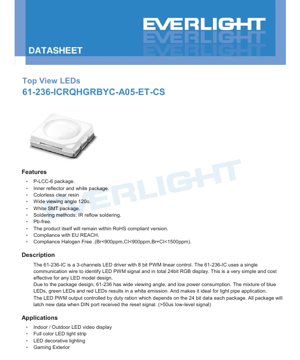
The 61-236-IC is a highly integrated, surface-mount LED driver designed for full-color RGB applications. It combines three individual LED chips (red, green, blue) with a dedicated control IC within a single P-LCC-6 package. This integration simplifies PCB design by eliminating the need for external driver components for each color channel. The device is engineered for applications requiring vibrant color mixing, dynamic lighting effects, and reliable performance in a compact form factor.
1.1 Core Advantages and Target Market
The primary advantage of the 61-236-IC is its system-level simplicity. It utilizes a single-wire data transmission protocol, significantly reducing the number of control lines needed from a microcontroller or main controller compared to traditional parallel RGB LED interfaces. This makes it a cost-effective solution for scalable designs. Its wide 120-degree viewing angle, achieved through an inner reflector and clear resin, ensures uniform light distribution, making it ideal for light pipe applications and decorative lighting where visibility from multiple angles is crucial.
The target markets include indoor and outdoor full-color LED displays, decorative and architectural lighting strips, gaming peripherals, and any application requiring addressable, multi-color LED points. The device's compliance with RoHS, REACH, and halogen-free standards ensures it meets stringent international environmental and safety regulations.
2. In-Depth Technical Parameter Analysis
This section provides a detailed breakdown of the device's operational limits and performance characteristics under specified conditions.
2.1 Absolute Maximum Ratings
These ratings define the stress limits beyond which permanent damage to the device may occur. Operation under or at these limits is not guaranteed.
- Power Supply Voltage (Vdd): 4.2V to 5.5V. This defines the operating voltage range for the internal control circuitry. A stable 5V supply is typical.
- Output Voltage (Vout): 17V. This is the maximum voltage the driver's output stage can withstand, which is relevant for the LED forward voltage.
- Input Voltage (Vin): -0.5V to Vdd+0.5V. This specifies the safe voltage range for the data input (Din) and set pins to prevent latch-up or damage.
- LED Output Current (Iout): 5 mA. This is the maximum constant current per color channel (Red, Green, Blue). Exceeding this current risks LED degradation or failure.
- Operating Temperature (Topr): -25°C to +85°C. The ambient temperature range for reliable device operation.
- Storage Temperature (Tstg): -40°C to +90°C. The safe temperature range for the device when not powered.
- ESD (Electrostatic Discharge): 2000V (Human Body Model). Indicates the level of electrostatic protection, suggesting careful handling is required during assembly.
- Soldering Temperature (Tsol): Reflow: 260°C max for 10 sec; Hand: 350°C max for 3 sec. Critical parameters for PCB assembly to avoid thermal damage to the package or die.
2.2 Electro-Optical Characteristics
Measured at Ta=25°C and IF=5mA per channel, these parameters define the light output and color properties.
- Luminous Intensity (Iv):
- Red (RQH): 90 mcd (Min) to 280 mcd (Max).
- Green (GR): 280 mcd (Min) to 900 mcd (Max).
- Blue (BY): 71 mcd (Min) to 224 mcd (Max).
- Viewing Angle (2θ1/2): 120 degrees (Typical). Defined as the full angle at which luminous intensity drops to half of its peak value. The wide angle is a key feature.
- Dominant Wavelength (λd):
- Red (RQH): 617.5 nm to 629.5 nm.
- Green (GR): 525 nm to 540 nm.
- Blue (BY): 462 nm to 474 nm.
2.3 Electrical Characteristics
Defined at Ta=-20~+70°C, Vdd=4.5~5.5V, Vss=0V.
- Output Current (IOL): 5 mA (Typical). The regulated current sourced to each LED.
- Input Current (II): ±1 μA (Max). The very low leakage current for the data input pins.
- Input Voltage Logic Levels:
- VIH (Logic High): Min 3.3V.
- VIL (Logic Low): Max 0.3*Vdd (e.g., 1.65V at Vdd=5.5V).
- Hysteresis Voltage (VH): 0.35V (Typical). Provides noise immunity on the data input by creating a voltage gap between the high and low switching thresholds.
- Dynamic Current Dissipation (IDDdyn): 2.5 mA (Typical). The current drawn by the internal control logic during data transmission and PWM operation.
3. Binning System Explanation
The datasheet implies a multi-parameter binning system to ensure color and brightness consistency in production applications. While not explicitly detailed in a single table, the following bins can be inferred from the parameter ranges:
- Luminous Intensity (CAT): Devices are sorted into bins based on their measured light output (mcd) for each color (Red, Green, Blue). This is critical for achieving uniform brightness across multiple units in a display or strip.
- Dominant Wavelength (HUE): LEDs are binned according to their peak wavelength (nm). This ensures consistent color points (e.g., the same shade of red or blue) across all devices in an assembly, which is vital for accurate color mixing and display quality.
- Forward Voltage (REF): Although not listed in the main tables, the packing materials section references a "Forward Voltage Rank," indicating that chips may also be sorted by their forward voltage (Vf) characteristics to ensure uniform power distribution in series/parallel strings.
When ordering, specific bin codes (CAT, HUE, REF) can typically be requested to match the requirements of the application.
4. Performance Curve Analysis
The datasheet includes typical performance curves that provide insight into behavior beyond single-point specifications.
4.1 Spectral Distribution
The provided graph shows the relative intensity of light emitted across the visible spectrum for the Red (RQH), Green (GR), and Blue (BY) chips. Key observations:
- Each curve shows a distinct, narrow peak corresponding to its dominant wavelength, confirming good color saturation.
- The red emission is centered in the longer wavelength region (~620-630nm), green in the mid-range (~525-540nm), and blue in the shorter wavelength region (~462-474nm).
- The overlap between color spectra is minimal, which is beneficial for creating a wide color gamut when mixing.
4.2 Radiation Pattern
The "Diagram Characteristics of Radiation" illustrates the spatial distribution of light. The curve for a wide-viewing-angle LED like this one is typically broad and Lambertian-like (cosine distribution), confirming the 120-degree specification. The intensity is highest when viewed directly on-axis (0 degrees) and decreases smoothly towards the edges (±60 degrees).
5. Mechanical and Package Information
5.1 Package Dimension and Pin Configuration
The device uses a P-LCC-6 (Plastic Leaded Chip Carrier, 6-pin) package. The detailed dimension drawing specifies the length, width, height, lead spacing, and pad sizes with a general tolerance of ±0.1mm. This information is critical for PCB footprint design.
Pinout:
- Vss: Ground connection for the internal circuit.
- NA: Not connected / No internal connection.
- Di: Control data signal input. Receives the serial data stream.
- Do: Control data signal output. Passes the data stream to the next device in a daisy-chain.
- NA: Not connected / No internal connection.
- Vdd: Positive power supply input (4.2V to 5.5V).
6. Soldering and Assembly Guidelines
6.1 Reflow Soldering Profile
The datasheet provides a specific Pb-free reflow soldering temperature profile:
- Pre-heating: 150–200°C for 60–120 seconds. Maximum ramp rate: 3°C/sec.
- Reflow (Above Liquidus): Temperature must exceed 217°C for 60–150 seconds. Peak temperature must not exceed 260°C, and the time above 260°C must be 10 seconds maximum.
- Cooling: Maximum ramp-down rate: 6°C/sec. Time above 255°C should be 30 seconds maximum.
6.2 Storage and Moisture Sensitivity
The device is packaged in moisture-resistant barrier bags with desiccant.
- Before Opening: Store at ≤30°C and ≤90% Relative Humidity (RH).
- Floor Life: After opening the sealed bag, the components must be soldered within 24 hours under factory floor conditions (typically ~30°C/60%RH).
- Baking: If the bag has been open for longer than 24 hours, or if the desiccant indicator shows saturation, baking at 60°C ±5°C for 24 hours is required to remove absorbed moisture and prevent "popcorning" (package cracking) during reflow.
6.3 Precautions
- Current Limiting: The internal driver provides constant current. However, the absolute maximum rating for Iout is 5mA. The application circuit must ensure the operating conditions do not exceed this limit. The driver itself does not require an external series resistor for current limiting under normal 5V operation, but care must be taken with the power supply design.
- Mechanical Stress: Avoid applying mechanical stress to the package during soldering or handling. Do not bend the PCB after assembly near the component.
7. Packaging and Ordering Information
7.1 Reel and Tape Specifications
The components are supplied on embossed carrier tapes wound onto reels for automated pick-and-place assembly.
- Packing Quantity: 800 pieces per reel.
- Detailed drawings for reel dimensions, carrier tape pocket dimensions (width, pitch, depth), and cover tape specifications are provided to ensure compatibility with SMT equipment.
7.2 Label Information
The reel label contains key information for traceability and correct assembly:
- Customer Part Number (CPN)
- Manufacturer Part Number (P/N): e.g., 61-236-ICRQHGRBYC-A 05-ET-CS
- Quantity (QTY)
- Binning Codes: CAT (Intensity), HUE (Wavelength), REF (Voltage)
- Lot Number (LOT No.) for traceability
8. Application Design Suggestions
8.1 Typical Application Circuit
The datasheet shows a standard 5V application circuit. A microcontroller (MCU) or dedicated controller sends serial data to the Din pin of the first LED driver. The Dout pin of each driver connects to the Din pin of the next, forming a daisy chain. A single power supply (5V) powers all Vdd pins, and all Vss pins are connected to ground. A small RC filter (e.g., 100Ω resistor and 100nF capacitor) on the data line near the MCU is recommended to suppress high-frequency noise and improve signal integrity, especially in longer chains or noisy environments.
8.2 Data Protocol and Timing
The device uses a proprietary single-wire, return-to-zero protocol.
- Data Frame: 24 bits per device, organized as 8 bits for Green, 8 bits for Red, and 8 bits for Blue (G7-G0, R7-R0, B7-B0). This allows 256 intensity levels (0-255) per color channel.
- Bit Timing:
- Logic '0': High time (T0H) = 0.30 µs ±80ns, Low time (T0L) = 0.90 µs ±80ns.
- Logic '1': High time (T1H) = 0.90 µs ±80ns, Low time (T1L) = 0.30 µs ±80ns.
- Total bit period is 1.2 µs for both '0' and '1', resulting in a data rate of approximately 833 kHz.
- Reset/Latch Signal: A low pulse on the Din line lasting longer than 50 µs (RES) signals the end of a data frame. Upon receiving this reset, all devices in the chain simultaneously latch the 24-bit data they have just received into their output registers and update the PWM outputs. This ensures all LEDs in a display update synchronously, preventing "ghosting" or "rainbow" effects during data refresh.
8.3 Design Considerations for Long Chains
For applications with many devices daisy-chained (e.g., long LED strips):
- Power Injection: The 5V supply must be injected at multiple points along the chain to prevent voltage drop, which can cause dimming or color shifts in LEDs farther from the power source. Use thick power traces or separate power wires.
- Data Signal Integrity: Long data lines can suffer from signal degradation (rise/fall time elongation, ringing). Using a buffer IC or a low-value series resistor (e.g., 33-100Ω) at the driver input can help match impedance and reduce reflections.
- Refresh Rate: The total update time is (Number of LEDs * 24 bits * 1.2 µs) + Reset Time. For a chain of 100 LEDs, this is ~2.88 ms + ~0.05 ms = ~2.93 ms, allowing a refresh rate over 300 Hz, which is sufficient for most visual applications.
9. Technical Comparison and Differentiation
Compared to discrete solutions (separate RGB LED + external constant current drivers or resistors + multiplexing logic), the 61-236-IC offers significant advantages:
- Component Count Reduction: Integrates three LEDs and their drivers into one package, saving PCB space and assembly cost.
- Simplified Control: Single-wire daisy-chain protocol drastically reduces MCU GPIO requirements—only one pin is needed to control hundreds of LEDs, versus three pins per RGB LED for basic PWM control.
- Integrated Current Control: Provides stable, regulated current to each LED chip, ensuring consistent brightness and color regardless of minor forward voltage (Vf) variations between individual LEDs. This eliminates the need for, and power loss associated with, current-limiting resistors.
- Synchronized Update: The global latch/reset function enables perfectly synchronized color changes across an entire display, a feature not easily achieved with multiplexed discrete LEDs.
10. Frequently Asked Questions (Based on Technical Parameters)
10.1 What is the maximum number of these LEDs I can daisy-chain?
There is no hard electrical limit specified in the datasheet. The practical limit is determined by: 1. Data Timing: The cumulative propagation delay through many devices. For very long chains (>500-1000), the data signal may degrade, requiring signal conditioning or segmentation. 2. Power Distribution: Ensuring adequate voltage (5V) at each device in the chain requires careful power bus design with multiple injection points. 3. Refresh Rate Requirement: More LEDs mean a longer frame update time, which may become noticeable if the refresh rate drops below 60-100 Hz for dynamic content.
10.2 Can I drive these LEDs with a 3.3V microcontroller?
The datasheet specifies a minimum high-level input voltage (VIH) of 3.3V. A 3.3V logic high from a microcontroller meets this minimum specification exactly. However, operating at the very edge of the specification leaves no noise margin. In a controlled environment with short connections, it may work. For reliable operation, especially in longer chains or noisy environments, it is strongly recommended to use a 5V microcontroller or a level shifter (e.g., a simple MOSFET or dedicated IC) to convert the 3.3V signal to a solid 5V signal.
10.3 Why is there a 5mA current limit? Can I increase brightness?
The 5mA limit is set by the design of the internal constant current driver and the thermal/electrical characteristics of the integrated LED chips. Exceeding this absolute maximum rating risks overheating the driver IC or the LED dice, leading to accelerated lumen depreciation (dimming over time) or catastrophic failure. Brightness should be controlled via the 8-bit PWM duty cycle (0-255), not by increasing the current. For higher brightness requirements, one would select a different LED product with a higher current rating.
11. Practical Application Example
Scenario: Designing a Short Addressable LED Sign. A designer is creating a small sign with 50 individually controllable RGB pixels to display animations and text.
- Component Selection: The 61-236-IC is chosen for its integrated driver, wide viewing angle for good visibility, and simple daisy-chain control.
- PCB Design: A PCB is laid out with 50 footprints for the P-LCC-6 package. The data line (Din/Do) is routed sequentially from the MCU connector to each pixel. A thick 5V power plane and ground plane are used. A 100µF bulk capacitor and several 0.1µF decoupling capacitors are placed near the power entry point.
- Firmware: The MCU (e.g., an ARM Cortex-M or ESP32) is programmed to generate the precise 1.2 µs bit timing. A buffer array holds the 24-bit color values for all 50 pixels. The firmware sequentially transmits 1200 bits (50 * 24) followed by a >50µs low pulse to latch the data.
- Assembly: Components are placed using SMT equipment following the specified reflow profile. After assembly, the sign is tested by sending various color patterns to ensure all pixels respond correctly and synchronously.
12. Operating Principle
The 61-236-IC operates on a straightforward principle. Internally, it contains a shift register and latches for each color channel. The serial data stream received on the Din pin is clocked into a 24-bit shift register based on the timing of the signal edges. Once a reset pulse is detected, the contents of the shift register are transferred in parallel to three 8-bit holding latches (one for Red, Green, and Blue). These latch values directly control the duty cycle of three independent PWM generators. Each PWM generator drives a constant current source connected to its respective LED chip (Red, Green, or Blue). The constant current source ensures the LED receives a stable 5mA when the PWM signal is high, regardless of minor variations in the LED's forward voltage. The combination of the three PWM-modulated primary colors at each point produces the desired mixed color. The data is simultaneously shifted out to the Dout pin, allowing the same data stream to propagate to the next device in the chain with minimal delay.
13. Technology Trends
Devices like the 61-236-IC represent a mature and widely adopted approach to addressable RGB LEDs. The trend in this field is towards even higher integration and smarter features:
- Higher Bit Depth: Moving from 8-bit (256 levels) to 10-bit, 12-bit, or even 16-bit PWM per channel for smoother color gradients and professional-grade color accuracy, especially in high-end displays and architectural lighting.
- Integrated Memory and Patterns: Some newer drivers include built-in memory to store pre-programmed lighting patterns or animations, offloading this task from the main controller and enabling standalone operation.
- Higher Data Rates and Protocols: Adoption of faster, more robust serial communication protocols (like SDI, which is differential) to support longer cable runs, higher pixel counts, and refresh rates suitable for high-speed video.
- Improved Efficiency and Thermal Management: Development of drivers with higher efficiency to reduce power loss as heat, allowing for brighter LEDs or denser packaging. This includes advanced thermal design within the package itself.
- Expanded Color Gamuts: Integration of additional LED colors beyond RGB, such as White (W), Amber (A), or Lime (L), to create RGBW or RGBAW modules capable of producing a wider range of colors, including more natural whites and pastels.
LED Specification Terminology
Complete explanation of LED technical terms
Photoelectric Performance
| Term | Unit/Representation | Simple Explanation | Why Important |
|---|---|---|---|
| Luminous Efficacy | lm/W (lumens per watt) | Light output per watt of electricity, higher means more energy efficient. | Directly determines energy efficiency grade and electricity cost. |
| Luminous Flux | lm (lumens) | Total light emitted by source, commonly called "brightness". | Determines if the light is bright enough. |
| Viewing Angle | ° (degrees), e.g., 120° | Angle where light intensity drops to half, determines beam width. | Affects illumination range and uniformity. |
| CCT (Color Temperature) | K (Kelvin), e.g., 2700K/6500K | Warmth/coolness of light, lower values yellowish/warm, higher whitish/cool. | Determines lighting atmosphere and suitable scenarios. |
| CRI / Ra | Unitless, 0–100 | Ability to render object colors accurately, Ra≥80 is good. | Affects color authenticity, used in high-demand places like malls, museums. |
| SDCM | MacAdam ellipse steps, e.g., "5-step" | Color consistency metric, smaller steps mean more consistent color. | Ensures uniform color across same batch of LEDs. |
| Dominant Wavelength | nm (nanometers), e.g., 620nm (red) | Wavelength corresponding to color of colored LEDs. | Determines hue of red, yellow, green monochrome LEDs. |
| Spectral Distribution | Wavelength vs intensity curve | Shows intensity distribution across wavelengths. | Affects color rendering and quality. |
Electrical Parameters
| Term | Symbol | Simple Explanation | Design Considerations |
|---|---|---|---|
| Forward Voltage | Vf | Minimum voltage to turn on LED, like "starting threshold". | Driver voltage must be ≥Vf, voltages add up for series LEDs. |
| Forward Current | If | Current value for normal LED operation. | Usually constant current drive, current determines brightness & lifespan. |
| Max Pulse Current | Ifp | Peak current tolerable for short periods, used for dimming or flashing. | Pulse width & duty cycle must be strictly controlled to avoid damage. |
| Reverse Voltage | Vr | Max reverse voltage LED can withstand, beyond may cause breakdown. | Circuit must prevent reverse connection or voltage spikes. |
| Thermal Resistance | Rth (°C/W) | Resistance to heat transfer from chip to solder, lower is better. | High thermal resistance requires stronger heat dissipation. |
| ESD Immunity | V (HBM), e.g., 1000V | Ability to withstand electrostatic discharge, higher means less vulnerable. | Anti-static measures needed in production, especially for sensitive LEDs. |
Thermal Management & Reliability
| Term | Key Metric | Simple Explanation | Impact |
|---|---|---|---|
| Junction Temperature | Tj (°C) | Actual operating temperature inside LED chip. | Every 10°C reduction may double lifespan; too high causes light decay, color shift. |
| Lumen Depreciation | L70 / L80 (hours) | Time for brightness to drop to 70% or 80% of initial. | Directly defines LED "service life". |
| Lumen Maintenance | % (e.g., 70%) | Percentage of brightness retained after time. | Indicates brightness retention over long-term use. |
| Color Shift | Δu′v′ or MacAdam ellipse | Degree of color change during use. | Affects color consistency in lighting scenes. |
| Thermal Aging | Material degradation | Deterioration due to long-term high temperature. | May cause brightness drop, color change, or open-circuit failure. |
Packaging & Materials
| Term | Common Types | Simple Explanation | Features & Applications |
|---|---|---|---|
| Package Type | EMC, PPA, Ceramic | Housing material protecting chip, providing optical/thermal interface. | EMC: good heat resistance, low cost; Ceramic: better heat dissipation, longer life. |
| Chip Structure | Front, Flip Chip | Chip electrode arrangement. | Flip chip: better heat dissipation, higher efficacy, for high-power. |
| Phosphor Coating | YAG, Silicate, Nitride | Covers blue chip, converts some to yellow/red, mixes to white. | Different phosphors affect efficacy, CCT, and CRI. |
| Lens/Optics | Flat, Microlens, TIR | Optical structure on surface controlling light distribution. | Determines viewing angle and light distribution curve. |
Quality Control & Binning
| Term | Binning Content | Simple Explanation | Purpose |
|---|---|---|---|
| Luminous Flux Bin | Code e.g., 2G, 2H | Grouped by brightness, each group has min/max lumen values. | Ensures uniform brightness in same batch. |
| Voltage Bin | Code e.g., 6W, 6X | Grouped by forward voltage range. | Facilitates driver matching, improves system efficiency. |
| Color Bin | 5-step MacAdam ellipse | Grouped by color coordinates, ensuring tight range. | Guarantees color consistency, avoids uneven color within fixture. |
| CCT Bin | 2700K, 3000K etc. | Grouped by CCT, each has corresponding coordinate range. | Meets different scene CCT requirements. |
Testing & Certification
| Term | Standard/Test | Simple Explanation | Significance |
|---|---|---|---|
| LM-80 | Lumen maintenance test | Long-term lighting at constant temperature, recording brightness decay. | Used to estimate LED life (with TM-21). |
| TM-21 | Life estimation standard | Estimates life under actual conditions based on LM-80 data. | Provides scientific life prediction. |
| IESNA | Illuminating Engineering Society | Covers optical, electrical, thermal test methods. | Industry-recognized test basis. |
| RoHS / REACH | Environmental certification | Ensures no harmful substances (lead, mercury). | Market access requirement internationally. |
| ENERGY STAR / DLC | Energy efficiency certification | Energy efficiency and performance certification for lighting. | Used in government procurement, subsidy programs, enhances competitiveness. |