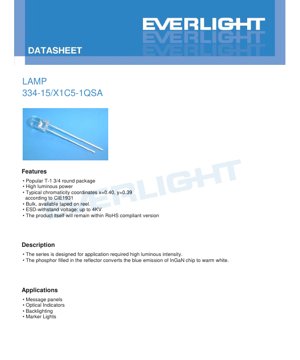
1. Product Overview
This document details the specifications for a high-performance warm white LED lamp. The device is designed for applications requiring significant luminous output within a compact, industry-standard package. Its core function is to provide efficient, reliable illumination across a range of indicator and lighting applications.
1.1 Core Advantages and Target Market
The primary advantages of this LED include its high luminous power output and its emission of a warm white light, achieved through a phosphor conversion system. It is housed in a popular T-1 3/4 round package, ensuring broad compatibility with existing sockets and designs. The device is also compliant with relevant environmental and handling standards, featuring ESD protection and RoHS compliance. Its target applications are diverse, spanning message panels, optical indicators, backlighting modules, and marker lights where clear, bright signaling is required.
2. Technical Parameter Deep-Dive
This section provides an objective analysis of the device's key electrical, optical, and thermal characteristics as defined in the datasheet.
2.1 Absolute Maximum Ratings
These ratings define the stress limits beyond which permanent damage to the device may occur. They are not intended for normal operation.
- Continuous Forward Current (IF): 30 mA. Exceeding this current continuously will overstress the semiconductor junction.
- Peak Forward Current (IFP): 100 mA at a 1/10 duty cycle and 1 kHz. This allows for brief pulses of higher current, useful in multiplexed display applications.
- Reverse Voltage (VR): 5 V. Applying a reverse bias voltage greater than this can cause junction breakdown.
- Power Dissipation (Pd): 110 mW. This is the maximum power the package can dissipate as heat under specified conditions.
- Operating & Storage Temperature: -40°C to +85°C and -40°C to +100°C, respectively, defining the environmental robustness of the device.
- ESD Withstand (HBM): 4 kV, indicating a good level of protection against electrostatic discharge during handling.
- Soldering Temperature: 260°C for 5 seconds, specifying the reflow soldering profile tolerance.
2.2 Electro-Optical Characteristics
These are the typical performance parameters measured at 25°C under standard test conditions (IF=20mA unless noted).
- Forward Voltage (VF): 2.8V to 3.6V. The voltage drop across the LED when conducting. The typical value is centered around 3.2V. Designers must ensure the driving circuit can accommodate this range.
- Luminous Intensity (IV): Ranges from 3600 mcd to 7150 mcd minimum, depending on the specific bin (see Section 3). This high intensity is a key feature for applications requiring high visibility.
- Viewing Angle (2θ1/2): 50 degrees (typical). This defines the angular width at which the luminous intensity drops to half its peak value, resulting in a moderately wide beam.
- Chromaticity Coordinates (x, y): x=0.40, y=0.39 (typical) according to the CIE 1931 color space. This places the emitted color in the warm white region.
- Zener Reverse Voltage (Vz): 5.2V typical at Iz=5mA. This integrated protection feature helps safeguard the LED from reverse voltage transients.
- Reverse Current (IR): 50 µA maximum at VR=5V, indicating very low leakage in the off-state.
3. Binning System Explanation
The device is categorized into bins to ensure consistency in key parameters. This allows designers to select LEDs that match their specific requirements for brightness and forward voltage.
3.1 Luminous Intensity Binning
LEDs are sorted into three primary bins based on their minimum luminous intensity at 20mA:
- Bin Q: 3600 - 4500 mcd
- Bin R: 4500 - 5650 mcd
- Bin S: 5650 - 7150 mcd
A tolerance of ±10% applies to these values. Selecting a higher bin (e.g., S) guarantees a brighter device.
3.2 Forward Voltage Binning
To aid in current matching for series connections or precise driver design, LEDs are also binned by forward voltage:
- Bin 0: 2.8 - 3.0 V
- Bin 1: 3.0 - 3.2 V
- Bin 2: 3.2 - 3.4 V
- Bin 3: 3.4 - 3.6 V
The measurement uncertainty is ±0.1V.
3.3 Color Binning (Chromaticity)
The warm white color is defined within a specific region on the CIE 1931 chromaticity diagram. The datasheet provides the corner coordinates for six color ranks (D1, D2, E1, E2, F1, F2), which are grouped together (Group 1). This grouping indicates that all these ranks fall within an acceptable warm white color space, with F1/F2 being warmer (lower correlated color temperature) and D1/D2 being cooler. The typical coordinates (x=0.40, y=0.39) lie within this grouped area.
4. Performance Curve Analysis
The provided graphs offer insight into the device's behavior under varying conditions.
4.1 Relative Intensity vs. Wavelength
The spectral power distribution curve shows a broad emission peak in the visible spectrum, characteristic of a phosphor-converted white LED. The peak is in the yellow region, with a underlying blue component from the InGaN chip, resulting in the warm white appearance.
4.2 Forward Current vs. Forward Voltage (IV Curve)
This curve exhibits the exponential relationship typical of a diode. The forward voltage increases logarithmically with current. The curve is essential for designing constant-current drivers, as a small change in voltage can lead to a large change in current.
4.3 Relative Intensity vs. Forward Current
Luminous output increases with forward current but not linearly. The curve may show a region of near-linear increase followed by a roll-off at higher currents due to efficiency droop and thermal effects. Operating at or below the recommended 20mA test current is advised for optimal efficiency and longevity.
4.4 Chromaticity vs. Forward Current & Thermal Performance
The chromaticity coordinates may shift slightly with drive current. The graph showing forward current vs. ambient temperature is crucial for thermal management. As ambient temperature rises, the maximum allowable forward current for a given junction temperature decreases. This derating curve must be followed to prevent overheating.
4.5 Directivity Pattern
The radiation pattern graph illustrates the spatial distribution of light. The T-1 3/4 package with a rounded lens produces a smooth, wide beam with the advertised 50-degree viewing angle.
5. Mechanical and Package Information
5.1 Package Dimensions
The LED uses a standard T-1 3/4 (5mm) round package. Key dimensional notes include:
- All dimensions are in millimeters with a general tolerance of ±0.25mm unless specified otherwise.
- Lead spacing is measured at the point where the leads exit the package body.
- The maximum protrusion of the resin below the flange is 1.5mm.
- The dimensional drawing provides exact measurements for overall length, lens diameter, lead diameter, and bending points, which are critical for PCB footprint design and mechanical fitting.
5.2 Polarity Identification
Polarity is typically indicated by the lead length (the longer lead is the anode) or by a flat spot on the package flange. The cathode is usually connected to the lead adjacent to this flat. Correct polarity is essential for operation and to avoid applying reverse bias.
6. Soldering and Assembly Guidelines
Proper handling is critical to reliability.
6.1 Lead Forming
- Bending must occur at least 3mm from the base of the epoxy bulb to avoid stress on the internal die and wire bonds.
- Form leads before soldering. Applying stress to a soldered joint can damage the PCB or the LED.
- Use proper tools to avoid stressing the package. Misalignment during PCB mounting can cause permanent stress.
- Cut leads at room temperature. High-temperature cutting can transfer heat and damage the device.
- Ensure PCB holes align perfectly with LED leads to avoid forced insertion.
6.2 Soldering Parameters
- Hand Soldering: Iron tip temperature maximum 300°C (for a 30W max iron), with a soldering time not exceeding 3 seconds per lead.
- Wave/DIP Soldering: Maximum preheat temperature of 100°C for up to 60 seconds.
- Maintain a distance of more than 3mm from the solder joint to the epoxy bulb. Soldering beyond the base of the tie bar (the small metal support between the leads inside the package) is recommended.
6.3 Storage Conditions
- Store at ≤30°C and ≤70% Relative Humidity after receipt. The recommended storage life in this condition is 3 months.
- For longer storage (up to one year), place the LEDs in a sealed container with a nitrogen atmosphere and desiccant.
- Avoid rapid temperature changes in high humidity to prevent condensation on and inside the package.
7. Packaging and Ordering Information
7.1 Packing Specification
The LEDs are packaged to prevent damage from moisture, static, and physical shock:
- Packed in anti-electrostatic bags.
- Minimum 200 to maximum 500 pieces per bag.
- Five bags are placed in one inner carton.
- Ten inner cartons are packed into one master (outside) carton.
7.2 Label Explanation
The label on the bag contains critical traceability and specification information:
- P/N: Part Number.
- QTY: Quantity in the bag.
- CAT: Combination code for Luminous Intensity and Forward Voltage bins.
- HUE: Color Rank (e.g., D1, F2).
- LOT No: Manufacturing lot number for traceability.
7.3 Model Number Designation
The part number 334-15/X1C5-1QSA follows a structured format where the placeholder squares (□) likely represent codes for specific bins of luminous intensity, forward voltage, and color rank, allowing precise ordering of the desired performance grade.
8. Application Suggestions
8.1 Typical Application Scenarios
- Message Panels & Scoreboards: Its high intensity and wide viewing angle make it suitable for character illumination in indoor/outdoor displays.
- Optical Indicators: Ideal for status lights on industrial equipment, consumer electronics, or control panels where a warm white indication is preferred.
- Backlighting: Can be used for edge-lighting small panels, signage, or decorative lighting.
- Marker Lights: Suitable for position indicators, exit signs, or low-level ambient pathway lighting.
8.2 Design Considerations
- Current Limiting: Always drive with a constant current source or a current-limiting resistor. Calculate the resistor value based on the supply voltage (Vs), the LED's forward voltage (Vf from its bin), and the desired current (e.g., 20mA): R = (Vs - Vf) / If.
- Thermal Management: While the package is not designed for high-power dissipation, ensure adequate ventilation in the application, especially if multiple LEDs are used or if operated near maximum current. Follow the current derating curve for elevated ambient temperatures.
- ESD Protection: Although rated for 4kV HBM, implement standard ESD precautions during assembly.
- Optical Design: The 50° viewing angle provides a good balance between beam width and intensity. For narrower beams, secondary optics (lenses) would be required.
9. Technical Comparison and Differentiation
Compared to generic 5mm white LEDs, this device offers several distinct advantages:
1. High Luminous Intensity: With bins up to 7150 mcd minimum, it delivers significantly more light output than standard indicator LEDs, enabling use in higher-ambient-light conditions.
2. Defined Warm White Chromaticity: The specified color coordinates and binning ensure a consistent, pleasant warm white color, unlike cool white or bluish-white LEDs.
3. Integrated Zener Protection: The built-in 5.2V Zener diode across the LED provides a measure of protection against reverse voltage spikes, enhancing reliability in electrically noisy environments.
4. Robust Specifications: Detailed maximum ratings, performance curves, and handling guidelines provide engineers with the data needed for reliable, long-term design.
10. Frequently Asked Questions (Based on Technical Parameters)
Q: What is the difference between Bin Q, R, and S?
A: These bins categorize the minimum luminous intensity. Bin S is the brightest (5650-7150 mcd min), Bin R is medium (4500-5650 mcd min), and Bin Q is the standard brightness (3600-4500 mcd min). Choose based on your application's brightness requirement.
Q: Can I drive this LED at 30mA continuously?
A: While 30mA is the absolute maximum continuous rating, the standard test condition and typical operating point is 20mA. Operating at 30mA will produce more light but will generate more heat, potentially reducing lifespan and shifting color. For optimal reliability, design for 20mA or less.
Q: How do I interpret the color coordinates (x=0.40, y=0.39)?
A> These coordinates plot a point on the CIE 1931 chromaticity diagram. This specific point falls within the \"warm white\" region, typically associated with a correlated color temperature (CCT) in the range of 3000K-4000K, similar to the warm white of an incandescent or halogen bulb.
Q: The LED has a Zener diode. Does this mean I don't need a series resistor for reverse protection?
A: No. The Zener diode primarily clamps reverse voltage to about 5.2V, protecting the LED from reverse bias. You still absolutely require a current-limiting resistor (or constant-current driver) in series when powering the LED in the forward direction to control the current and prevent thermal runaway.
11. Design and Usage Case Study
Scenario: Designing a multi-LED exit sign.
1. Requirement: 12 LEDs to illuminate the word \"EXIT\". Need consistent brightness and color across all LEDs. Operates from a 12VDC power supply in an indoor environment (Ta max ~40°C).
2. LED Selection: Choose LEDs from the same Intensity Bin (e.g., Bin R) and the same Color Group (Group 1) to ensure uniformity. Selecting the same Forward Voltage Bin (e.g., Bin 1) will also help if connecting in parallel.
3. Circuit Design: Connect 3 LEDs in series with a current-limiting resistor, and create 4 such identical strings in parallel. For a Bin 1 LED (Vf typ 3.1V), three in series drop ~9.3V. For a 12V supply and a target current of 18mA (slightly derated for longevity), R = (12V - 9.3V) / 0.018A ≈ 150 Ω. Calculate resistor power rating: P = I²R = (0.018)² * 150 ≈ 0.049W, so a standard 1/8W (0.125W) resistor is sufficient.
4. Layout: Follow the mechanical drawing for PCB pad spacing. Ensure the 3mm lead bending rule is observed if leads need forming. Provide some spacing between LEDs for heat dissipation.
5. Result: A reliably illuminated sign with uniform appearance, operating within all specified limits of the LED.
12. Operational Principle Introduction
This is a phosphor-converted white LED. The core light-emitting element is a semiconductor chip made of Indium Gallium Nitride (InGaN), which emits blue light when a forward current is applied across its p-n junction (electroluminescence). This blue light is not emitted directly. Instead, the LED's reflector cup is filled with a yellow (or yellow-red) phosphor material. When the blue photons from the chip strike the phosphor particles, they are absorbed. The phosphor then re-emits light across a broader spectrum, primarily in the yellow and red regions. The combination of the remaining unabsorbed blue light and the newly emitted yellow/red light mixes perceptually to create white light. The specific blend of phosphors determines the color temperature—in this case, a \"warm white\" with more red spectral content. The integrated Zener diode is a separate semiconductor component connected in parallel but with opposite polarity (cathode to anode) to protect the fragile LED junction from reverse voltage breakdown.
13. Technology Trends and Context
The device described represents a mature, widely adopted technology. The T-1 3/4 (5mm) through-hole package has been an industry standard for decades for indicator and low-level lighting applications. Current trends in the broader LED industry are moving towards:
1. Increased Efficiency (lm/W): Newer chip designs and advanced phosphors continue to improve the amount of light output per electrical watt, reducing energy consumption.
2. Surface-Mount Device (SMD) Dominance: For most new designs, SMD packages (like 3528, 5050, or smaller) are preferred due to their smaller size, suitability for automated assembly, and often better thermal path to the PCB.
3. Higher Color Quality and Consistency: Tighter binning for color (using metrics like MacAdam Ellipses) and improved Color Rendering Index (CRI) are becoming standard for lighting applications.
4. Integrated Solutions: LEDs with built-in drivers (constant-current ICs), controllers, or multiple color channels (RGB, RGBW) in a single package are growing in popularity for smart lighting.
Despite these trends, the through-hole LED lamp remains highly relevant for applications requiring simple replacement, high single-point intensity, robustness in harsh environments, or where through-hole PCB assembly is specified. Its well-defined characteristics and long history make it a reliable and predictable choice for many engineering designs.
LED Specification Terminology
Complete explanation of LED technical terms
Photoelectric Performance
| Term | Unit/Representation | Simple Explanation | Why Important |
|---|---|---|---|
| Luminous Efficacy | lm/W (lumens per watt) | Light output per watt of electricity, higher means more energy efficient. | Directly determines energy efficiency grade and electricity cost. |
| Luminous Flux | lm (lumens) | Total light emitted by source, commonly called "brightness". | Determines if the light is bright enough. |
| Viewing Angle | ° (degrees), e.g., 120° | Angle where light intensity drops to half, determines beam width. | Affects illumination range and uniformity. |
| CCT (Color Temperature) | K (Kelvin), e.g., 2700K/6500K | Warmth/coolness of light, lower values yellowish/warm, higher whitish/cool. | Determines lighting atmosphere and suitable scenarios. |
| CRI / Ra | Unitless, 0–100 | Ability to render object colors accurately, Ra≥80 is good. | Affects color authenticity, used in high-demand places like malls, museums. |
| SDCM | MacAdam ellipse steps, e.g., "5-step" | Color consistency metric, smaller steps mean more consistent color. | Ensures uniform color across same batch of LEDs. |
| Dominant Wavelength | nm (nanometers), e.g., 620nm (red) | Wavelength corresponding to color of colored LEDs. | Determines hue of red, yellow, green monochrome LEDs. |
| Spectral Distribution | Wavelength vs intensity curve | Shows intensity distribution across wavelengths. | Affects color rendering and quality. |
Electrical Parameters
| Term | Symbol | Simple Explanation | Design Considerations |
|---|---|---|---|
| Forward Voltage | Vf | Minimum voltage to turn on LED, like "starting threshold". | Driver voltage must be ≥Vf, voltages add up for series LEDs. |
| Forward Current | If | Current value for normal LED operation. | Usually constant current drive, current determines brightness & lifespan. |
| Max Pulse Current | Ifp | Peak current tolerable for short periods, used for dimming or flashing. | Pulse width & duty cycle must be strictly controlled to avoid damage. |
| Reverse Voltage | Vr | Max reverse voltage LED can withstand, beyond may cause breakdown. | Circuit must prevent reverse connection or voltage spikes. |
| Thermal Resistance | Rth (°C/W) | Resistance to heat transfer from chip to solder, lower is better. | High thermal resistance requires stronger heat dissipation. |
| ESD Immunity | V (HBM), e.g., 1000V | Ability to withstand electrostatic discharge, higher means less vulnerable. | Anti-static measures needed in production, especially for sensitive LEDs. |
Thermal Management & Reliability
| Term | Key Metric | Simple Explanation | Impact |
|---|---|---|---|
| Junction Temperature | Tj (°C) | Actual operating temperature inside LED chip. | Every 10°C reduction may double lifespan; too high causes light decay, color shift. |
| Lumen Depreciation | L70 / L80 (hours) | Time for brightness to drop to 70% or 80% of initial. | Directly defines LED "service life". |
| Lumen Maintenance | % (e.g., 70%) | Percentage of brightness retained after time. | Indicates brightness retention over long-term use. |
| Color Shift | Δu′v′ or MacAdam ellipse | Degree of color change during use. | Affects color consistency in lighting scenes. |
| Thermal Aging | Material degradation | Deterioration due to long-term high temperature. | May cause brightness drop, color change, or open-circuit failure. |
Packaging & Materials
| Term | Common Types | Simple Explanation | Features & Applications |
|---|---|---|---|
| Package Type | EMC, PPA, Ceramic | Housing material protecting chip, providing optical/thermal interface. | EMC: good heat resistance, low cost; Ceramic: better heat dissipation, longer life. |
| Chip Structure | Front, Flip Chip | Chip electrode arrangement. | Flip chip: better heat dissipation, higher efficacy, for high-power. |
| Phosphor Coating | YAG, Silicate, Nitride | Covers blue chip, converts some to yellow/red, mixes to white. | Different phosphors affect efficacy, CCT, and CRI. |
| Lens/Optics | Flat, Microlens, TIR | Optical structure on surface controlling light distribution. | Determines viewing angle and light distribution curve. |
Quality Control & Binning
| Term | Binning Content | Simple Explanation | Purpose |
|---|---|---|---|
| Luminous Flux Bin | Code e.g., 2G, 2H | Grouped by brightness, each group has min/max lumen values. | Ensures uniform brightness in same batch. |
| Voltage Bin | Code e.g., 6W, 6X | Grouped by forward voltage range. | Facilitates driver matching, improves system efficiency. |
| Color Bin | 5-step MacAdam ellipse | Grouped by color coordinates, ensuring tight range. | Guarantees color consistency, avoids uneven color within fixture. |
| CCT Bin | 2700K, 3000K etc. | Grouped by CCT, each has corresponding coordinate range. | Meets different scene CCT requirements. |
Testing & Certification
| Term | Standard/Test | Simple Explanation | Significance |
|---|---|---|---|
| LM-80 | Lumen maintenance test | Long-term lighting at constant temperature, recording brightness decay. | Used to estimate LED life (with TM-21). |
| TM-21 | Life estimation standard | Estimates life under actual conditions based on LM-80 data. | Provides scientific life prediction. |
| IESNA | Illuminating Engineering Society | Covers optical, electrical, thermal test methods. | Industry-recognized test basis. |
| RoHS / REACH | Environmental certification | Ensures no harmful substances (lead, mercury). | Market access requirement internationally. |
| ENERGY STAR / DLC | Energy efficiency certification | Energy efficiency and performance certification for lighting. | Used in government procurement, subsidy programs, enhances competitiveness. |