1. Introduction & Overview
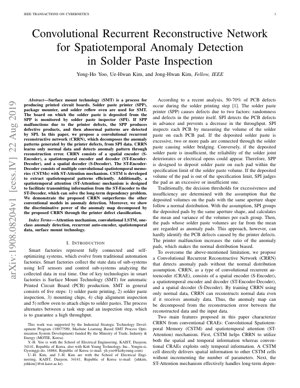
This paper addresses a critical pain point in Surface Mount Technology (SMT) for Printed Circuit Board (PCB) manufacturing: defect detection during the solder paste printing stage. Traditional inspection methods, which rely on statistical assumptions of normal distribution for solder paste volume, fail when printer malfunctions systematically bias the data. The proposed Convolutional Recurrent Reconstructive Network (CRRN) is a novel one-class anomaly detection model that learns only from normal data patterns and identifies anomalies through reconstruction error. It is specifically designed to handle the spatiotemporal nature of Solder Paste Inspection (SPI) data, where defects manifest as spatial patterns that evolve over sequential PCB productions.
50-70%
of PCB defects originate in the solder printing step.
One-Class Learning
CRRN is trained exclusively on normal data, eliminating the need for labeled anomaly samples.
2. Methodology: The CRRN Architecture
The CRRN is a specialized autoencoder comprising three core modules designed for efficient spatiotemporal feature learning and reconstruction.
2.1 Spatial Encoder (S-Encoder)
The S-Encoder compresses the spatial information of a single SPI frame (e.g., solder paste volume map) into a lower-dimensional latent vector using standard convolutional layers. It transforms the input $X_t \in \mathbb{R}^{H \times W \times C}$ into a spatial feature representation $h_t^s$.
2.2 Spatiotemporal Encoder-Decoder (ST-Encoder-Decoder)
This is the heart of the CRRN, responsible for modeling temporal dependencies across a sequence of spatial features $\{h_1^s, h_2^s, ..., h_T^s\}$.
2.2.1 Convolutional Spatiotemporal Memory (CSTM)
A novel recurrent unit developed to replace traditional ConvLSTM. The CSTM is designed for more efficient spatiotemporal pattern extraction, likely by modifying gating mechanisms or memory cell operations to be more parameter-efficient or better suited for the specific structure of SPI data. The state update can be conceptually represented as:
$C_t, H_t = \text{CSTM}(H_{t-1}, C_{t-1}, h_t^s; \Theta)$
where $C_t$ is the cell state, $H_t$ is the hidden state, and $\Theta$ are learnable parameters.
2.2.2 ST-Attention Mechanism
To address the vanishing gradient problem in long sequences, an ST-Attention mechanism is integrated. It allows the decoder to dynamically focus on relevant hidden states from the encoder across both space and time, facilitating better information flow. The attention weight $\alpha_{t,t'}$ for decoder step $t$ looking back at encoder step $t'$ might be computed as:
$\alpha_{t,t'} = \frac{\exp(\text{score}(H_t^{dec}, H_{t'}^{enc}))}{\sum_{k}\exp(\text{score}(H_t^{dec}, H_{k}^{enc}))}$
The context vector is then a weighted sum: $c_t = \sum_{t'} \alpha_{t,t'} H_{t'}^{enc}$.
2.3 Spatial Decoder (S-Decoder)
The S-Decoder takes the output from the ST-Decoder (a sequence of spatiotemporal context vectors) and uses transposed convolutions to reconstruct the original sequence of SPI frames $\{\hat{X}_1, \hat{X}_2, ..., \hat{X}_T\}$.
3. Technical Details & Mathematical Formulation
The core objective is reconstruction loss minimization for normal sequences. The loss function $\mathcal{L}$ is typically the Mean Squared Error (MSE) between the original and reconstructed sequences:
$\mathcal{L} = \frac{1}{T} \sum_{t=1}^{T} \| X_t - \hat{X}_t \|_2^2$
During inference, an anomaly score $A_t$ for a frame at time $t$ is computed based on the reconstruction error:
$A_t = \| X_t - \hat{X}_t \|_2^2$
A threshold $\tau$ is then applied to $A_t$ to classify the frame (and by extension, the PCB) as normal or anomalous. The model's strength lies in its inability to accurately reconstruct patterns it has not seen during training (i.e., anomalies).
4. Experimental Results & Performance
The paper demonstrates CRRN's superiority over conventional models like standard Autoencoders (AE), Variational Autoencoders (VAE), and simpler recurrent models. Key results include:
- Higher Anomaly Detection Accuracy: CRRN achieved superior performance metrics (e.g., F1-score, AUC-ROC) on SPI datasets containing printer-induced defects compared to baselines.
- Effective Anomaly Localization: Beyond binary detection, CRRN generates an anomaly map by highlighting regions with high reconstruction error. This map was shown to have discriminative power, successfully aiding in the classification of specific printer defect types (e.g., stencil clogging, misalignment).
- Robustness to Long Sequences: The ST-Attention mechanism proved crucial for maintaining performance over long temporal sequences of PCB production, a common scenario in real-world SMT lines.
Chart Description: A hypothetical performance chart would show CRRN's AUC-ROC curve significantly above curves for AE, VAE, and LSTM-based autoencoders, especially at low false positive rates critical for industrial applications.
5. Analysis Framework & Case Study
Scenario: A PCB assembly line experiences intermittent solder bridging. Traditional SPI thresholding fails to pinpoint the root cause as it flags many pads as "excessive" due to a shifted distribution.
CRRN Application:
- Training Phase: CRRN is trained on several weeks of SPI volume map data from periods of known-good printer operation.
- Inference & Detection: During live production, CRRN processes the sequence of PCBs. It flags a specific PCB with a high overall anomaly score.
- Root Cause Analysis: The generated anomaly map for the flagged PCB shows a spatially contiguous pattern of high error along one axis of the board, not just random isolated pads.
- Diagnosis: This spatial pattern is characteristic of a printer squeegee blade wear defect, which applies paste unevenly. Maintenance is alerted to replace the blade, preventing further defective batches.
6. Future Applications & Research Directions
- Cross-Domain Adaptation: Applying the CRRN framework to other spatiotemporal anomaly detection tasks in Industry 4.0, such as vibration analysis in rotating machinery, thermal imaging in electronics assembly, or video surveillance for assembly line safety.
- Integration with Digital Twins: Embedding CRRN as an anomaly detection module within a digital twin of the SMT line for real-time simulation and prescriptive analytics.
- Few-Shot or Semi-Supervised Learning: Enhancing CRRN to incorporate a small number of labeled anomaly examples to improve detection specificity for known critical defects.
- Explainability Enhancement: Developing methods to make the ST-Attention weights and anomaly maps more interpretable for plant engineers, perhaps by linking attention foci to specific physical components of the printer.
- Edge Deployment: Optimizing the model for deployment on edge devices within the SPI machine for low-latency, in-situ anomaly detection.
7. References
- Yoo, Y.-H., Kim, U.-H., & Kim, J.-H. (Year). Convolutional Recurrent Reconstructive Network for Spatiotemporal Anomaly Detection in Solder Paste Inspection. IEEE Transactions on Cybernetics.
- Hochreiter, S., & Schmidhuber, J. (1997). Long Short-Term Memory. Neural Computation.
- Vaswani, A., et al. (2017). Attention Is All You Need. Advances in Neural Information Processing Systems.
- Zhao, Y., et al. (2017). Spatiotemporal Stacked Autoencoders for Anomaly Detection in Videos. Pattern Recognition.
- International Electronics Manufacturing Initiative (iNEMI) reports on SMT technology trends and defect analysis.
8. Expert Analysis & Critical Review
Core Insight
This paper isn't just another neural network tweak; it's a targeted surgical strike on a multi-billion dollar industry's chronic waste problem. The authors correctly identify that the real value in smart manufacturing isn't in detecting a defective board—it's in diagnosing the machine that made it, in real-time, before it produces a thousand more. By framing printer defects as spatiotemporal anomalies, they move beyond simplistic per-pad statistics to a holistic system-level view. This is the difference between a mechanic listening to a single engine knock and an aerospace engineer analyzing the entire flight data recorder.
Logical Flow
The architectural logic is sound and reflects lessons learned from adjacent fields. The use of a reconstructive (autoencoder) approach for one-class learning is well-established in anomaly detection literature, as it elegantly sidesteps the near-impossible task of collecting labeled data for every possible printer failure mode. The innovation lies in the hybridization: marrying the spatial prowess of CNNs (proven in image analysis) with the temporal modeling of recurrent networks, then supercharging it with an attention mechanism. The ST-Attention is a direct, pragmatic adoption of the transformer paradigm's success in NLP (as seen in the seminal "Attention is All You Need" paper) to solve the industrial analog of long-term dependency—tracking a degrading mechanical part across hours of production.
Strengths & Flaws
Strengths: The model's discriminative anomaly maps are its killer feature. This provides actionable intelligence, not just an alarm bell. The focus on real-world SPI data grounds the research in tangible industrial relevance, a refreshing contrast to models only tested on curated academic datasets like MNIST-variants for anomaly detection. The proposed CSTM unit suggests an understanding that off-the-shelf ConvLSTM might be overkill or inefficient for this specific data structure.
Potential Flaws & Questions: The paper is light on the computational cost and inference latency. In a high-speed SMT line producing a board every few seconds, can CRRN keep up? The "one-class" training assumes a clean, anomaly-free dataset, which is a notorious challenge in real factory settings—how robust is it to slight contamination in the training data? Furthermore, while the architecture is sophisticated, the community would benefit from an ablation study quantitatively proving the necessity of each component (CSTM vs. ConvLSTM, with/without ST-Attention) for this specific task.
Actionable Insights
For manufacturing engineers, this research is a blueprint to transition from reactive to predictive quality control. The immediate step is to pilot CRRN on a single, critical SPP line, focusing on its anomaly mapping to guide maintenance schedules. For AI researchers, the work validates the immense potential of applying advanced sequence-to-sequence models with attention to industrial time-series and image-sequence data. The next frontier, as hinted in iNEMI roadmaps, is moving from detection to prescription—could the CRRN's latent space not only flag a worn squeegee but also recommend optimal pressure and speed adjustments to compensate for it until the next maintenance window? That would be the true leap from a smart detector to a self-optimizing production system.