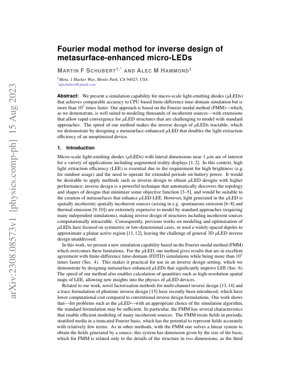
Fourier Modal Method for Inverse Design of Metasurface-Enhanced Micro-LEDs
A novel simulation capability based on the Fourier Modal Method (FMM) enabling fast and accurate inverse design of micro-LEDs with metasurfaces for enhanced light extraction efficiency.
Home »
Documentation »
Fourier Modal Method for Inverse Design of Metasurface-Enhanced Micro-LEDs
1. Introduction
Micro-scale light-emitting diodes (µLEDs) are critical components for next-generation displays, particularly in augmented reality (AR) applications where high brightness and energy efficiency are paramount. A key performance metric is Light Extraction Efficiency (LEE). Traditional design methods struggle with the computational complexity of modeling spatially incoherent light sources inherent to µLEDs (e.g., from spontaneous emission), making advanced optimization techniques like inverse design computationally intractable. This work introduces a simulation framework based on the Fourier Modal Method (FMM) that overcomes this barrier, enabling efficient and accurate inverse design of metasurface-enhanced µLEDs.
2. Methodology
The core of this work is an adapted and extended Fourier Modal Method.
2.1 Fourier Modal Method (FMM) Fundamentals
FMM, also known as Rigorous Coupled-Wave Analysis (RCWA), models electromagnetic fields in periodic, stratified media by expanding them in a truncated Fourier basis. The fields in the direction of stratification (e.g., the vertical direction in a layered structure) are handled analytically. This leads to a linear system whose size depends only on the in-plane (2D) complexity, allowing for relatively small system matrices solvable by direct methods.
2.2 Extensions for Incoherent Source Modeling
Standard FMM assumes periodic sources. Modeling a single, localized incoherent source (like a dipole in a µLED) as periodic introduces non-physical interference. The authors address this by implementing Brillouin zone integration [17-19]. This technique involves sampling multiple wavevectors across the Brillouin zone and integrating the results, effectively simulating a localized source within a periodic array without artificial coherence effects.
2.3 Addressing Convergence Challenges
Classic FMM formulations suffer from poor convergence in structures containing metals or high-index-contrast materials (the "Li factorization" problem [16]). This work employs a vector formulation of FMM with an improved method for computing vector fields, which dramatically improves convergence rates for the challenging material stacks found in µLEDs.
3. Technical Implementation & FMMAX
The method is implemented in a tool named FMMAX. A key advantage for inverse design is computational reuse: the expensive eigendecomposition steps required to build the system matrix for each layer need only be recalculated when that layer's profile changes. During optimization, where many layers may remain constant between iterations, this provides massive computational savings.
4. Results & Performance
Speedup Factor
>107x
Faster than CPU-based FDTD
LEE Improvement
2x
Via inverse-designed metasurface
4.1 Speed and Accuracy Benchmark
The FMM-based approach achieves accuracy comparable to Finite-Difference Time-Domain (FDTD) simulations, the gold standard for accuracy in computational electromagnetics, while being more than 10 million times faster. This performance leap transforms inverse design from intractable to practical.
4.2 Inverse Design Case Study
The power of the method is demonstrated by inversely designing a metasurface integrated atop a µLED. The optimized metasurface doubles the Light Extraction Efficiency (LEE) compared to an unoptimized baseline device. Furthermore, the method's speed enables the generation of high-resolution spatial maps of LEE, providing new physical insights into device performance.
Chart Description (Conceptual): A bar chart would show "Unoptimized µLED LEE" at a normalized value of 1.0, and "Metasurface-Enhanced µLED (Inverse Designed)" at a value of 2.0. A line graph inset could show the convergence of the inverse design optimization, with the objective function (e.g., 1/LEE) rapidly decreasing over a few hundred iterations.
5. Analysis & Expert Commentary
Core Insight:
The paper's breakthrough isn't a new algorithm per se, but the strategic resuscitation and augmentation of an existing one (FMM) for a problem (incoherent source inverse design) deemed computationally prohibitive. It's a masterclass in pragmatic engineering: identifying that the bottleneck was the simulator, not the optimizer, and surgically fixing it. This shifts the paradigm for µLED design from slow, intuition-based tweaks to rapid, algorithmic exploration.
Logical Flow & Comparison:
The authors correctly identify that prior work either simplified the physics (using sparse dipoles) or the geometry (exploiting symmetry), leaving 3D inverse design unsolved. Their solution flow is elegant: 1) Choose FMM for its inherent efficiency with stratified structures. 2) Fix its known flaws (convergence, periodicity) with modern formulations. 3) Leverage the resulting speed for inverse design. The >107x speedup claim is staggering. To contextualize, this is akin to reducing a simulation that took a year to less than 3 seconds. While FDTD is notoriously heavy, this gap underscores how algorithm choice dominates computational scaling. This mirrors lessons from other fields; for instance, the success of CycleGAN [Zhu et al., 2017] wasn't due to more compute, but a clever cyclic consistency loss that enabled unpaired image translation where previous methods failed.
Strengths & Flaws:
Strengths: The performance claim is the crown jewel, backed by a clear methodology. The use of Brillouin zone integration is a textbook-perfect solution to the localized source problem. The open-source implementation (FMMAX) is a significant contribution, enabling verification and adoption. The 2x LEE improvement is a tangible, industry-relevant result.
Potential Flaws & Questions: The paper is light on the specifics of the inverse design algorithm (e.g., which adjoint method, regularization). The 107x speedup, while plausible for a single simulation, may narrow when considering the thousands of simulations required for a full inverse design loop—though it remains transformative. The method is inherently limited to periodic, stratified structures. It cannot handle truly arbitrary, non-layered 3D geometries, which is a domain where methods like topology optimization with FDTD still reign, albeit slowly.
Actionable Insights:
For AR/VR companies: This tool is a direct enabler for designing the next generation of ultra-bright, efficient micro-displays. Prioritize integrating this simulation capability into your R&D pipeline. For Photonic CAD/TCAD developers: The success of FMMAX highlights a market need for fast, specialized solvers, not just general-purpose ones. Develop modular solvers that can be plugged into optimization frameworks. For Researchers: The core idea—retrofitting a "fast" solver to handle "hard" physics—is generalizable. Explore applying similar principles (e.g., with Boundary Element Methods or specialized FFT solvers) to other inverse design problems in acoustics, mechanics, or thermal management.
6. Technical Details & Mathematical Formulation
The Fourier Modal Method solves Maxwell's equations in a layer with periodic permittivity $\epsilon(x,y)$. The electric and magnetic fields are expanded in Fourier series:
$$
\mathbf{E}(x,y,z) = \sum_{\mathbf{G}} \mathbf{E}_{\mathbf{G}}(z) e^{i(\mathbf{k}_{\parallel} + \mathbf{G}) \cdot \mathbf{r}_{\parallel}}
$$
$$
\mathbf{H}(x,y,z) = \sum_{\mathbf{G}} \mathbf{H}_{\mathbf{G}}(z) e^{i(\mathbf{k}_{\parallel} + \mathbf{G}) \cdot \mathbf{r}_{\parallel}}
$$
where $\mathbf{G}$ are reciprocal lattice vectors, $\mathbf{k}_{\parallel}$ is the in-plane wavevector, and $\mathbf{r}_{\parallel} = (x,y)$. Substituting into Maxwell's equations leads to a system of ordinary differential equations in $z$ for the Fourier coefficients $\mathbf{E}_{\mathbf{G}}(z)$ and $\mathbf{H}_{\mathbf{G}}(z)$, which can be solved via eigen-decomposition. The scattering at interfaces between layers is solved using a scattering matrix (S-matrix) algorithm for numerical stability.
The key extension for incoherent sources is that the total extracted power $P_{\text{ext}}$ for a distribution of dipoles is computed by integrating over the Brillouin zone (BZ) and summing over dipole positions $\mathbf{r}_0$ and orientations $\hat{\mathbf{p}}$:
$$
P_{\text{ext}} \propto \sum_{\hat{\mathbf{p}}} \int_{\text{BZ}} d\mathbf{k}_{\parallel} \sum_{\mathbf{r}_0} \left| \mathbf{E}_{\text{ext}}(\mathbf{k}_{\parallel}, \hat{\mathbf{p}}, \mathbf{r}_0) \right|^2
$$
This integration averages out the coherent interference that would arise from assuming a single periodic source, correctly modeling the incoherent emission.
7. Analysis Framework: A Conceptual Case Study
Scenario: Optimizing a nano-patterned sapphire substrate (NPSS) for a blue µLED to enhance LEE.
Framework Application:
Parameterization: Define the nano-pattern as a 2D pixelated grating with a fixed period. Each pixel's etch depth is a design variable.
Forward Model: Use FMMAX to compute the LEE for the current structure. The tool efficiently handles the multilayer stack (active region, p-GaN, NPSS, air).
Gradient Computation: Employ the adjoint method. FMM's formulation allows for efficient calculation of the gradient of LEE with respect to all etch depth variables simultaneously—this is where the speed is critical.
Optimization Loop: Use a gradient-based algorithm (e.g., L-BFGS) to update the etch depths to maximize LEE. The eigendecompositions for unmodified layers (like the uniform active region) are cached and reused.
Validation: The final, irregular pattern discovered by the algorithm would be fabricated and measured, showing superior LEE compared to standard periodic gratings.
This case study illustrates how the framework automates the discovery of complex, non-intuitive patterns that scatter light more effectively than human-designed ones.
8. Future Applications & Directions
Multi-Physics Optimization: Extend inverse design to co-optimize LEE with electrical properties (current spreading, thermal management) and color conversion efficiency for full-color µLEDs.
Beyond Displays: Apply the same fast incoherent source modeling to inverse design for highly efficient solid-state lighting (LED bulbs), single-photon sources for quantum technologies, and enhanced photodetectors.
Algorithm Integration: Integrate FMMAX with more advanced optimization frameworks, such as those handling multi-objective goals or manufacturability constraints (minimum feature size, etch angles).
Material Discovery: Use the framework in a "closed-loop" system with high-throughput experimentation to not only design structures but also suggest promising new material combinations for active layers or metasurfaces.
Neural Network Surrogate Models: The speed of FMMAX allows for generating massive datasets to train neural networks as ultra-fast surrogate models, enabling real-time interactive design exploration.
9. References
Z. Liu et al., "Micro-LEDs for Augmented Reality Displays," Nature Photonics, vol. 15, pp. 1–12, 2021.
J. A. Fan et al., "Inverse Design of Photonic Structures," Nature Photonics, vol. 11, no. 9, pp. 543–554, 2017.
L. Su et al., "Inverse Design of Nanophotonic Structures Using Adjoint Methods," IEEE Journal of Selected Topics in Quantum Electronics, vol. 26, no. 2, 2020.
M. G. Moharam and T. K. Gaylord, "Rigorous coupled-wave analysis of planar-grating diffraction," J. Opt. Soc. Am., vol. 71, no. 7, pp. 811–818, 1981.
P. Lalanne and G. M. Morris, "Highly improved convergence of the coupled-wave method for TM polarization," J. Opt. Soc. Am. A, vol. 13, no. 4, pp. 779–784, 1996.
J. Zhu et al., "Unpaired Image-to-Image Translation using Cycle-Consistent Adversarial Networks," Proc. IEEE ICCV, 2017. (External reference for algorithmic insight comparison).
U.S. Department of Energy, "Solid-State Lighting R&D Plan," 2022. (External reference for industry importance).
L. Li, "Use of Fourier series in the analysis of discontinuous periodic structures," J. Opt. Soc. Am. A, vol. 13, no. 9, pp. 1870–1876, 1996. (Reference for convergence challenges).
M. F. S. Schubert and A. M. Hammond, "FMMAX: Fourier Modal Method for Stratified Media," GitHub Repository, 2023. (Reference for the implementation).