1. Introduction & Overview
This paper presents a novel Internet of Things (IoT) optical sensor design based on series-connected Red, Green, and Blue (RGB) Light-Emitting Diodes (LEDs). The core innovation lies in its phototransistor-like behavior, where the sensor's optoelectrical response can be controlled or "programmed" by incident light of different colors. This device operates dually as both a transmitter and receiver in Visible Light Communication (VLC) systems, potentially reducing system complexity and cost for IoT networks.
Max Responsivity
Violet Light (B+R)
Peak AC/DC response
Key Feature
Light-Programmable
Response controlled by impinging light color
Primary Application
VLC for IoT
Transceiver functionality
2. RGB Sensor Model & Experimental Setup
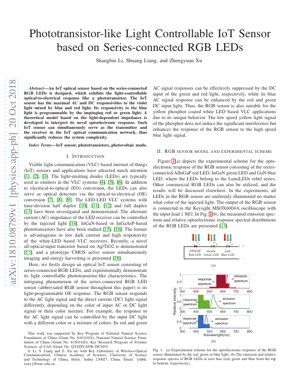
The sensor is constructed by connecting an AlInGaP red LED, an InGaN green LED, and a GaN blue LED in series (LumiLEDs rebel series). All LEDs are uniformly illuminated during experiments.
2.1 Experimental Configuration
The output of the RGB sensor is connected to a Keysight MSOX6004A oscilloscope with a 1 MΩ input load. The setup allows for precise measurement of the sensor's response to various colored light inputs (red, green, blue, and mixtures).
2.2 LED Characteristics & Spectra
Figure 1(b) in the paper shows the measured emission spectrum and relative optoelectronic response spectral distributions for each RGB LED at zero bias. This data is crucial for understanding the wavelength-dependent behavior of each component within the series circuit.
3. Core Technical Principle & Model
The sensor's operation is interpreted through a light-dependent impedance model. The incident light alters the effective impedance of the individual LEDs in the series chain, thereby modulating the overall current flow and voltage output of the sensor.
3.1 Light-Dependent Impedance Model
The optoelectronic response is complex, involving photoconductive and photovoltaic modes, as well as photocurrent generation from exciton dissociation. The model treats the LED receiver as a current source when the load impedance is sufficiently small.
3.2 Photovoltaic vs. Photoconductive Modes
The sensor likely exploits both modes: the photovoltaic effect generates a voltage/current from absorbed photons, while the photoconductive effect changes the semiconductor's conductivity. The series connection creates interdependencies between these effects across different color channels.
4. Experimental Results & Performance
4.1 AC/DC Responsivity Measurements
The sensor exhibits maximal AC and DC responsivity to violet light, created by mixing blue and red light. This indicates a synergistic effect when multiple junctions are activated simultaneously.
4.2 Color-Programmable Response
This is the hallmark feature:
- The sensor's responsivity to blue AC light can be enhanced by impinging red or green DC light.
- The response to red AC signal can be suppressed by green DC light.
- The response to green AC signal can be suppressed by red DC light.
4.3 Key Performance Metrics
The paper highlights suitability for phosphor-coated white LED VLC. The slow yellow phosphor emission does not cause significant interference but can enhance the response to the high-speed blue pump light signal, offering a built-in filtering advantage.
5. Analyst's Perspective: Core Insight & Critique
Core Insight: This isn't just a clever circuit trick; it's a fundamental rethinking of the LED as a multifunctional optoelectronic unit cell. The authors have effectively created a "color-coded optoelectronic transistor" by leveraging the intrinsic photovoltaic properties and spectral sensitivities of commercial RGB LEDs in series. The real genius is in using the color of light itself as the control variable, moving beyond traditional electrical biasing. This aligns with a broader trend in neuromorphic and in-sensor computing, where devices perform analog processing at the point of sensing, as seen in research from institutes like MIT's Microsystems Technology Laboratories on vision sensors.
Logical Flow: The logic is elegant: 1) Series connection forces current continuity, 2) Each LED's impedance is a function of incident photon flux at its specific bandgap, 3) Therefore, the total voltage/current output becomes a non-linear function of the spectral composition of the input light. This creates the programmable transfer function. It's a hardware implementation of a function that would typically require separate sensors, filters, and a microprocessor.
Strengths & Flaws: The strength is profound simplicity and cost-effectiveness, using entirely off-the-shelf components to achieve novel functionality. The dual transceiver capability is a major win for IoT node miniaturization and power budget. However, the glaring flaw is the paper's silence on speed and bandwidth. Phototransistors, like those based on InGaAs (as referenced from works in IEEE Journal of Quantum Electronics), trade gain for bandwidth. What is the -3dB modulation bandwidth of this RGB sensor under various control light conditions? For VLC, this is paramount. Furthermore, the linearity and dynamic range of the "gain" control via DC light are unexplored but critical for practical communication systems.
Actionable Insights: For researchers: Probe the transient response and noise characteristics immediately. The impedance model needs refinement to predict AC behavior. For product developers: This is a golden ticket for low-cost, smart ambient light sensors that can discern not just intensity but spectral context (e.g., is this blue light from a screen or the sky?). Partner with VLC standard groups (like IEEE 802.15.7) to define control channel protocols using this color-gating feature. The future isn't just in making the sensor, but in defining the "color language" it uses to communicate and compute.
6. Technical Details & Mathematical Formulation
The paper develops a theoretical model based on light-dependent impedance. The effective impedance of an LED under illumination can be represented as a function of the photogenerated current. For a simplified model, the current through the series circuit can be expressed as: $$I = \frac{V_{bias} + \sum_{i=R,G,B} V_{ph,i}}{R_{load} + \sum_{i=R,G,B} Z_i(I_{ph,i})}$$ where:
- $V_{bias}$ is any applied bias voltage (likely zero in photovoltaic mode).
- $V_{ph,i}$ is the photovoltage generated by the i-th LED (Red, Green, Blue).
- $R_{load}$ is the load resistance (1 MΩ).
- $Z_i(I_{ph,i})$ is the complex impedance of the i-th LED, which is a function of its photogenerated current $I_{ph,i}$. $I_{ph,i}$ itself depends on the incident optical power at wavelengths within that LED's absorption band.
7. Analysis Framework & Conceptual Case Study
Framework for Evaluating Optoelectronic Multi-Functionality:
- Function Integration: Does the device combine sensing, modulation, and control in one physical entity? (This sensor scores high).
- Control Dimension: What is the independent variable for controlling the response? (Electrical bias, wavelength, intensity, polarization). Here, it's wavelength/color.
- Non-linearity & Gain: Is the input-output relationship linear? What is the effective gain? (This device shows clear non-linear, tunable gain).
- System-Level Impact: How does it reduce external components (filters, amplifiers, separate transceivers)?
Imagine a node using this RGB sensor:
- Role 1 (Receiver): It receives high-speed blue data from an overhead LED light (VLC downlink). A steady ambient red light (from a safety beacon) is simultaneously present, which the paper shows can enhance the blue signal reception.
- Role 2 (Transmitter): The same node modulates its own red LED to send status data back (uplink). The received green light (from an exit sign) can be used to suppress cross-talk from other nodes' red signals.
- Role 3 (Sensor): The DC levels of received RGB light provide ambient color temperature data for environmental monitoring.
8. Application Outlook & Future Directions
Immediate Applications:
- Simplified VLC IoT Nodes: Enables ultra-compact, low-cost transceivers for sensor networks in smart buildings, industrial IoT, and underwater communications.
- Color-Discriminative Light Sensors: Beyond simple intensity, for adaptive lighting systems, display calibration, or agricultural monitoring.
- Bandwidth Optimization: Characterize and engineer the transient response. Explore different semiconductor materials (e.g., perovskites) for faster response times.
- Integrated Design: Move from discrete RGB LEDs to a monolithic, multi-junction chip with optimized spectral filters and interconnects.
- Neuromorphic Sensing: The color-gating behavior is reminiscent of synaptic weighting. Could arrays of such sensors perform rudimentary spectral preprocessing or pattern recognition at the edge?
- Standardization: Develop modulation and coding schemes that explicitly leverage the color-dependent gain control for secure or multi-channel communication, as suggested by recent work in optical domain multiple access.
- Energy Harvesting Integration: Combine the photovoltaic energy harvesting capability with the communication function for truly self-powered IoT nodes, following the path of research presented at conferences like ISSCC on CMOS energy-harvesting sensors.
9. References
- Li, S., Liang, S., & Xu, Z. (2018). Phototransistor-like Light Controllable IoT Sensor based on Series-connected RGB LEDs. arXiv:1810.08789.
- IEEE Standard for Local and Metropolitan Area Networks–Part 15.7: Short-Range Wireless Optical Communication Using Visible Light. IEEE Std 802.15.7-2018.
- Ismail, T., et al. (2021). CMOS Image Sensors as Multi-Functional Devices for IoT: A Review. IEEE Transactions on Circuits and Systems I.
- Zhu, J., et al. (2017). InGaAs/InP Phototransistors for High-Speed Lightwave Communication. IEEE Journal of Quantum Electronics.
- MIT Microsystems Technology Laboratories. (2023). Research on Neuromorphic Vision Sensors. [Online]. Available: https://www.mtl.mit.edu
- International Solid-State Circuits Conference (ISSCC). (2022). Advances in Energy-Harvesting Sensor Interfaces.