1. Introduction
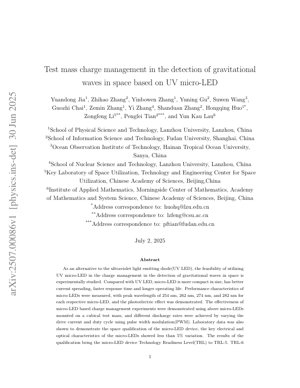
Space-based gravitational wave detectors, such as the upcoming Laser Interferometer Space Antenna (LISA), face a critical challenge: the test masses at the heart of their ultra-precise measurements become charged by high-energy cosmic rays and solar particles. This charge induces electrostatic forces, generating noise that can overwhelm the faint gravitational wave signals. Effective charge management is therefore not optional but mission-critical. This paper presents an experimental investigation into a next-generation solution: using ultraviolet (UV) micro-light-emitting diodes (micro-LEDs) as a compact, efficient, and controllable light source for photoelectric discharge of test masses.
2. Technology Overview
2.1. The Charge Management Problem
In the heliospheric environment, protons and alpha particles with energies >80 MeV penetrate the spacecraft and deposit charge on the isolated test mass. Uncontrolled, this leads to acceleration noise that jeopardizes the measurement. An open-loop charge control system is required to neutralize this charge without physical contact.
2.2. From Mercury Lamps to UV LEDs
Historically, missions like Gravity Probe B and LISA Pathfinder used mercury lamps. The shift to UV LEDs offered improvements in size, lifetime, and controllability. The photoelectric effect is harnessed: UV photons strike the test mass or its housing, ejecting electrons and thereby reducing positive charge.
2.3. The Micro-LED Advantage
This work proposes micro-LEDs as a superior alternative to conventional UV LEDs. Key advantages include:
- Extreme Compactness: Significantly smaller size and weight.
- Superior Performance: Better current spreading, faster response time, and longer operating life.
- Precise Control: Optical power can be controlled down to the picowatt (pW) level.
- Integration Potential: Can be integrated directly into electrode housing structures, potentially eliminating optical fibers.
Peak Wavelengths Tested
254, 262, 274, 282 nm
Performance Variation
< 5%
Post-qualification
Technology Readiness Level
TRL-5
Achieved
3. Experimental Setup & Methodology
3.1. Micro-LED Device Specifications
The study characterized micro-LEDs with four distinct peak wavelengths: 254 nm, 262 nm, 274 nm, and 282 nm. Fundamental photoelectric emission was confirmed as the working principle.
3.2. Test Mass & Discharge Experiment
Micro-LEDs were mounted on a cubical test mass. Discharge experiments were conducted by irradiating the surface. The discharge rate was precisely controlled by varying two key parameters:
- Drive Current: Adjusting the electrical input power.
- Duty Cycle via PWM: Using Pulse Width Modulation to cycle the LED on and off at high frequency, effectively controlling the average optical power.
3.3. Space Qualification Tests
A suite of laboratory tests was performed to assess the device's suitability for the space environment. The goal was to demonstrate that key electrical and optical characteristics remained stable within acceptable limits.
4. Results & Analysis
4.1. Photoelectric Effect Demonstration
The core principle was successfully validated. Illumination from the micro-LEDs caused measurable discharge of the test mass, confirming electron ejection via the photoelectric effect.
4.2. Discharge Rate Control via PWM
The experiment demonstrated fine-grained control over the discharge rate. By modulating the drive current and PWM duty cycle, researchers could achieve different, stable discharge rates, essential for matching the variable charging rate expected in orbit.
4.3. Space Qualification Data
Laboratory qualification data showed remarkable stability. The key electrical and optical parameters of the micro-LEDs varied by less than 5% under test conditions. This performance milestone elevated the Technology Readiness Level (TRL) of the micro-LED device to TRL-5 (component validation in relevant environment).
Key Insights
- UV micro-LEDs are a technically viable and potentially superior alternative to existing UV light sources for space charge management.
- Precise discharge control is achievable through electronic means (current & PWM), enabling adaptive feedback systems.
- The achieved TRL-5 is a significant step, but reaching flight-ready status (TRL-6/7) requires rigorous radiation and thermal vacuum testing.
- The compact form factor opens the door to novel, integrated sensor architectures.
5. Technical Details & Physics
The fundamental physics is governed by the photoelectric effect. The energy of a UV photon must exceed the work function ($\phi$) of the material (e.g., gold coating on the test mass). The kinetic energy ($K_{max}$) of the ejected electron is given by: $$K_{max} = h\nu - \phi$$ where $h$ is Planck's constant and $\nu$ is the photon frequency. The discharge current $I_d$ is proportional to the incident photon flux $\Phi_p$ and the quantum efficiency $\eta$ of the process: $$I_d = e \cdot \eta \cdot \Phi_p$$ where $e$ is the electron charge. The use of PWM with a duty cycle $D$ modulates the average photon flux: $$\langle \Phi_p \rangle = D \cdot \Phi_{p, max}$$ allowing direct electronic control of $I_d$.
6. Analysis Framework & Case Study
Framework: Technology Substitution Analysis for Critical Space Systems.
This study serves as a prime case for evaluating a new component within a high-stakes system. The analysis follows a structured path:
- Problem Definition: Identify the system vulnerability (test mass charging).
- Incumbent Technology Audit: Evaluate current solutions (Hg lamps, UV LEDs) against system-level requirements (mass, power, reliability, control).
- Candidate Technology Screening: Propose micro-LEDs based on inherent advantages (size, speed, life).
- Critical Function Validation: Experimentally prove the core function (photoelectric discharge) works.
- Performance & Control Characterization: Quantify performance (discharge rate) and establish control parameters (I, PWM).
- Environmental Qualification: Test against relevant environmental stresses to gauge robustness and advance TRL.
7. Future Applications & Development
- Path to TRL-6/7: Immediate next steps involve dedicated radiation testing (e.g., with proton beams at facilities like NASA's Space Radiation Effects Laboratory) and comprehensive thermal vacuum cycling to simulate launch and orbit conditions.
- Advanced Integration: Future prototypes could explore monolithic integration of micro-LED arrays onto the electrode housing itself, creating a "smart surface" for charge control, reducing complexity and failure points.
- Broader Space Applications: The technology is relevant for any precision space mission requiring charge control of isolated components, such as atomic clocks, cold atom experiments, or electrostatic levitation systems.
- Adaptive Control Algorithms: Development of closed-loop control algorithms that use test mass potential measurements to dynamically adjust PWM signals, creating a robust, autonomous charge management system.
8. References
- J. P. et al., "Charge management for the LISA Pathfinder mission," Class. Quantum Grav., vol. 28, 2011.
- M. A. et al., "The LISA Pathfinder mission," J. Phys.: Conf. Ser., vol. 610, 2015.
- B. S. et al., "UV LED development for space applications," Proc. SPIE, vol. 10562, 2017.
- National Aeronautics and Space Administration (NASA). "Technology Readiness Level." [Online]. Available: https://www.nasa.gov/directorates/heo/scan/engineering/technology/technology_readiness_level
- European Space Agency (ESA). "LISA: Laser Interferometer Space Antenna." [Online]. Available: https://www.cosmos.esa.int/web/lisa
- H. Group, "Pioneering study on micro-LED for gravitational wave detection," Internal Report, 2023.
- Z. et al., "Micro-LEDs for display and communication," Nature Photonics, vol. 13, pp. 81–88, 2019.
Analyst's Perspective: A Calculated Gamble on Miniaturization
Core Insight: This paper isn't just about a new light bulb for space; it's a strategic bet on miniaturization and integration as the next frontier for precision space instrumentation. The move from mercury lamps to LEDs was about swapping a fragile, analog component for a solid-state digital one. The proposed jump to micro-LEDs is more profound—it's about transforming a discrete subsystem into a potential surface-level feature of the sensor itself. The authors correctly identify that the true prize isn't merely a smaller UV source, but the possibility of its direct integration into the electrode housing. This aligns with a broader trend in aerospace, akin to the shift from distributed avionics to integrated modular architectures in modern aircraft.
Logical Flow & Strengths: The experimental logic is sound and follows the classic playbook for space technology maturation. First, prove basic functionality (photoelectric effect). Second, demonstrate controllability (PWM). Third, show initial robustness (TRL-5 qualification). The strength lies in the clear, quantifiable results: sub-5% parameter variation is a strong data point for early-stage hardware. The choice of multiple wavelengths (254-282 nm) is also savvy, as it allows future optimization based on the work function of the actual flight-grade test mass coating.
Flaws & Critical Gaps: The paper's primary weakness, which the authors openly acknowledge, is the distance between TRL-5 and flight readiness. Radiation hardness is the elephant in the room. UV LEDs, particularly those based on AlGaN materials, are known to be susceptible to displacement damage from high-energy particles—the very environment they're meant to operate in. Studies from groups like those at the Japan Aerospace Exploration Agency (JAXA) have documented significant degradation in LED output under proton irradiation. The paper's "less than 5% variation" claim needs the crucial context of what tests were performed. Without proton/ion irradiation data, the TRL-5 claim feels optimistic. Furthermore, the thermal management of a densely integrated micro-LED array, potentially operating in vacuum, is a non-trivial challenge that is not addressed.
Actionable Insights: For mission planners (e.g., for LISA or Taiji), this work should be seen as a promising but high-risk development path. The recommendation is a dual-track approach: continue maturing conventional UV LED systems as the baseline, while funding a targeted, accelerated test campaign for micro-LEDs focused on radiation lifetime and thermal-optical co-design. A collaboration with a semiconductor foundry to develop a custom, radiation-hardened micro-LED process would be a logical next step. The potential payoff—a radically simpler, more reliable, and higher-performance charge management system—is significant enough to justify the investment, but the timeline must be realistic. This technology is unlikely to be ready for the first launch of LISA in the mid-2030s, but it could be a game-changer for subsequent generations of space-based gravitational wave observatories and other precision physics experiments in space.