目录
- 1. 产品概述
- 2. 深度技术参数分析
- 2.1 光度与电气特性
- 2.2 热特性与绝对最大额定值
- 3. 分档系统说明
- 3.1 光通量分档
- 3.2 正向电压分档
- 3.3 颜色(色度)分档
- 4. 性能曲线分析
- 4.1 IV曲线与相对光通量
- 4.2 温度依赖性
- 4.3 光谱分布与辐射模式
- 4.4 降额与脉冲处理能力
- 5. 机械结构、封装与组装信息
- 5.1 机械尺寸
- 5.2 推荐焊盘布局
- 6. 焊接、组装与操作指南
- 6.1 回流焊温度曲线
- 6.2 使用注意事项
- 6.3 湿敏等级与存储
- 7. 环保合规性与可靠性
- 8. 应用说明与设计考量
- 8.1 主要应用:汽车照明
- 8.2 驱动电路设计
- 8.3 光学设计
- 9. 技术对比与市场定位
- 10. 常见问题解答
- 11. 设计与应用案例研究
- 12. 工作原理
- 13. 技术发展趋势
1. 产品概述
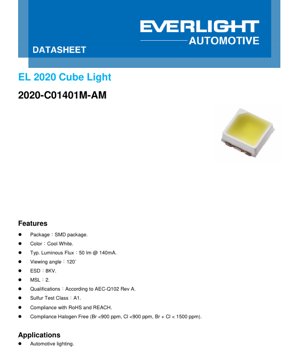
EL 2020 立方体灯是一款专为严苛汽车照明应用设计的高性能表面贴装器件(SMD)LED。该元件提供了一种紧凑、可靠的固态照明解决方案,在现代车辆系统所需的光输出、效率和鲁棒性之间取得了平衡。其核心设计理念旨在确保在汽车环境典型的大温度范围和恶劣环境条件下,性能表现始终如一。
该LED提供冷白光色温,适用于需要明亮、中性偏蓝白色光的应用场景。其封装设计便于自动化组装工艺,适合大批量生产。该器件的一个关键优势在于其符合AEC-Q102分立光电子半导体应力测试认证,这是汽车级元件的行业标准。这确保了其可靠性和使用寿命能够达到甚至超越汽车原始设备制造商的要求。
2. 深度技术参数分析
2.1 光度与电气特性
主要光度特性是在正向电流(I_F)为140毫安时,典型光通量为50流明(lm)。必须注意,光通量的指定测量公差为±8%,这涵盖了正常的生产差异。相同条件下的最小值和最大值分别为45流明和70流明,定义了性能窗口。F电气特性方面,该器件在140毫安下表现出3.0伏的典型正向电压(V_F),范围从2.75伏到3.5伏。正向电压测量公差指定为±0.05伏。器件具有宽广的工作正向电流范围,从最小10毫安到绝对最大额定值250毫安。光学性能的特点是120°的宽视角(公差为±5°),提供了适合各种照明光学器件的宽广、均匀的辐射模式。
2.2 热特性与绝对最大额定值F热管理对于LED的性能和寿命至关重要。规格书指定了两个热阻值:从结到焊点的实际热阻(R_th JS real)典型值为24 K/W(最大32 K/W),而电气推导值(R_th JS el)典型值为17 K/W(最大23 K/W)。较低的电气值通常用作保守的设计指导。
绝对最大额定值定义了为防止永久性损坏而绝不能超过的操作极限。关键额定值包括:
功耗(P_tot):875 毫瓦正向电流(I_F):250 毫安(连续)浪涌电流(I_FSM):在低占空比(D=0.005)下,脉冲≤10微秒时为750毫安结温(T_j):150 °C工作与存储温度:-40 °C 至 +125 °C
ESD敏感度(HBM):8 千伏
- 回流焊温度:峰值260°C,最长30秒d遵守这些限制对于可靠运行至关重要。
- 3. 分档系统说明F为管理生产差异并实现精确的系统设计,LED根据关键参数被分类到不同的档位中。
- 3.1 光通量分档FM光通量分为三个档位:
- F4:45 流明(最小)至 52 流明(最大)JF5:52 流明(最小)至 60 流明(最大)
- F6:60 流明(最小)至 70 流明(最大)
- 50流明的典型值落在F4档内。设计人员必须根据其应用所需的光输出选择合适的档位。
- 3.2 正向电压分档
2730:2.75 伏(最小)至 3.0 伏(最大)
3032:3.0 伏(最小)至 3.25 伏(最大)
3235:3.25 伏(最小)至 3.5 伏(最大)
3.3 颜色(色度)分档
- 冷白光发射在CIE 1931色度图中定义。规格书提供了四个不同档位(63M、61M、58M、56M)的角坐标,这些坐标对应于相关色温(CCT)范围:63M:约6100K 至 6600K
- 61M:约5800K 至 6300K58M:约5600K 至 6100K
- 56M:约5300K 至 5800KCIE色度图上的图形表示将这些档位显示为四边形。色坐标的指定测量公差为±0.005。这种分档确保了组件中多个LED的颜色一致性。
4.1 IV曲线与相对光通量
正向电流与正向电压的关系图显示了其特征性的指数关系。在140毫安的典型工作点,V_F约为3.0伏。该曲线对于设计限流电路至关重要。
- 相对光通量与正向电流的关系图表明,光输出与电流呈亚线性关系。虽然输出随电流增加而增加,但由于结温升高等因素,在较高电流下光效(每瓦流明数)通常会降低。该曲线以140毫安时的光通量为基准进行了归一化。4.2 温度依赖性
- 两个关键图表说明了性能随结温(T_j)的变化。相对光通量与结温的关系:显示光输出随T_j升高而降低。有效的散热对于维持所需亮度至关重要。
- 相对正向电压与结温的关系:表明V_F具有负温度系数,随T_j升高而线性下降。这一特性有时可用于温度传感。色度漂移与结温的关系:绘制了CIE x和y坐标的变化,显示在整个温度范围内漂移极小,这对于颜色稳定性很重要。
4.3 光谱分布与辐射模式
相对光谱分布图绘制了从400纳米到800纳米波长范围内的强度。它显示了来自LED芯片主发射的蓝光区域(约450-455纳米)的峰值,以及由荧光粉涂层产生的更宽的黄光区域(约550-600纳米)的次峰,两者结合产生冷白光。
- 辐射特性典型图直观地表示了120°视角,显示了相对于中心线(0°)的光强角度分布。4.4 降额与脉冲处理能力
- 正向电流降额曲线是一个重要的设计工具。它绘制了最大允许连续正向电流与焊盘温度(T_sp)的关系。随着T_sp升高,必须降低最大允许电流以防止超过150°C的T_j(最大值)。例如,在T_sp为125°C时,最大I_F为250毫安。允许脉冲处理能力图定义了在焊点温度为25°C时,对于给定脉冲宽度(t_p)和占空比(D)所允许的峰值脉冲电流(I_FP)。这对于使用脉冲驱动方案的应用至关重要。
- 5. 机械结构、封装与组装信息5.1 机械尺寸
- 规格书包含LED封装的详细机械图纸。关键尺寸(以毫米为单位)定义了封装外形、高度和引脚位置。除非另有说明,公差通常为±0.1毫米。该图纸对于PCB焊盘设计和确保在最终组件中的正确安装至关重要。5.2 推荐焊盘布局
6. 焊接、组装与操作指南
6.1 回流焊温度曲线
该元件额定最高回流焊峰值温度为260°C,持续30秒。应使用典型回流焊温度曲线,包括受控的预热、保温、回流和冷却阶段,以最大限度地减少热冲击,确保可靠的焊点,同时不损坏LED封装或内部材料。F6.2 使用注意事项
一般操作注意事项包括避免对封装施加机械应力、防止透镜污染,以及在操作和组装过程中使用适当的ESD控制措施,因为该器件的ESD等级为8千伏HBM。
6.3 湿敏等级与存储
该LED的湿敏等级(MSL)为2级。这意味着封装在需要进行回流焊前烘烤之前,可以在工厂车间条件(≤30°C/60% RH)下暴露长达一年。对于更长时间的存储或袋子打开后,应遵循IPC/JEDEC标准的特定烘烤程序,以防止回流焊过程中出现“爆米花”现象。j7. 环保合规性与可靠性
- 该器件符合RoHS(有害物质限制)和REACH法规。同时被指定为无卤素,对溴(Br)和氯(Cl)含量有限制(Br <900 ppm,Cl <900 ppm,Br+Cl <1500 ppm)。一个重要的可靠性特性是其在高硫环境中的性能。该器件满足硫测试A1级标准,表明其对大气硫引起的腐蚀具有高抵抗力,这是汽车和工业环境中常见的问题。j8. 应用说明与设计考量
- 8.1 主要应用:汽车照明主要目标应用是汽车照明。潜在用例包括内饰照明(顶灯、阅读灯、脚坑照明、氛围灯)、外部信号灯(高位刹车灯 - CHMSL),以及可能的辅助照明。AEC-Q102认证、宽广的温度范围和抗硫性使其适用于这些恶劣环境。F8.2 驱动电路设计j设计人员必须实施恒流驱动电路,而非恒压电源,以确保稳定的光输出并防止热失控。驱动电路应设计为适应正向电压分档范围。热管理不容妥协;PCB必须提供从LED散热焊盘到散热器或电路板铜层的充分热路径,以将结温保持在安全范围内,尤其是在高电流或高环境温度下运行时。
- 8.3 光学设计120°视角提供了灵活性。对于需要聚焦光束的应用,需要次级光学器件(反射器、透镜)。宽视角对于需要在区域上实现均匀、漫射照明的应用非常有益。
9. 技术对比与市场定位
与标准商用级LED相比,该元件的主要区别在于其汽车级认证(AEC-Q102)、扩展的工作温度范围(-40°C至+125°C)以及特定的抗硫腐蚀能力。这些特性以更高的成本为代价,但对于汽车安全和可靠性标准是强制性的。在汽车LED市场中,其在140毫安下50流明的输出使其定位为中功率器件,适用于超越简单指示功能的广泛应用。
10. 常见问题解答
问:这款LED的典型光效(每瓦流明数)是多少?
答:在典型工作点(140毫安,3.0伏,50流明),输入功率为0.42瓦(140毫安 * 3.0伏)。光效约为119 流明/瓦(50流明 / 0.42瓦)。S问:我可以用12伏汽车电池直接驱动这款LED吗?S答:不可以。LED需要恒流驱动器。直接连接到12伏电源会导致电流过大,立即损坏器件。需要一个将电流调节到所需水平(例如140毫安)的驱动电路。J问:如何理解两个不同的热阻值?S答:在进行保守的热设计计算时,请使用较高的“实际”热阻值(R_th JS real,典型值24 K/W)。电气值是通过测量技术推导出来的,通常较低。F问:MSL 2对我的生产工艺意味着什么?
答:MSL 2意味着元件在其密封的防潮袋中,在受控条件(≤30°C/60%RH)下最多可存储12个月。一旦袋子打开,通常有1周的时间完成回流焊接,之后部件可能需要烘烤。FP11. 设计与应用案例研究p场景:设计一款汽车内饰顶灯。 设计师需要为顶灯组件提供明亮的白光。他们选择了这款LED,光通量档位为F5(52-60流明),颜色档位为61M(约5800-6300K),以获得中性白外观。他们按照推荐的焊盘布局精确设计了PCB。选择了一款恒流降压驱动IC,从车辆的12伏系统提供140毫安电流。使用降额曲线和热阻进行热分析:如果PCB的热管理能将焊盘温度保持在85°C以下,则LED可以以其全额定值140毫安运行。120°的宽视角非常适合均匀照亮车厢,无需复杂的次级光学器件。AEC-Q102认证使设计师对该元件在此汽车应用中的长期可靠性充满信心。
12. 工作原理
这是一款荧光粉转换型白光LED。其核心是一个半导体芯片,通常由氮化铟镓(InGaN)制成,当电流通过时(电致发光)会发射蓝光。这种蓝光部分被沉积在芯片上或附近的掺铈钇铝石榴石(YAG:Ce)荧光粉涂层吸收。荧光粉吸收部分蓝色光子,并在更宽的光谱范围内重新发射光,主要在黄光区域。人眼感知到的剩余蓝光与转换后的黄光的混合光即为白光。蓝光与黄光发射的确切比例由荧光粉成分和厚度控制,决定了相关色温(CCT),从而产生指定的“冷白光”输出。
13. 技术发展趋势
汽车LED照明的大趋势是朝着更高效率(更高的每瓦流明数)、更高功率密度和更高可靠性发展。同时也在推动更精确的颜色控制和更高的显色指数(CRI),以获得更好的视觉感知。集成是另一个趋势,多芯片封装以及集成驱动器或控制电路的封装变得越来越普遍。此外,越来越关注智能自适应照明系统,这可能要求LED能够非常快速地开关或调光。虽然本规格书描述的是一个分立、单芯片元件,但底层技术仍在不断发展,以满足未来汽车照明系统(包括先进的前照灯和动态信号灯)的这些需求。
A separate drawing provides the recommended copper pad pattern on the PCB for optimal soldering. This includes the pad sizes and spacing for the electrical terminals and the thermal pad. Following this recommendation ensures good solder joint formation, proper thermal transfer to the PCB, and mechanical stability.
. Soldering, Assembly, and Handling Guidelines
.1 Reflow Soldering Profile
The component is rated for a maximum peak reflow temperature of 260°C for 30 seconds. A typical reflow profile should be used, with controlled preheat, soak, reflow, and cooling phases to minimize thermal shock and ensure reliable solder joints without damaging the LED package or internal materials.
.2 Precautions for Use
General handling precautions include avoiding mechanical stress on the package, preventing contamination of the lens, and using proper ESD controls during handling and assembly, as the device is rated for 8kV HBM ESD.
.3 Moisture Sensitivity and Storage
The LED has a Moisture Sensitivity Level (MSL) of 2. This means the package can be exposed to factory floor conditions (≤30°C/60% RH) for up to one year before it requires baking prior to reflow soldering. For longer storage or after the bag is opened, specific baking procedures per IPC/JEDEC standards should be followed to prevent "popcorning" during reflow.
. Environmental Compliance and Reliability
The device is compliant with RoHS (Restriction of Hazardous Substances) and REACH regulations. It is also specified as Halogen Free, with limits on Bromine (Br) and Chlorine (Cl) content (Br <900 ppm, Cl <900 ppm, Br+Cl <1500 ppm).
A significant reliability feature is its performance in sulfur-rich environments. The device meets Sulfur Test Class A1 criteria, indicating high resistance to corrosion caused by atmospheric sulfur, which is a common concern in automotive and industrial settings.
. Application Notes and Design Considerations
.1 Primary Application: Automotive Lighting
The primary intended application is automotive lighting. Potential use cases include interior lighting (dome lights, map lights, footwell lighting, ambient lighting), exterior signaling (center high-mount stop lights - CHMSL), and possibly auxiliary lighting. The AEC-Q102 qualification, wide temperature range, and sulfur resistance make it suitable for these harsh environments.
.2 Driver Circuit Design
Designers must implement a constant-current driver circuit, not a constant-voltage supply, to ensure stable light output and prevent thermal runaway. The driver should be designed to accommodate the forward voltage bin range. Thermal management is non-negotiable; the PCB must provide an adequate thermal path from the LED's thermal pad to a heatsink or the board's copper planes to keep the junction temperature within safe limits, especially when operating at high currents or in high ambient temperatures.
.3 Optical Design
The 120° viewing angle offers flexibility. For applications requiring a focused beam, secondary optics (reflectors, lenses) will be necessary. The wide angle is beneficial for applications requiring even, diffuse illumination over an area.
. Technical Comparison and Positioning
Compared to standard commercial-grade LEDs, the key differentiators of this component are its automotive-grade qualification (AEC-Q102), extended operating temperature range (-40°C to +125°C), and specific resistance to sulfur corrosion. These features come at the expense of higher cost but are mandatory for automotive safety and reliability standards. Within the automotive LED market, its 50lm output at 140mA positions it as a medium-power device suitable for a wide array of applications beyond simple indicator functions.
. Frequently Asked Questions (FAQs)
Q: What is the typical efficacy (lumens per watt) of this LED?
A: At the typical operating point (140mA, 3.0V, 50lm), the input power is 0.42W (140mA * 3.0V). The efficacy is approximately 119 lm/W (50lm / 0.42W).
Q: Can I drive this LED with a 12V automotive battery directly?
A: No. The LED requires a constant current driver. Connecting it directly to a 12V source would cause excessive current flow, immediately destroying the device. A driver circuit that regulates current to the desired level (e.g., 140mA) is required.
Q: How do I interpret the two different thermal resistance values?
A> Use the higher, "real" thermal resistance value (Rth JS realtyp. 24 K/W) for conservative thermal design calculations. The electrical value is derived from a measurement technique and is often lower.
Q: What does MSL 2 mean for my production process?
A> MSL 2 means the components can be stored in their sealed, moisture-barrier bag for up to 12 months under controlled conditions (≤30°C/60%RH). Once the bag is opened, you typically have 1 week to complete reflow soldering before the parts may need to be baked.
. Design and Usage Case Study
Scenario: Designing an automotive interior dome light.
A designer needs a bright, white light for a dome light assembly. They select this LED in the F5 luminous flux bin (52-60 lm) and the 61M color bin (~5800-6300K) for a neutral white appearance. They design a PCB with the exact recommended solder pad layout. A constant-current buck driver IC is selected to provide 140mA from the vehicle's 12V system. Thermal analysis is performed using the derating curve and thermal resistance: if the PCB's thermal management keeps the solder pad below 85°C, the LED can be run at its full 140mA rating. The wide 120° viewing angle is perfect for illuminating the cabin evenly without requiring complex secondary optics. The AEC-Q102 qualification gives confidence in the component's long-term reliability for this automotive application.
. Operating Principle
This is a phosphor-converted white LED. The core is a semiconductor chip, typically made of indium gallium nitride (InGaN), which emits light in the blue spectrum when electrical current passes through it (electroluminescence). This blue light is partially absorbed by a layer of cerium-doped yttrium aluminum garnet (YAG:Ce) phosphor coating deposited on or near the chip. The phosphor absorbs some blue photons and re-emits light across a broader spectrum, predominantly in the yellow region. The mixture of the remaining blue light and the converted yellow light is perceived by the human eye as white light. The exact ratio of blue to yellow emission, controlled by the phosphor composition and thickness, determines the correlated color temperature (CCT), resulting in the "Cool White" output specified.
. Technology Trends
The general trend in automotive LED lighting is toward higher efficiency (more lumens per watt), higher power density, and improved reliability. There is also a drive for more precise color control and higher Color Rendering Index (CRI) for better visual perception. Integration is another trend, with multi-chip packages and packages with integrated drivers or control circuits becoming more common. Furthermore, there is increasing focus on smart, adaptive lighting systems, which may require LEDs capable of very fast switching or dimming. While this datasheet describes a discrete, single-die component, the underlying technology continues to evolve to meet these demands for future automotive lighting systems, including advanced forward lighting and dynamic signal lighting.
LED规格术语详解
LED技术术语完整解释
一、光电性能核心指标
| 术语 | 单位/表示 | 通俗解释 | 为什么重要 |
|---|---|---|---|
| 光效(Luminous Efficacy) | lm/W(流明/瓦) | 每瓦电能发出的光通量,越高越节能。 | 直接决定灯具的能效等级与电费成本。 |
| 光通量(Luminous Flux) | lm(流明) | 光源发出的总光量,俗称"亮度"。 | 决定灯具够不够亮。 |
| 发光角度(Viewing Angle) | °(度),如120° | 光强降至一半时的角度,决定光束宽窄。 | 影响光照范围与均匀度。 |
| 色温(CCT) | K(开尔文),如2700K/6500K | 光的颜色冷暖,低值偏黄/暖,高值偏白/冷。 | 决定照明氛围与适用场景。 |
| 显色指数(CRI / Ra) | 无单位,0–100 | 光源还原物体真实颜色的能力,Ra≥80为佳。 | 影响色彩真实性,用于商场、美术馆等高要求场所。 |
| 色容差(SDCM) | 麦克亚当椭圆步数,如"5-step" | 颜色一致性的量化指标,步数越小颜色越一致。 | 保证同一批灯具颜色无差异。 |
| 主波长(Dominant Wavelength) | nm(纳米),如620nm(红) | 彩色LED颜色对应的波长值。 | 决定红、黄、绿等单色LED的色相。 |
| 光谱分布(Spectral Distribution) | 波长 vs. 强度曲线 | 显示LED发出的光在各波长的强度分布。 | 影响显色性与颜色品质。 |
二、电气参数
| 术语 | 符号 | 通俗解释 | 设计注意事项 |
|---|---|---|---|
| 正向电压(Forward Voltage) | Vf | LED点亮所需的最小电压,类似"启动门槛"。 | 驱动电源电压需≥Vf,多个LED串联时电压累加。 |
| 正向电流(Forward Current) | If | 使LED正常发光的电流值。 | 常采用恒流驱动,电流决定亮度与寿命。 |
| 最大脉冲电流(Pulse Current) | Ifp | 短时间内可承受的峰值电流,用于调光或闪光。 | 脉冲宽度与占空比需严格控制,否则过热损坏。 |
| 反向电压(Reverse Voltage) | Vr | LED能承受的最大反向电压,超过则可能击穿。 | 电路中需防止反接或电压冲击。 |
| 热阻(Thermal Resistance) | Rth(°C/W) | 热量从芯片传到焊点的阻力,值越低散热越好。 | 高热阻需更强散热设计,否则结温升高。 |
| 静电放电耐受(ESD Immunity) | V(HBM),如1000V | 抗静电打击能力,值越高越不易被静电损坏。 | 生产中需做好防静电措施,尤其高灵敏度LED。 |
三、热管理与可靠性
| 术语 | 关键指标 | 通俗解释 | 影响 |
|---|---|---|---|
| 结温(Junction Temperature) | Tj(°C) | LED芯片内部的实际工作温度。 | 每降低10°C,寿命可能延长一倍;过高导致光衰、色漂移。 |
| 光衰(Lumen Depreciation) | L70 / L80(小时) | 亮度降至初始值70%或80%所需时间。 | 直接定义LED的"使用寿命"。 |
| 流明维持率(Lumen Maintenance) | %(如70%) | 使用一段时间后剩余亮度的百分比。 | 表征长期使用后的亮度保持能力。 |
| 色漂移(Color Shift) | Δu′v′ 或 麦克亚当椭圆 | 使用过程中颜色的变化程度。 | 影响照明场景的颜色一致性。 |
| 热老化(Thermal Aging) | 材料性能下降 | 因长期高温导致的封装材料劣化。 | 可能导致亮度下降、颜色变化或开路失效。 |
四、封装与材料
| 术语 | 常见类型 | 通俗解释 | 特点与应用 |
|---|---|---|---|
| 封装类型 | EMC、PPA、陶瓷 | 保护芯片并提供光学、热学接口的外壳材料。 | EMC耐热好、成本低;陶瓷散热优、寿命长。 |
| 芯片结构 | 正装、倒装(Flip Chip) | 芯片电极布置方式。 | 倒装散热更好、光效更高,适用于高功率。 |
| 荧光粉涂层 | YAG、硅酸盐、氮化物 | 覆盖在蓝光芯片上,部分转化为黄/红光,混合成白光。 | 不同荧光粉影响光效、色温与显色性。 |
| 透镜/光学设计 | 平面、微透镜、全反射 | 封装表面的光学结构,控制光线分布。 | 决定发光角度与配光曲线。 |
五、质量控制与分档
| 术语 | 分档内容 | 通俗解释 | 目的 |
|---|---|---|---|
| 光通量分档 | 代码如 2G、2H | 按亮度高低分组,每组有最小/最大流明值。 | 确保同一批产品亮度一致。 |
| 电压分档 | 代码如 6W、6X | 按正向电压范围分组。 | 便于驱动电源匹配,提高系统效率。 |
| 色区分档 | 5-step MacAdam椭圆 | 按颜色坐标分组,确保颜色落在极小范围内。 | 保证颜色一致性,避免同一灯具内颜色不均。 |
| 色温分档 | 2700K、3000K等 | 按色温分组,每组有对应的坐标范围。 | 满足不同场景的色温需求。 |
六、测试与认证
| 术语 | 标准/测试 | 通俗解释 | 意义 |
|---|---|---|---|
| LM-80 | 流明维持测试 | 在恒温条件下长期点亮,记录亮度衰减数据。 | 用于推算LED寿命(结合TM-21)。 |
| TM-21 | 寿命推演标准 | 基于LM-80数据推算实际使用条件下的寿命。 | 提供科学的寿命预测。 |
| IESNA标准 | 照明工程学会标准 | 涵盖光学、电气、热学测试方法。 | 行业公认的测试依据。 |
| RoHS / REACH | 环保认证 | 确保产品不含有害物质(如铅、汞)。 | 进入国际市场的准入条件。 |
| ENERGY STAR / DLC | 能效认证 | 针对照明产品的能效与性能认证。 | 常用于政府采购、补贴项目,提升市场竞争力。 |