目录
- 1. 产品概述
- 2. 深入技术参数分析
- 2.1 光度与电气特性
- 3. 分档系统说明
- 温度显著影响LED性能。相对正向电压与结温曲线显示负温度系数,V随温度升高线性下降。此特性有时可用于温度传感。相反,相对发光强度与结温曲线显示光输出随温度升高明显下降,这种现象称为热衰减。因此,有效的热设计对于维持亮度至关重要。色度坐标偏移与结温图表明,与电流变化相比,温度引起的颜色偏移更为明显,在高精度颜色应用中必须考虑这一点。
- 波长特性图显示了荧光粉转换琥珀色光的相对光谱功率分布,通常在黄琥珀色区域有一个宽峰。典型辐射图特性说明了空间强度分布,证实了宽120°视角,在离轴±60°处强度降至峰值的一半。
- 5.1 物理尺寸与极性
- 提供了推荐的焊盘布局,以确保可靠的焊点形成和适当的机械稳定性。根据提供的回流焊接曲线图,该器件适用于峰值温度为260°C、最长30秒的回流焊接。此曲线定义了关键区域:预热、保温、回流和冷却。遵循此曲线可防止LED封装和内部芯片受到热损伤。
- LED以卷带形式提供,兼容自动贴片组装设备。包装信息详细说明了卷盘尺寸、载带宽度、料袋间距以及元件在载带上的方向。湿度敏感等级为3级,意味着封装在需要烘烤前,可在工厂车间条件下暴露长达168小时。建议按照IPC/JEDEC标准进行适当处理,以避免回流过程中因湿气造成损坏。
- 8. 常见问题解答
- .3 Spectral and Radiation Patterns
- . Mechanical, Assembly, and Packaging Information
- .1 Physical Dimensions and Polarity
- .2 Soldering and Reflow Guidelines
- .3 Packaging and Handling
- . Application Notes and Design Considerations
- .1 Primary Application Scenarios
- .2 Circuit Design and Precautions
- . Technical Comparison and Market Context
- . Frequently Asked Questions (FAQ)
- . Design-in Case Study
- . Technology Principle and Trends
- LED规格术语详解
- 一、光电性能核心指标
- 二、电气参数
- 三、热管理与可靠性
- 四、封装与材料
- 五、质量控制与分档
- 六、测试与认证
1. 产品概述
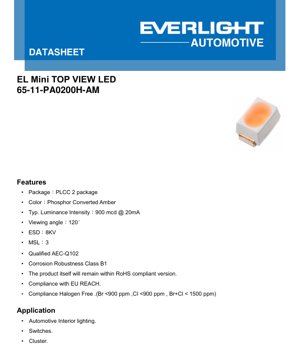
本文档详述了一款采用PLCC-2封装的高可靠性表面贴装LED的规格。该器件发出荧光粉转换琥珀色光,在20毫安正向电流驱动下,典型发光强度为900毫坎德拉。其设计主要面向汽车内饰应用,在这些应用中,稳定的性能、长期可靠性以及符合严苛的行业标准至关重要。
该LED具有120度的宽视角,适用于需要大面积均匀照明的应用,例如开关和仪表盘的背光。它通过了汽车应用分立光电器件AEC-Q102标准认证,确保满足车辆使用的严格质量和可靠性要求。此外,产品符合RoHS、REACH和无卤素等环保指令,与现代制造和生态标准保持一致。
2. 深入技术参数分析
2.1 光度与电气特性
核心工作参数在20mA正向电流和25°C环境温度的典型条件下定义。正向电压典型值为3.0伏,规定范围从2.5V到3.5V。此参数对于设计驱动电路和确保稳定供电至关重要。F主要光度输出为发光强度,典型值为900 mcd。该特定型号的最小和最大限值分别为560 mcd和1400 mcd。需注意光通量的测量容差为±8%。主色度坐标指定为,容差严格控制在±0.005以内,确保各生产批次琥珀色输出的一致性。F2.2 绝对最大额定值与热管理
超出这些限值操作可能导致永久性损坏。绝对最大连续正向电流为30 mA,最大功耗为75 mW。对于短脉冲,器件可承受高达250 mA的浪涌电流。结温不得超过125°C,工作温度范围为-40°C至+110°C。V热管理对LED性能和寿命至关重要。规格书指定了两个热阻值:最大实际热阻为160 K/W,最大电气热阻为120 K/W。这些值代表从半导体结到焊点的热阻抗,指导散热设计。正向电流降额曲线清晰显示,随着焊盘温度升高,最大允许连续电流必须降低,在110°C时降至27 mA。
3. 分档系统说明
为管理生产差异,LED根据关键参数被分档。理解此系统对于设计一致性至关重要。FM3.1 发光强度分档J发光强度采用字母数字代码系统分档,范围从L1到GA。对于此特定型号,可能的输出档位在V1和V2范围内,典型值900 mcd位于边界。3.2 色度与正向电压分档荧光粉转换琥珀色在CIE色度图上的特定区域内定义。提供的分档结构显示了如8285、8588和8891等代码的坐标,定义了琥珀色发射的允许色域。正向电压也进行分档,代码如2527、2730和3032,在I=20mA下测量。典型的3.0V值落在2730档内。
4. 性能曲线分析规格书包含多张图表,描述了电气、热学和光学参数之间的关系。4.1 电气与光学关系正向电流与正向电压图显示了经典的二极管指数特性。相对发光强度与正向电流曲线在典型20mA点之前近乎线性,表明在正常工作范围内效率稳定。色度坐标偏移与正向电流图显示颜色随电流变化极小,这对于稳定的颜色输出是可取的。4.2 温度依赖性
温度显著影响LED性能。相对正向电压与结温曲线显示负温度系数,V随温度升高线性下降。此特性有时可用于温度传感。相反,相对发光强度与结温曲线显示光输出随温度升高明显下降,这种现象称为热衰减。因此,有效的热设计对于维持亮度至关重要。色度坐标偏移与结温图表明,与电流变化相比,温度引起的颜色偏移更为明显,在高精度颜色应用中必须考虑这一点。
4.3 光谱与辐射模式
波长特性图显示了荧光粉转换琥珀色光的相对光谱功率分布,通常在黄琥珀色区域有一个宽峰。典型辐射图特性说明了空间强度分布,证实了宽120°视角,在离轴±60°处强度降至峰值的一半。
5. 机械、组装与包装信息
5.1 物理尺寸与极性
该元件封装在标准的PLCC-2表面贴装封装中。机械图纸提供了本体长、宽、高和引脚间距的精确尺寸。阴极通常通过封装上的缺口、圆点或倒角等视觉标记来识别,图纸中已明确标示。组装时的正确方向至关重要。F5.2 焊接与回流指南
提供了推荐的焊盘布局,以确保可靠的焊点形成和适当的机械稳定性。根据提供的回流焊接曲线图,该器件适用于峰值温度为260°C、最长30秒的回流焊接。此曲线定义了关键区域:预热、保温、回流和冷却。遵循此曲线可防止LED封装和内部芯片受到热损伤。
5.3 包装与处理
LED以卷带形式提供,兼容自动贴片组装设备。包装信息详细说明了卷盘尺寸、载带宽度、料袋间距以及元件在载带上的方向。湿度敏感等级为3级,意味着封装在需要烘烤前,可在工厂车间条件下暴露长达168小时。建议按照IPC/JEDEC标准进行适当处理,以避免回流过程中因湿气造成损坏。
6. 应用说明与设计考量6.1 主要应用场景此LED明确设计用于汽车内饰照明。这包括但不限于:开关与控制背光:换挡选择器、车窗开关、空调控制面板。仪表盘照明:仪表和警告指示灯的背光。通用氛围照明:脚坑灯、杯架照明及其他座舱装饰照明。选择琥珀色通常是因为其在夜间感知眩光较低,且传统上用于警告/指示功能。6.2 电路设计与注意事项与所有LED一样,电流调节是强制性的;器件应由恒流源驱动,而非恒压源,以确保稳定的光输出并防止热失控。使用电压电源时,串联限流电阻是最简单的方法。驱动电路必须遵守绝对最大额定值,包括反向电压限制。在处理和组装过程中应实施静电放电保护措施,因为器件的ESD敏感度为8kV。规格书还包含具体的使用注意事项和硫化物测试标准,强调了在含有硫化氢等腐蚀性气体的恶劣环境中可能出现的失效模式,这些气体会侵蚀镀银引脚。这对于可能遇到此类环境的汽车应用尤其相关。7. 技术对比与市场背景与非车规级LED相比,此器件的关键区别在于其AEC-Q102认证、扩展的工作温度范围以及针对汽车环境的增强可靠性测试。与某些传统的琥珀色芯片LED相比,荧光粉转换琥珀色技术提供了更一致和饱和的颜色,对驱动电流和温度变化的耐受性更好。PLCC-2封装在紧凑的占位面积和优于0402或0603等更小封装的热性能之间取得了良好平衡,这得益于其更大的散热焊盘面积。
8. 常见问题解答
问:实际热阻与电气热阻有何区别?答:电气热阻是根据温度敏感电气参数计算得出的,而实际热阻可能通过物理传感器测量。电气值通常较低;设计者应使用更保守的实际热阻值进行最坏情况下的热设计。问:我可以连续以30mA驱动此LED吗?答:虽然30mA是绝对最大额定值,但不建议在此电流下连续工作。请参考正向电流降额曲线。在焊盘温度升高的情况下,最大允许连续电流显著低于30mA。设计时应以典型20mA或更低电流为目标,以确保寿命和可靠性。问:如何解读发光强度分档代码以进行订购?答:型号指定了特定的分档组合。要请求不同的强度或颜色分档,您需要查阅订购信息或联系供应商,获取对应于产品系列内所需V1、V2或其他分档的特定后缀代码。F9. 设计案例研究考虑为汽车中控台开关面板设计背光。设计要求多个按钮实现均匀、低眩光的照明。使用此PLCC-2琥珀色LED,其120°宽视角有助于在扩散器下均匀散布光线。设计了一个恒流驱动电路,为每个LED提供18mA电流,提供安全裕度并降低结温。对PCB布局进行热分析,确保在最坏情况下的座舱环境温度下,焊盘温度保持在85°C以下,使LED工作在降额电流限值内。AEC-Q102认证为该元件承受汽车振动和温度循环的能力提供了信心。10. 技术原理与趋势原理:这是一款荧光粉转换LED。它可能使用蓝色或近紫外半导体芯片。部分原始光被陶瓷或硅胶基荧光粉层吸收,并以更长的波长重新发射。剩余原始光与荧光粉转换光的结合产生了感知的琥珀色。与使用直接发射的琥珀色半导体材料相比,这种方法通常能提供更好的颜色一致性和稳定性。趋势:汽车照明市场持续要求更高的可靠性、更高的效率和更小的尺寸。存在向更高集成度的趋势,例如内置驱动器或控制IC的LED。此外,高级驾驶辅助系统和自动驾驶汽车的推动正在增加LED在车内传感应用中的使用,这可能推动对特定光谱输出或调制能力的要求。环保合规性仍然是整个行业强大且不容妥协的趋势。graph indicates a more pronounced color shift with temperature compared to current variation, which must be considered in high-precision color applications.
.3 Spectral and Radiation Patterns
TheWavelength Characteristicsgraph shows the relative spectral power distribution of the phosphor-converted amber light, typically featuring a broad peak in the yellow-amber region. TheTypical Diagram Characteristics of Radiationillustrates the spatial intensity distribution, confirming the wide 120° viewing angle where intensity drops to half of its peak value at ±60° off-axis.
. Mechanical, Assembly, and Packaging Information
.1 Physical Dimensions and Polarity
The component is housed in a standard PLCC-2 (Plastic Leaded Chip Carrier) surface-mount package. The mechanical drawing provides precise dimensions for the body length, width, height, and lead spacing. The cathode is typically identified by a visual marker such as a notch or a dot on the package, or a chamfered corner, which is clearly indicated in the drawing. Correct orientation during assembly is vital.
.2 Soldering and Reflow Guidelines
A recommended solder pad layout (land pattern) is provided to ensure reliable solder joint formation and proper mechanical stability. The device is rated for reflow soldering with a peak temperature of 260°C for a maximum of 30 seconds, as per the provided reflow soldering profile graph. This profile defines the critical zones: preheat, soak, reflow (with time above liquidus), and cooling. Adherence to this profile prevents thermal damage to the LED package and internal die.
.3 Packaging and Handling
The LEDs are supplied on tape and reel for compatibility with automated pick-and-place assembly equipment. Packaging information details the reel dimensions, tape width, pocket spacing, and orientation of components on the tape. The Moisture Sensitivity Level (MSL) is rated at 3, meaning the package can be exposed to factory floor conditions (≤ 30°C / 60% RH) for up to 168 hours before requiring baking. Proper handling per IPC/JEDEC standards is recommended to avoid moisture-induced damage during reflow.
. Application Notes and Design Considerations
.1 Primary Application Scenarios
This LED is explicitly designed forAutomotive Interior Lighting. This includes, but is not limited to:
- Backlighting for Switches and Controls:Gear selectors, window switches, climate control panels.
- Instrument Cluster Illumination:Backlighting for gauges and warning indicators.
- General Ambient Lighting:Footwell lights, cupholder illumination, and other cabin accent lighting.
.2 Circuit Design and Precautions
As with all LEDs, current regulation is mandatory; the device should be driven by a constant current source, not a constant voltage source, to ensure stable light output and prevent thermal runaway. A series current-limiting resistor is the simplest method when using a voltage supply. The driver circuit must respect the absolute maximum ratings, including the reverse voltage limitation (the device is not designed for reverse operation).
Electrostatic Discharge (ESD) protection measures should be implemented during handling and assembly, as the device has an ESD sensitivity of 8kV (Human Body Model). The datasheet also includes specificPrecautions for UseandSulfur Test Criteria, highlighting potential failure modes in harsh environments containing corrosive gases like hydrogen sulfide, which can attack silver-plated leads. This is particularly relevant for automotive applications where such environments may be encountered.
. Technical Comparison and Market Context
Compared to non-automotive grade LEDs, this device's key differentiators are its AEC-Q102 qualification, extended operating temperature range (-40°C to +110°C), and enhanced reliability testing for automotive environments. The Phosphor Converted Amber technology offers a more consistent and saturated color compared to some traditional amber chip LEDs, with better tolerance to drive current and temperature variations. The PLCC-2 package provides a good balance between a compact footprint and improved thermal performance over smaller packages like 0402 or 0603, due to its larger thermal pad area.
. Frequently Asked Questions (FAQ)
Q: What is the difference between real and electrical thermal resistance (Rth JS)?
A: The electrical Rthis calculated from the temperature-sensitive electrical parameter (the forward voltage), while the real Rthmight be measured with a physical sensor. The electrical value is often lower; designers should use the more conservative (higher) real Rthvalue of 160 K/W for worst-case thermal design.
Q: Can I drive this LED at 30mA continuously?
A: While 30mA is the absolute maximum rating, continuous operation at this current is not recommended. Refer to the forward current derating curve. At an elevated solder pad temperature (e.g., 80°C), the maximum allowable continuous current is significantly lower than 30mA. Design for the typical 20mA or lower to ensure longevity and reliability.
Q: How do I interpret the luminous intensity bin code for ordering?
A> The part number 65-11-PA0200H-AM specifies a particular bin combination. To request a different intensity or color bin, you would need to consult the ordering information or contact the supplier for the specific suffix codes that correspond to the desired V1, V2, or other bins within the product family.
. Design-in Case Study
Consider designing backlighting for an automotive center console switch panel. The design requires uniform, low-glare illumination across multiple buttons. Using this PLCC-2 amber LED, the wide 120° viewing angle helps spread light evenly under a diffuser. A constant-current driver circuit is designed to supply 18mA (slightly below the 20mA typical) to each LED, providing a safety margin and reducing junction temperature. Thermal analysis of the PCB layout ensures the solder pad temperature remains below 85°C in the worst-case ambient cabin temperature (70°C), keeping the LEDs within the derated current limits. The AEC-Q102 qualification provides confidence in the component's ability to withstand automotive vibration and temperature cycling.
. Technology Principle and Trends
Principle:This is a Phosphor Converted LED. It likely uses a blue or near-UV semiconductor die. A portion of the primary light is absorbed by a ceramic or silicone-based phosphor layer, which re-emits light at longer wavelengths. The combination of the remaining primary light and the phosphor-converted light results in the perceived amber color. This method often provides better color consistency and stability than using a direct-emitting amber semiconductor material.
Trends:The automotive lighting market continues to demand higher reliability, greater efficiency (lumens per watt), and miniaturization. There is a trend towards higher integration, such as LEDs with built-in drivers or control ICs. Furthermore, the push for advanced driver assistance systems (ADAS) and autonomous vehicles is increasing the use of LEDs for interior sensing applications (e.g., driver monitoring), which may drive requirements for specific spectral outputs or modulation capabilities. Environmental compliance (RoHS, REACH, halogen-free) remains a strong and non-negotiable trend across the industry.
LED规格术语详解
LED技术术语完整解释
一、光电性能核心指标
| 术语 | 单位/表示 | 通俗解释 | 为什么重要 |
|---|---|---|---|
| 光效(Luminous Efficacy) | lm/W(流明/瓦) | 每瓦电能发出的光通量,越高越节能。 | 直接决定灯具的能效等级与电费成本。 |
| 光通量(Luminous Flux) | lm(流明) | 光源发出的总光量,俗称"亮度"。 | 决定灯具够不够亮。 |
| 发光角度(Viewing Angle) | °(度),如120° | 光强降至一半时的角度,决定光束宽窄。 | 影响光照范围与均匀度。 |
| 色温(CCT) | K(开尔文),如2700K/6500K | 光的颜色冷暖,低值偏黄/暖,高值偏白/冷。 | 决定照明氛围与适用场景。 |
| 显色指数(CRI / Ra) | 无单位,0–100 | 光源还原物体真实颜色的能力,Ra≥80为佳。 | 影响色彩真实性,用于商场、美术馆等高要求场所。 |
| 色容差(SDCM) | 麦克亚当椭圆步数,如"5-step" | 颜色一致性的量化指标,步数越小颜色越一致。 | 保证同一批灯具颜色无差异。 |
| 主波长(Dominant Wavelength) | nm(纳米),如620nm(红) | 彩色LED颜色对应的波长值。 | 决定红、黄、绿等单色LED的色相。 |
| 光谱分布(Spectral Distribution) | 波长 vs. 强度曲线 | 显示LED发出的光在各波长的强度分布。 | 影响显色性与颜色品质。 |
二、电气参数
| 术语 | 符号 | 通俗解释 | 设计注意事项 |
|---|---|---|---|
| 正向电压(Forward Voltage) | Vf | LED点亮所需的最小电压,类似"启动门槛"。 | 驱动电源电压需≥Vf,多个LED串联时电压累加。 |
| 正向电流(Forward Current) | If | 使LED正常发光的电流值。 | 常采用恒流驱动,电流决定亮度与寿命。 |
| 最大脉冲电流(Pulse Current) | Ifp | 短时间内可承受的峰值电流,用于调光或闪光。 | 脉冲宽度与占空比需严格控制,否则过热损坏。 |
| 反向电压(Reverse Voltage) | Vr | LED能承受的最大反向电压,超过则可能击穿。 | 电路中需防止反接或电压冲击。 |
| 热阻(Thermal Resistance) | Rth(°C/W) | 热量从芯片传到焊点的阻力,值越低散热越好。 | 高热阻需更强散热设计,否则结温升高。 |
| 静电放电耐受(ESD Immunity) | V(HBM),如1000V | 抗静电打击能力,值越高越不易被静电损坏。 | 生产中需做好防静电措施,尤其高灵敏度LED。 |
三、热管理与可靠性
| 术语 | 关键指标 | 通俗解释 | 影响 |
|---|---|---|---|
| 结温(Junction Temperature) | Tj(°C) | LED芯片内部的实际工作温度。 | 每降低10°C,寿命可能延长一倍;过高导致光衰、色漂移。 |
| 光衰(Lumen Depreciation) | L70 / L80(小时) | 亮度降至初始值70%或80%所需时间。 | 直接定义LED的"使用寿命"。 |
| 流明维持率(Lumen Maintenance) | %(如70%) | 使用一段时间后剩余亮度的百分比。 | 表征长期使用后的亮度保持能力。 |
| 色漂移(Color Shift) | Δu′v′ 或 麦克亚当椭圆 | 使用过程中颜色的变化程度。 | 影响照明场景的颜色一致性。 |
| 热老化(Thermal Aging) | 材料性能下降 | 因长期高温导致的封装材料劣化。 | 可能导致亮度下降、颜色变化或开路失效。 |
四、封装与材料
| 术语 | 常见类型 | 通俗解释 | 特点与应用 |
|---|---|---|---|
| 封装类型 | EMC、PPA、陶瓷 | 保护芯片并提供光学、热学接口的外壳材料。 | EMC耐热好、成本低;陶瓷散热优、寿命长。 |
| 芯片结构 | 正装、倒装(Flip Chip) | 芯片电极布置方式。 | 倒装散热更好、光效更高,适用于高功率。 |
| 荧光粉涂层 | YAG、硅酸盐、氮化物 | 覆盖在蓝光芯片上,部分转化为黄/红光,混合成白光。 | 不同荧光粉影响光效、色温与显色性。 |
| 透镜/光学设计 | 平面、微透镜、全反射 | 封装表面的光学结构,控制光线分布。 | 决定发光角度与配光曲线。 |
五、质量控制与分档
| 术语 | 分档内容 | 通俗解释 | 目的 |
|---|---|---|---|
| 光通量分档 | 代码如 2G、2H | 按亮度高低分组,每组有最小/最大流明值。 | 确保同一批产品亮度一致。 |
| 电压分档 | 代码如 6W、6X | 按正向电压范围分组。 | 便于驱动电源匹配,提高系统效率。 |
| 色区分档 | 5-step MacAdam椭圆 | 按颜色坐标分组,确保颜色落在极小范围内。 | 保证颜色一致性,避免同一灯具内颜色不均。 |
| 色温分档 | 2700K、3000K等 | 按色温分组,每组有对应的坐标范围。 | 满足不同场景的色温需求。 |
六、测试与认证
| 术语 | 标准/测试 | 通俗解释 | 意义 |
|---|---|---|---|
| LM-80 | 流明维持测试 | 在恒温条件下长期点亮,记录亮度衰减数据。 | 用于推算LED寿命(结合TM-21)。 |
| TM-21 | 寿命推演标准 | 基于LM-80数据推算实际使用条件下的寿命。 | 提供科学的寿命预测。 |
| IESNA标准 | 照明工程学会标准 | 涵盖光学、电气、热学测试方法。 | 行业公认的测试依据。 |
| RoHS / REACH | 环保认证 | 确保产品不含有害物质(如铅、汞)。 | 进入国际市场的准入条件。 |
| ENERGY STAR / DLC | 能效认证 | 针对照明产品的能效与性能认证。 | 常用于政府采购、补贴项目,提升市场竞争力。 |