1. Product Overview
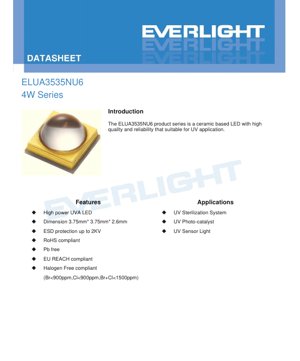
The ELUA3535NU6 product series represents a high-reliability, ceramic-based LED solution engineered specifically for demanding ultraviolet-A (UVA) applications. This series is designed to deliver consistent performance in environments where durability and optical output stability are critical.
1.1 Core Advantages and Target Market
The primary advantages of this series stem from its robust construction and electrical design. The use of an Aluminum Nitride (AlN) ceramic substrate provides superior thermal conductivity, which is essential for managing the heat generated by high-power UV operation and ensuring long-term reliability. The device incorporates built-in Electrostatic Discharge (ESD) protection rated up to 2KV (Human Body Model), significantly enhancing its handling robustness during assembly. Furthermore, the product is fully compliant with RoHS, EU REACH, and halogen-free regulations (Br<900ppm, Cl<900ppm, Br+Cl<1500ppm), making it suitable for global markets with strict environmental standards. The target applications are primarily in industrial and commercial sectors requiring UVA irradiation, including but not limited to UV sterilization systems for air and water purification, UV photocatalyst activation for surface treatment, and specialized UV sensor lighting.
2. Technical Parameter Deep-Dive
This section provides a detailed, objective analysis of the key technical parameters specified in the datasheet.
2.1 Absolute Maximum Ratings
The Absolute Maximum Ratings define the stress limits beyond which permanent damage to the device may occur. For the 385nm, 395nm, and 405nm variants, the maximum continuous forward current (IF) is 1250mA. Notably, the 365nm variant has a lower maximum current rating of 700mA, which is a critical design consideration. The maximum junction temperature (TJ) is 105°C. The thermal resistance from junction to the thermal pad (Rth) is specified as 4°C/W. This parameter is vital for thermal management design; for example, at the maximum rated current, the temperature rise from the pad to the junction can be calculated. The device can operate within an ambient temperature range of -10°C to +100°C.
2.2 Photometric and Electrical Characteristics
The order code table provides the key performance metrics for different wavelength bins. The radiant flux, a measure of the total optical power output in the UV spectrum, varies by model. For the 365nm version (ELUA3535NU6-P6070U23648700-V41G), the typical radiant flux is 1300mW at 700mA. For the 385nm, 395nm, and 405nm versions, the typical radiant flux is 1475mW at 1000mA. The forward voltage (VF) for all models is specified within a range of 3.6V to 4.8V, measured at their respective test currents. This range must be accounted for in driver circuit design to ensure proper current regulation.
3. Binning System Explanation
The product is classified into bins based on three key parameters to ensure consistency for the end-user.
3.1 Peak Wavelength Binning
The emitted UV light is categorized into four distinct wavelength bins: U36 (360-370nm), U38 (380-390nm), U39 (390-400nm), and U40 (400-410nm). The peak wavelength measurement has a tolerance of ±1nm. This precise binning allows designers to select the exact spectral output required for their application, such as matching the activation spectrum of a specific photocatalyst.
3.2 Radiant Flux Binning
Radiant flux output is also binned. For the 365nm wavelength, bins range from U1 (900-1000mW) to U4 (1400-1600mW). For the 385-405nm wavelengths, the bins are U51 (1350-1600mW) and U52 (1600-1850mW). The measurement tolerance is ±10%. This system enables selection based on required optical power density.
3.3 Forward Voltage Binning
The forward voltage is grouped into three bins: 3640 (3.6-4.0V), 4044 (4.0-4.4V), and 4448 (4.4-4.8V), measured at the specified test current (700mA for 365nm, 1000mA for others) with a ±2% tolerance. Knowledge of the VF bin can help in optimizing the efficiency of the power supply and predicting thermal load.
4. Performance Curve Analysis
The typical characteristic curves provide insight into the device's behavior under various operating conditions.
4.1 Spectrum and Relative Radiant Flux vs. Current
The spectrum graphs show distinct peaks for the different wavelength models (365nm, 385nm, 395nm, 405nm), with relatively narrow spectral bandwidths typical of LED sources. The Relative Radiant Flux vs. Forward Current curve demonstrates a near-linear relationship between drive current and optical output up to the rated current, indicating good efficiency within the operating range. The 365nm curve stops at 700mA, reflecting its lower maximum current rating.
4.2 Thermal Characteristics
The Relative Radiant Flux vs. Ambient Temperature graph is crucial. It shows that as the ambient temperature (measured at the thermal pad) increases, the radiant flux decreases. This thermal droop effect is a fundamental characteristic of LEDs. The rate of decrease varies slightly between wavelengths but is significant, emphasizing the necessity of effective heat sinking to maintain output. The Forward Voltage vs. Ambient Temperature curve shows a negative temperature coefficient, where VF decreases as temperature rises, which is important for constant-current driver stability.
4.3 Forward Voltage and Peak Wavelength Shift
The Forward Voltage vs. Forward Current curve exhibits the standard exponential shape of a diode. The Peak Wavelength vs. Forward Current and vs. Ambient Temperature curves show that the peak emission wavelength shifts slightly with changes in drive current and temperature. This shift is typically on the order of a few nanometers and is an important factor in applications requiring precise spectral positioning.
5. Mechanical and Packaging Information
5.1 Physical Dimensions
The LED is housed in a surface-mount device (SMD) package with dimensions of 3.75mm (L) x 3.75mm (W) x 2.6mm (H). The dimensional drawing specifies all critical lengths, including the lens dome height and the pad locations. General tolerance is ±0.1mm, and thickness tolerance is ±0.15mm.
5.2 Pad Configuration and Polarity
The bottom view diagram clearly shows the pad layout. The package features multiple thermal/electrical pads. The central pad is primarily for efficient heat transfer to the PCB's copper plane. The surrounding pads are for electrical connection. The polarity is indicated, with the anode and cathode pads distinctly marked to prevent reverse mounting during assembly.
6. Soldering and Assembly Guidelines
6.1 Reflow Soldering Process
The device is suitable for standard Surface Mount Technology (SMT) processes. The datasheet includes a reflow soldering profile graph, indicating the recommended temperature ramp-up, soak, peak, and cooling rates. Key instructions include: the reflow process should not be performed more than twice to avoid undue thermal stress on the internal die and bonds. Mechanical stress on the LED body during heating should be avoided. After soldering, bending the PCB should be avoided to prevent cracking the solder joints or the ceramic package.
6.2 Storage and Handling
While not explicitly detailed in the provided excerpt, based on the operating and storage temperature ratings (TStg: -40°C to +100°C), the devices should be stored in a dry, temperature-controlled environment. Standard ESD precautions should be observed during handling, despite the built-in 2KV ESD protection.
7. Application Suggestions
7.1 Typical Application Circuits
In design, a constant current driver is mandatory for stable operation. The driver must be selected to deliver the required current (700mA for 365nm, up to 1000mA or more for others, within the absolute maximum limit) and must accommodate the forward voltage range of the selected bin. Adequate heat sinking is non-negotiable. The PCB should have a thermally optimized layout with a large copper area connected to the central thermal pad via multiple vias to dissipate heat to other layers or an external heatsink.
7.2 Design Considerations
Thermal Management: Calculate the expected junction temperature using the formula TJ = TPCB + (Rth * Pdiss), where Pdiss ≈ VF * IF. Ensure TJ remains below 105°C.
Optical Design: The 60° viewing angle provides a relatively wide beam. For focused applications, secondary optics (lenses, reflectors) made of UV-transparent materials (e.g., quartz, specialized plastics) will be required.
Safety: UVA radiation can be harmful to eyes and skin. Appropriate enclosures, warning labels, and safety interlocks must be incorporated into the final product design.
8. Technical Comparison and Differentiation
Compared to standard plastic or lower-power UV LEDs, the ELUA3535NU6 series differentiates itself through its ceramic package, which offers superior thermal performance and longevity under high-drive conditions. The explicit binning across three parameters (wavelength, flux, voltage) provides a level of consistency and selectivity that is essential for industrial applications where process repeatability is key. The high radiant flux output in a compact package enables more compact and powerful system designs.
9. Frequently Asked Questions (Based on Technical Parameters)
Q: Why does the 365nm version have a lower maximum current (700mA) than the others (1250mA)?
A: This is typically due to the different semiconductor material properties and efficiency characteristics at shorter wavelengths. The 365nm chip may have higher operating voltages or different thermal characteristics, limiting the safe operating current to ensure reliability and prevent accelerated degradation.
Q: How do I interpret the \"Typical Radiant Flux\" value?
A: The \"Typical\" value is a representative or average value from production. For guaranteed minimum performance, designers should use the \"Minimum Radiant Flux\" value from the order code table or the lower limit of the selected Radiant Flux bin for their circuit calculations and system performance guarantees.
Q: Can I drive this LED with a constant voltage source?
A: It is strongly discouraged. LEDs are current-driven devices. Their forward voltage has a tolerance and a negative temperature coefficient. A constant voltage source could lead to thermal runaway, where increasing current causes heating, which lowers VF, causing more current to flow, potentially destroying the LED. Always use a constant current driver.
10. Practical Use Case Example
Scenario: Designing a UV-Curing Station for Adhesives.
A manufacturer needs to cure a UV-sensitive adhesive that activates at 395nm. They select the ELUA3535NU6-P9000U5136481K0-V41G (390-400nm bin, U51 flux bin). They design an array of 10 LEDs on an aluminum-core PCB (MCPCB) for optimal heat dissipation. Each LED is driven at 1000mA by a dedicated constant-current driver module. The thermal design ensures the PCB temperature under the LED stays below 85°C to keep the junction temperature within safe limits and maintain high radiant output. The wide 60° angle provides good coverage over the curing area. The consistent wavelength from the binning ensures uniform curing performance across all units produced.
11. Operating Principle Introduction
UVA LEDs operate on the same fundamental principle as visible LEDs, based on electroluminescence in a semiconductor p-n junction. When a forward voltage is applied, electrons and holes recombine in the active region, releasing energy in the form of photons. The specific wavelength of these photons (in the UVA range, 315-400nm) is determined by the bandgap energy of the semiconductor materials used in the chip's construction, such as aluminum gallium nitride (AlGaN) or similar compound semiconductors. The ceramic package serves as a robust mechanical housing, electrical insulator, and highly efficient thermal pathway to remove heat from the semiconductor die.
12. Industry Trends and Developments
The UVA LED market is driven by the replacement of traditional mercury-vapor lamps in applications like sterilization and curing, offering benefits such as instant on/off, longer lifetime, smaller size, and no hazardous materials. Trends include continuous improvement in Wall-Plug Efficiency (WPE), which converts electrical power to optical power more effectively, reducing system heat load. There is also ongoing development to increase output power density from a single package and to improve reliability at higher operating temperatures. Furthermore, spectral tuning to match specific photo-initiated chemical processes is an area of active research, allowing for more efficient and targeted industrial processes.
LED Specification Terminology
Complete explanation of LED technical terms
Photoelectric Performance
| Term | Unit/Representation | Simple Explanation | Why Important |
|---|---|---|---|
| Luminous Efficacy | lm/W (lumens per watt) | Light output per watt of electricity, higher means more energy efficient. | Directly determines energy efficiency grade and electricity cost. |
| Luminous Flux | lm (lumens) | Total light emitted by source, commonly called "brightness". | Determines if the light is bright enough. |
| Viewing Angle | ° (degrees), e.g., 120° | Angle where light intensity drops to half, determines beam width. | Affects illumination range and uniformity. |
| CCT (Color Temperature) | K (Kelvin), e.g., 2700K/6500K | Warmth/coolness of light, lower values yellowish/warm, higher whitish/cool. | Determines lighting atmosphere and suitable scenarios. |
| CRI / Ra | Unitless, 0–100 | Ability to render object colors accurately, Ra≥80 is good. | Affects color authenticity, used in high-demand places like malls, museums. |
| SDCM | MacAdam ellipse steps, e.g., "5-step" | Color consistency metric, smaller steps mean more consistent color. | Ensures uniform color across same batch of LEDs. |
| Dominant Wavelength | nm (nanometers), e.g., 620nm (red) | Wavelength corresponding to color of colored LEDs. | Determines hue of red, yellow, green monochrome LEDs. |
| Spectral Distribution | Wavelength vs intensity curve | Shows intensity distribution across wavelengths. | Affects color rendering and quality. |
Electrical Parameters
| Term | Symbol | Simple Explanation | Design Considerations |
|---|---|---|---|
| Forward Voltage | Vf | Minimum voltage to turn on LED, like "starting threshold". | Driver voltage must be ≥Vf, voltages add up for series LEDs. |
| Forward Current | If | Current value for normal LED operation. | Usually constant current drive, current determines brightness & lifespan. |
| Max Pulse Current | Ifp | Peak current tolerable for short periods, used for dimming or flashing. | Pulse width & duty cycle must be strictly controlled to avoid damage. |
| Reverse Voltage | Vr | Max reverse voltage LED can withstand, beyond may cause breakdown. | Circuit must prevent reverse connection or voltage spikes. |
| Thermal Resistance | Rth (°C/W) | Resistance to heat transfer from chip to solder, lower is better. | High thermal resistance requires stronger heat dissipation. |
| ESD Immunity | V (HBM), e.g., 1000V | Ability to withstand electrostatic discharge, higher means less vulnerable. | Anti-static measures needed in production, especially for sensitive LEDs. |
Thermal Management & Reliability
| Term | Key Metric | Simple Explanation | Impact |
|---|---|---|---|
| Junction Temperature | Tj (°C) | Actual operating temperature inside LED chip. | Every 10°C reduction may double lifespan; too high causes light decay, color shift. |
| Lumen Depreciation | L70 / L80 (hours) | Time for brightness to drop to 70% or 80% of initial. | Directly defines LED "service life". |
| Lumen Maintenance | % (e.g., 70%) | Percentage of brightness retained after time. | Indicates brightness retention over long-term use. |
| Color Shift | Δu′v′ or MacAdam ellipse | Degree of color change during use. | Affects color consistency in lighting scenes. |
| Thermal Aging | Material degradation | Deterioration due to long-term high temperature. | May cause brightness drop, color change, or open-circuit failure. |
Packaging & Materials
| Term | Common Types | Simple Explanation | Features & Applications |
|---|---|---|---|
| Package Type | EMC, PPA, Ceramic | Housing material protecting chip, providing optical/thermal interface. | EMC: good heat resistance, low cost; Ceramic: better heat dissipation, longer life. |
| Chip Structure | Front, Flip Chip | Chip electrode arrangement. | Flip chip: better heat dissipation, higher efficacy, for high-power. |
| Phosphor Coating | YAG, Silicate, Nitride | Covers blue chip, converts some to yellow/red, mixes to white. | Different phosphors affect efficacy, CCT, and CRI. |
| Lens/Optics | Flat, Microlens, TIR | Optical structure on surface controlling light distribution. | Determines viewing angle and light distribution curve. |
Quality Control & Binning
| Term | Binning Content | Simple Explanation | Purpose |
|---|---|---|---|
| Luminous Flux Bin | Code e.g., 2G, 2H | Grouped by brightness, each group has min/max lumen values. | Ensures uniform brightness in same batch. |
| Voltage Bin | Code e.g., 6W, 6X | Grouped by forward voltage range. | Facilitates driver matching, improves system efficiency. |
| Color Bin | 5-step MacAdam ellipse | Grouped by color coordinates, ensuring tight range. | Guarantees color consistency, avoids uneven color within fixture. |
| CCT Bin | 2700K, 3000K etc. | Grouped by CCT, each has corresponding coordinate range. | Meets different scene CCT requirements. |
Testing & Certification
| Term | Standard/Test | Simple Explanation | Significance |
|---|---|---|---|
| LM-80 | Lumen maintenance test | Long-term lighting at constant temperature, recording brightness decay. | Used to estimate LED life (with TM-21). |
| TM-21 | Life estimation standard | Estimates life under actual conditions based on LM-80 data. | Provides scientific life prediction. |
| IESNA | Illuminating Engineering Society | Covers optical, electrical, thermal test methods. | Industry-recognized test basis. |
| RoHS / REACH | Environmental certification | Ensures no harmful substances (lead, mercury). | Market access requirement internationally. |
| ENERGY STAR / DLC | Energy efficiency certification | Energy efficiency and performance certification for lighting. | Used in government procurement, subsidy programs, enhances competitiveness. |