1. Product Overview
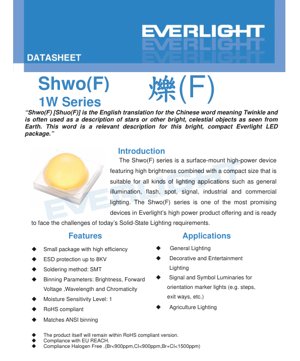
The Shwo(F) series represents a surface-mount, high-power LED device engineered to deliver high luminous output from a compact form factor. This product line is designed to meet the rigorous demands of modern Solid-State Lighting (SSL) applications, balancing performance with reliability. The series name, derived from a word meaning \"Twinkle,\" aptly describes its bright and focused light output, comparable to celestial objects.
The core advantage of this series lies in its combination of a small package footprint with high luminous efficiency. This makes it an ideal solution for applications where space is at a premium but high light output is required. The device is constructed to be robust, featuring integrated ESD protection, and is compliant with major environmental and safety standards.
1.1 Target Applications
The versatility of the Shwo(F) series allows it to be deployed across a wide spectrum of lighting scenarios. Its primary applications include:
- General Illumination: Providing efficient and bright light for everyday use.
- Decorative and Entertainment Lighting: Used in settings where aesthetic lighting effects are desired.
- Signal and Symbol Luminaires: Ideal for exit signs, step markers, and other orientation or safety lighting where clear, consistent illumination is critical.
- Agricultural Lighting: Supporting specialized lighting needs in horticulture and farming environments.
- Flash and Spot Lighting: Suitable for applications requiring directed, high-intensity beams of light.
2. Technical Parameter Deep Dive
This section provides a detailed, objective analysis of the key technical specifications that define the performance and operational limits of the Shwo(F) series LEDs.
2.1 Absolute Maximum Ratings
These ratings define the stress limits beyond which permanent damage to the device may occur. Operation at or near these limits is not recommended for extended periods.
- Maximum DC Forward Current (IF): The standard Shwo(F) series is rated for 1000mA at a thermal pad temperature of 25°C. The \"High\" and \"Super High\" luminous variants within the series have an increased rating of 1500mA under the same condition.
- Maximum Peak Pulse Current (IPulse): For pulsed operation (1/10 duty cycle @ 1kHz), the standard series can handle 1250mA, while the high-luminance versions are rated for 1500mA.
- Maximum Junction Temperature (TJ): The semiconductor junction must not exceed 150°C. Proper thermal management is essential to stay below this limit during operation.
- Operating & Storage Temperature (TOpr, TStg): The device is specified for an ambient temperature range of -40°C to +100°C.
- Thermal Resistance (Rth): A key parameter of 5 °C/W indicates the temperature rise per watt of power dissipated. Lower values are better for heat extraction.
- ESD Protection (VB): The device offers protection against Electrostatic Discharge up to 8000V (Human Body Model), enhancing handling robustness.
- Soldering: The maximum allowable soldering temperature during reflow is 260°C, with a maximum of 2 reflow cycles recommended.
2.2 Photometric and Electrical Characteristics
The performance of the LED is characterized under specific test conditions, typically with the thermal pad stabilized at 25°C.
Luminous Flux: The datasheet provides detailed binning for minimum luminous flux. For example, Cool White LEDs are offered in bins ranging from 130 lm (J41CX) up to 175 lm (JJ1CX) when driven at 350mA. Neutral White and Warm White variants have their own corresponding flux bins, with Warm White typically showing slightly lower output values for equivalent drive currents due to phosphor conversion efficiency.
Forward Voltage (VF): While not listed in the provided excerpt, the product nomenclature includes a \"V\" code for forward voltage binning. This parameter is crucial for driver design, as it determines the required supply voltage for a given current.
Color Characteristics: White LEDs are categorized by Correlated Color Temperature (CCT): Cool White (4745-7050K), Neutral White (3710-4745K), and Warm White (2580-3710K). The provided excerpt also mentions Royal Blue (445-460nm) as a colored LED option. Chromaticity binning ensures color consistency within a defined range on the CIE chromaticity diagram.
2.3 Thermal Management
Effective heat sinking is paramount for LED performance and longevity. The 5 °C/W thermal resistance rating specifies how efficiently heat travels from the LED junction to the thermal pad. To maintain a safe junction temperature, the thermal path from this pad to the ambient environment (via the PCB and possibly a heatsink) must be designed with low thermal impedance. Exceeding the maximum junction temperature will accelerate lumen depreciation and can lead to catastrophic failure.
3. Binning System Explanation
The Shwo(F) series employs a comprehensive binning structure to guarantee consistent performance and color for end-users. Bins are groups of LEDs sorted by specific measured parameters.
3.1 Luminous Flux Binning
LEDs are sorted based on their minimum light output at a standard test current (350mA). The bin code (e.g., JJ, J8, JH for Cool White) directly corresponds to a guaranteed minimum luminous flux in lumens. This allows designers to select the brightness level required for their application with certainty.
3.2 Color/Chromaticity Binning
For white LEDs, the primary binning is by Correlated Color Temperature (CCT), as defined in the \"Color offerings\" table (C, N, M). Within each CCT range, further chromaticity binning (the \"1234\" code in the part number) ensures that the emitted white light falls within a tightly controlled area on the color chart, minimizing visible color differences between individual LEDs in a fixture.
3.3 Forward Voltage Binning
LEDs are also binned by their forward voltage drop at a specified current. This is indicated by the \"V\" code in the part number. Grouping LEDs by VF helps in designing more efficient and consistent driver circuits, especially when multiple LEDs are connected in series.
4. Performance Curve Analysis
Graphical data, though not fully detailed in the excerpt, is critical for understanding device behavior under real-world conditions.
4.1 Typical Light Output vs. Thermal Pad Temperature
LED light output decreases as the temperature at the thermal pad (and consequently the junction) increases. A derating curve would typically show the relative luminous flux dropping from 100% at 25°C to a lower percentage at elevated temperatures (e.g., 85°C). This curve is essential for calculating the true light output in an application where the LED cannot be maintained at 25°C.
4.2 Typical Relative Luminous Flux vs. Forward Current
This curve shows how light output scales with drive current. While output generally increases with current, the relationship is not perfectly linear, and efficiency (lumens per watt) often decreases at higher currents due to increased thermal load and droop effects. The datasheet likely provides this graph to help designers optimize the trade-off between brightness and efficacy.
4.3 Current Derating Curves
To prevent overheating, the maximum allowable forward current must be reduced as the ambient or thermal pad temperature rises. Derating curves specify the safe operating current at temperatures above 25°C, ensuring the maximum junction temperature is never exceeded.
5. Mechanical and Packaging Information
5.1 Pad Configuration
The device uses a Surface-Mount Technology (SMT) pad layout. While a specific dimensional drawing is not in the excerpt, the pad configuration is a critical part of the datasheet. It defines the footprint for PCB design, including the location and size of the electrical connection pads and, crucially, the large thermal pad. The thermal pad is essential for transferring heat from the LED die to the printed circuit board.
5.2 Polarity Identification
SMT LEDs must have clear polarity markings (typically a cathode mark) on the package or in the footprint diagram to ensure correct orientation during assembly. Incorrect polarity will prevent the device from illuminating.
5.3 Emitter Packaging
The LEDs are supplied in tape-and-reel packaging suitable for automated pick-and-place assembly machines. The \"P\" code in the part number denotes \"Tape\" packaging. This format protects the devices and ensures efficient handling during high-volume manufacturing.
6. Soldering and Assembly Guidelines
6.1 Reflow Soldering Parameters
The device is rated for a maximum soldering temperature of 260°C and can withstand a maximum of two reflow cycles. Standard lead-free reflow profiles (with a peak temperature typically between 240-260°C) are applicable. The thermal mass of the package, especially the thermal pad, must be considered when developing the reflow profile to ensure all solder joints properly reflow.
6.2 Moisture Sensitivity
The Shwo(F) series is rated at Moisture Sensitivity Level (MSL) 1 per JEDEC standards. This is the most robust level, indicating an unlimited floor life at conditions ≤30°C/85% RH. No baking is required before use if the packaging seal is intact. This simplifies storage and handling logistics.
6.3 Storage Conditions
Recommended storage temperature is between -40°C to +100°C. While MSL 1 is forgiving, it is still good practice to store components in a dry, controlled environment to prevent any potential contamination or degradation.
7. Ordering Information and Product Labeling
7.1 Model Number Nomenclature
The part number follows a detailed structure: ELSWF–ABCDE–FGHIJ–V1234. Each segment conveys specific information:
- AB: Minimum luminous flux or radiant power code.
- C: Radiation pattern (e.g., \"1\" for Lambertian).
- D: Color code (C, N, M, L).
- E: Proposed operating power (\"1\" for 1W).
- H: Packaging type (\"P\" for Tape).
- V: Forward voltage bin.
- 1234: Color chromaticity or CCT bin.
7.2 Product Labeling
The reel and tape packaging will include labels with the full part number, quantity, date code, and other traceability information to ensure correct material handling and inventory control.
8. Application Design Considerations
8.1 Driver Selection
A constant-current driver is mandatory for operating power LEDs. The driver's current output must match the intended operating point of the LED (e.g., 350mA, 700mA, or up to the maximum rated current). The driver's voltage compliance range must be sufficient to accommodate the sum of the forward voltages of all LEDs in the series string, considering the voltage bin (V code) and the effect of temperature on VF.
8.2 Thermal Design
This is the most critical aspect of high-power LED design. The PCB must be designed to act as a heatsink. This involves:
- Using a PCB with sufficient copper thickness (e.g., 2 oz).
- Designing large copper pour areas connected to the LED's thermal pad via multiple thermal vias.
- Potentially attaching the PCB to an external aluminum heatsink for high-power applications.
- Using thermal interface materials to minimize thermal resistance between layers.
8.3 Optical Design
The Lambertian radiation pattern provides a wide, even viewing angle. For applications requiring a focused beam, secondary optics (lenses or reflectors) must be used. The small package size of the Shwo(F) series allows for compact optical assemblies.
9. Compliance and Environmental Standards
The product is designed to comply with several key international standards:
- RoHS (Restriction of Hazardous Substances): The device is free of lead, mercury, cadmium, and other restricted materials.
- Halogen-Free: Compliant with strict limits on Bromine (Br < 900ppm), Chlorine (Cl < 900ppm), and their sum (Br+Cl < 1500ppm).
- EU REACH: Compliance with the Registration, Evaluation, Authorisation and Restriction of Chemicals regulation.
10. Reliability and Operational Life
While specific L70 or L90 lifetime figures (time to 70% or 90% of initial light output) are not provided in the excerpt, the longevity of an LED is directly tied to its operating conditions. The primary factor is junction temperature. Operating the LED well within its maximum ratings, especially by maintaining a low junction temperature through effective thermal management, is the single most important action to ensure long operational life and slow lumen depreciation. The rated maximum junction temperature of 150°C is a limit, not a target; lower is always better for reliability.
11. Technical Comparison and Differentiation
The Shwo(F) series positions itself within the competitive landscape of SMT high-power LEDs through several key attributes:
- High Brightness in Compact Size: It offers a favorable lumen-per-package-area ratio.
- Robust ESD Protection: 8kV HBM protection enhances durability during handling and assembly compared to devices with lower or no protection.
- Comprehensive Binning: Detailed flux, voltage, and chromaticity binning provides designers with high predictability and consistency.
- Favorable Moisture Sensitivity: An MSL 1 rating offers significant logistical and storage advantages over components with higher MSL ratings that require dry packing and baking.
- Broad Compliance: Meeting RoHS, Halogen-Free, and REACH standards out of the box simplifies the compliance process for end-product manufacturers.
12. Frequently Asked Questions (Based on Technical Parameters)
Q: Can I drive this LED with a constant voltage source?
A: No. LEDs are current-driven devices. A constant-voltage supply will not regulate the current, leading to thermal runaway and destruction of the LED. Always use a constant-current driver.
Q: The datasheet shows performance at 25°C. What output can I expect at 60°C?
A: You must consult the \"Typical Light Output vs. Thermal Pad Temperature\" curve. Light output decreases with temperature. At 60°C, the relative luminous flux will be a percentage (e.g., ~85-90%) of the 25°C value. Your thermal design must account for this derating.
Q: What is the difference between the standard, high, and super high luminous series?
A: The primary differences are in the maximum allowable drive current (1000mA vs. 1500mA) and the correspondingly higher luminous flux bins available. The high-luminance versions use likely more advanced die technology or packaging to handle higher power densities.
Q: Is a heatsink always required?
A: It depends on the drive current and application environment. At the full rated current (1000mA/1500mA), a dedicated heatsink is almost certainly required. At lower currents (e.g., 350mA) and with good PCB thermal design, a standalone heatsink might not be necessary, but careful thermal analysis is still required.
13. Practical Design and Usage Examples
Example 1: Exit Sign Luminaire
An engineer is designing a low-profile, energy-efficient exit sign. They select a Shwo(F) LED in Neutral White (e.g., ELSWF-J71NX-...), driven at 350mA to achieve the required brightness with high efficacy. The compact SMT package allows the light engine to be very thin. The MSL 1 rating simplifies the assembly process in their factory. They design a two-layer PCB with a large bottom-layer copper plane connected to the LED's thermal pad via an array of vias, ensuring the junction temperature remains low for long-term reliability.
Example 2: High-Bay Industrial Lighting
For a high-output industrial fixture, the designer chooses the Super High Luminous series variant, driven at 1200mA. Multiple LEDs are arranged on a metal-core PCB (MCPCB) which is then attached to a large aluminum extrusion heatsink. The driver is selected to provide a constant 1200mA, with a voltage range high enough to power a string of 12 LEDs in series. The detailed chromaticity binning (the \"1234\" code) is specified to be identical for all LEDs purchased, ensuring uniform white light across the fixture with no visible color variation.
14. Operating Principle Introduction
Light Emitting Diodes (LEDs) are semiconductor devices that emit light through electroluminescence. When a forward voltage is applied across the p-n junction, electrons and holes recombine within the semiconductor material, releasing energy in the form of photons. The wavelength (color) of the emitted light is determined by the energy bandgap of the semiconductor material. For white LEDs like the Shwo(F) series, a blue LED chip is coated with a phosphor layer. Part of the blue light is converted by the phosphor into longer wavelengths (yellow, red), and the mixture of blue and converted light is perceived by the human eye as white. The specific blend of phosphors determines the Correlated Color Temperature (CCT) of the white light.
15. Technology Trends and Developments
The Solid-State Lighting industry continues to evolve along several key trajectories relevant to components like the Shwo(F) series:
- Increased Efficacy (Lumens per Watt): Ongoing improvements in LED chip design, phosphor technology, and package efficiency drive higher light output for the same electrical input power.
- Higher Power Density: Packages are becoming capable of handling higher drive currents and dissipating more heat from a shrinking footprint, as seen in the \"High\" and \"Super High\" variants.
- Improved Color Quality and Consistency: Tighter chromaticity binning and the development of phosphors for high Color Rendering Index (CRI) and specific spectral power distributions (e.g., for horticulture).
- Enhanced Reliability and Robustness: Improvements in materials and packaging techniques to withstand higher temperatures and harsher environmental conditions, extending operational lifetime.
- Integration and Smart Features: While not present in this discrete component, the broader trend includes LEDs integrated with drivers, sensors, and communication interfaces for intelligent lighting systems.
LED Specification Terminology
Complete explanation of LED technical terms
Photoelectric Performance
| Term | Unit/Representation | Simple Explanation | Why Important |
|---|---|---|---|
| Luminous Efficacy | lm/W (lumens per watt) | Light output per watt of electricity, higher means more energy efficient. | Directly determines energy efficiency grade and electricity cost. |
| Luminous Flux | lm (lumens) | Total light emitted by source, commonly called "brightness". | Determines if the light is bright enough. |
| Viewing Angle | ° (degrees), e.g., 120° | Angle where light intensity drops to half, determines beam width. | Affects illumination range and uniformity. |
| CCT (Color Temperature) | K (Kelvin), e.g., 2700K/6500K | Warmth/coolness of light, lower values yellowish/warm, higher whitish/cool. | Determines lighting atmosphere and suitable scenarios. |
| CRI / Ra | Unitless, 0–100 | Ability to render object colors accurately, Ra≥80 is good. | Affects color authenticity, used in high-demand places like malls, museums. |
| SDCM | MacAdam ellipse steps, e.g., "5-step" | Color consistency metric, smaller steps mean more consistent color. | Ensures uniform color across same batch of LEDs. |
| Dominant Wavelength | nm (nanometers), e.g., 620nm (red) | Wavelength corresponding to color of colored LEDs. | Determines hue of red, yellow, green monochrome LEDs. |
| Spectral Distribution | Wavelength vs intensity curve | Shows intensity distribution across wavelengths. | Affects color rendering and quality. |
Electrical Parameters
| Term | Symbol | Simple Explanation | Design Considerations |
|---|---|---|---|
| Forward Voltage | Vf | Minimum voltage to turn on LED, like "starting threshold". | Driver voltage must be ≥Vf, voltages add up for series LEDs. |
| Forward Current | If | Current value for normal LED operation. | Usually constant current drive, current determines brightness & lifespan. |
| Max Pulse Current | Ifp | Peak current tolerable for short periods, used for dimming or flashing. | Pulse width & duty cycle must be strictly controlled to avoid damage. |
| Reverse Voltage | Vr | Max reverse voltage LED can withstand, beyond may cause breakdown. | Circuit must prevent reverse connection or voltage spikes. |
| Thermal Resistance | Rth (°C/W) | Resistance to heat transfer from chip to solder, lower is better. | High thermal resistance requires stronger heat dissipation. |
| ESD Immunity | V (HBM), e.g., 1000V | Ability to withstand electrostatic discharge, higher means less vulnerable. | Anti-static measures needed in production, especially for sensitive LEDs. |
Thermal Management & Reliability
| Term | Key Metric | Simple Explanation | Impact |
|---|---|---|---|
| Junction Temperature | Tj (°C) | Actual operating temperature inside LED chip. | Every 10°C reduction may double lifespan; too high causes light decay, color shift. |
| Lumen Depreciation | L70 / L80 (hours) | Time for brightness to drop to 70% or 80% of initial. | Directly defines LED "service life". |
| Lumen Maintenance | % (e.g., 70%) | Percentage of brightness retained after time. | Indicates brightness retention over long-term use. |
| Color Shift | Δu′v′ or MacAdam ellipse | Degree of color change during use. | Affects color consistency in lighting scenes. |
| Thermal Aging | Material degradation | Deterioration due to long-term high temperature. | May cause brightness drop, color change, or open-circuit failure. |
Packaging & Materials
| Term | Common Types | Simple Explanation | Features & Applications |
|---|---|---|---|
| Package Type | EMC, PPA, Ceramic | Housing material protecting chip, providing optical/thermal interface. | EMC: good heat resistance, low cost; Ceramic: better heat dissipation, longer life. |
| Chip Structure | Front, Flip Chip | Chip electrode arrangement. | Flip chip: better heat dissipation, higher efficacy, for high-power. |
| Phosphor Coating | YAG, Silicate, Nitride | Covers blue chip, converts some to yellow/red, mixes to white. | Different phosphors affect efficacy, CCT, and CRI. |
| Lens/Optics | Flat, Microlens, TIR | Optical structure on surface controlling light distribution. | Determines viewing angle and light distribution curve. |
Quality Control & Binning
| Term | Binning Content | Simple Explanation | Purpose |
|---|---|---|---|
| Luminous Flux Bin | Code e.g., 2G, 2H | Grouped by brightness, each group has min/max lumen values. | Ensures uniform brightness in same batch. |
| Voltage Bin | Code e.g., 6W, 6X | Grouped by forward voltage range. | Facilitates driver matching, improves system efficiency. |
| Color Bin | 5-step MacAdam ellipse | Grouped by color coordinates, ensuring tight range. | Guarantees color consistency, avoids uneven color within fixture. |
| CCT Bin | 2700K, 3000K etc. | Grouped by CCT, each has corresponding coordinate range. | Meets different scene CCT requirements. |
Testing & Certification
| Term | Standard/Test | Simple Explanation | Significance |
|---|---|---|---|
| LM-80 | Lumen maintenance test | Long-term lighting at constant temperature, recording brightness decay. | Used to estimate LED life (with TM-21). |
| TM-21 | Life estimation standard | Estimates life under actual conditions based on LM-80 data. | Provides scientific life prediction. |
| IESNA | Illuminating Engineering Society | Covers optical, electrical, thermal test methods. | Industry-recognized test basis. |
| RoHS / REACH | Environmental certification | Ensures no harmful substances (lead, mercury). | Market access requirement internationally. |
| ENERGY STAR / DLC | Energy efficiency certification | Energy efficiency and performance certification for lighting. | Used in government procurement, subsidy programs, enhances competitiveness. |